Suzuki Hitoshi, Kaneko Hiroyasu, Tamai Nobushige, Shimotohno Kunitada, Miyano-Kurosaki Naoko, Takaku Hiroshi
Department of Life and Environmental Sciences, Chiba Institute of Technology, Chiba, Japan.
Nucleosides Nucleotides Nucleic Acids. 2007;26(6-7):815-20. doi: 10.1080/15257770701503787.
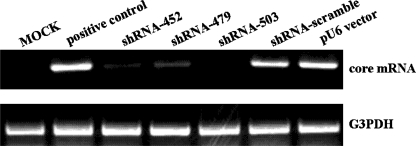
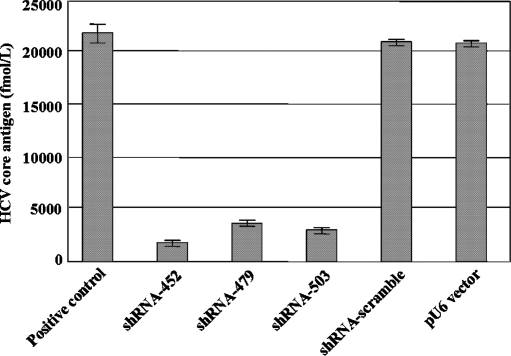
Short hairpin RNAs (shRNAs) efficiently inhibit gene expression by RNA interference. Here, we report the efficient inhibition by DNA-based vector-derived shRNAs of core protein expression in Huh-7 cells. The shRNAs were designed to target the core region of the hepatitis C virus (HCV) genome. The core region is the most conserved region in the HCV genome, making it an ideal target for shRNAs. We identified an effective site on the core region for suppression of the HCV core protein. The HCV core protein in core protein-expressing Huh-7 cells was downregulated by core protein-shRNA expression vectors (core-shRNA-452, 479, and 503). Our results support the feasibility of using shRNA-based gene therapy to inhibit HCV core protein production.
短发夹RNA(shRNA)通过RNA干扰有效抑制基因表达。在此,我们报道了基于DNA载体的shRNA对Huh-7细胞中核心蛋白表达的有效抑制。这些shRNA被设计用于靶向丙型肝炎病毒(HCV)基因组的核心区域。核心区域是HCV基因组中最保守的区域,使其成为shRNA的理想靶点。我们在核心区域鉴定出一个用于抑制HCV核心蛋白的有效位点。表达核心蛋白的Huh-7细胞中的HCV核心蛋白被核心蛋白-shRNA表达载体(核心-shRNA-452、479和503)下调。我们的结果支持使用基于shRNA的基因疗法抑制HCV核心蛋白产生的可行性。