Longo Christopher J, Heyland Daren K, Fisher Harold N, Fowler Robert A, Martin Claudio M, Day Andrew G
McMaster University, Main Street West, Hamilton, Ontario, Canada, L8S 4M4.
Crit Care. 2007;11(6):R128. doi: 10.1186/cc6195.
Recombinant human activated protein C (APC) therapy has been shown to reduce short-term mortality in patients with severe sepsis. However, survivors of sepsis may have long-term complications affecting health-related quality of life (HRQoL) and resource utilization. The objective of this study was to evaluate prospectively the effect of APC on long-term HRQoL and resource utilization compared with a nonrandomized control group that received standard care.
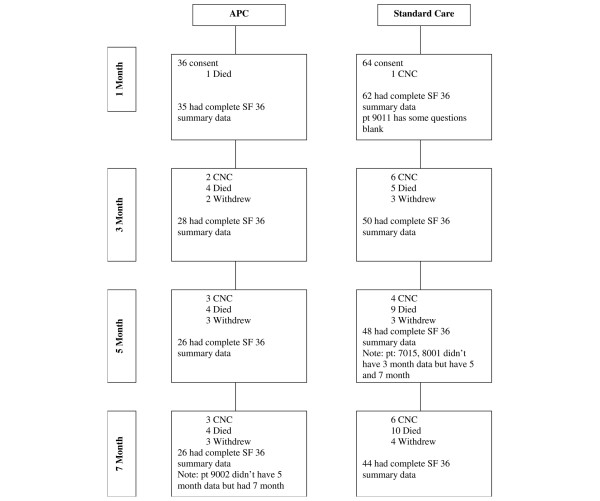
This was an observational cohort study at nine Canadian intensive care units. Patients with severe sepsis who survived to 28 days were recruited. Patients who received APC formed the treatment group and those that did not formed the standard care group. Patients who did not receive APC because of central nervous system bleeding risk were excluded from the standard care group. HRQoL (determined using the 36-item Short Form) and resource use were recorded at 28 days, and 3, 5 and 7 months.
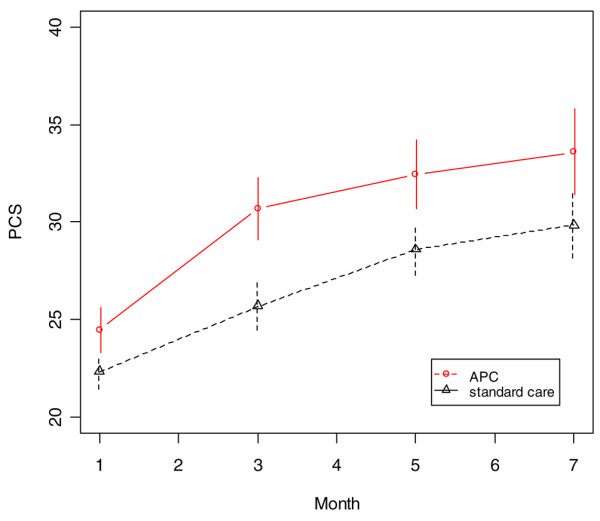
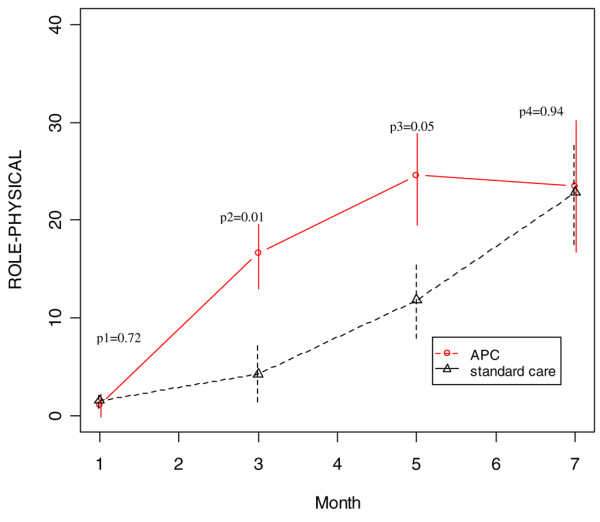
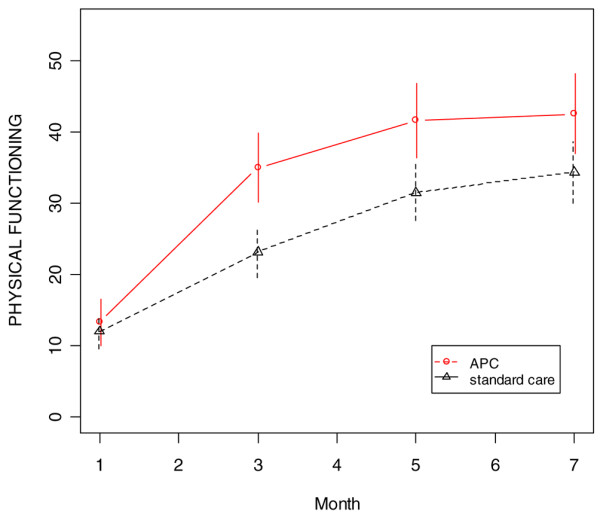
One hundred patients were enrolled (64 in the standard care group and 36 in the APC group), with 70 patients completing all follow-up visits. Over the 6 months of follow up, APC-treated patients exhibited statistically significantly better scores for the physical component score (P = 0.04) and trends toward improvements in physical functioning (P = 0.12), role physical (P = 0.10) and bodily pain (P = 0.14) as compared with standard care patients. Shorter hospital length of stay was observed for the APC group (36 days versus 48 days; P = 0.05).
These findings challenge earlier assumptions suggesting equivalent HRQoL and resource use in APC-treated and standard care patients who survive severe sepsis.
重组人活化蛋白C(APC)疗法已被证明可降低严重脓毒症患者的短期死亡率。然而,脓毒症幸存者可能会出现影响健康相关生活质量(HRQoL)和资源利用的长期并发症。本研究的目的是前瞻性评估与接受标准治疗的非随机对照组相比,APC对长期HRQoL和资源利用的影响。
这是一项在加拿大9个重症监护病房进行的观察性队列研究。招募存活至28天的严重脓毒症患者。接受APC治疗的患者组成治疗组,未接受治疗的患者组成标准治疗组。因中枢神经系统出血风险未接受APC治疗的患者被排除在标准治疗组之外。在28天、3个月、5个月和7个月时记录HRQoL(使用36项简短问卷确定)和资源使用情况。
共纳入100例患者(标准治疗组64例,APC组36例),70例患者完成了所有随访。在6个月的随访中,与标准治疗组患者相比,接受APC治疗的患者在身体成分得分方面具有统计学显著更好的分数(P = 0.04),并且在身体功能(P = 0.12)、角色身体(P = 0.10)和身体疼痛(P = 0.14)方面有改善趋势。APC组的住院时间较短(36天对48天;P = 0.05)。
这些发现挑战了早期的假设,即严重脓毒症存活患者中,接受APC治疗和标准治疗的患者在HRQoL和资源使用方面相当。