Smith George Davey, Lawlor Debbie A, Harbord Roger, Timpson Nic, Day Ian, Ebrahim Shah
Department of Social Medicine, University of Bristol, Bristol, United Kingdom.
PLoS Med. 2007 Dec;4(12):e352. doi: 10.1371/journal.pmed.0040352.
In conventional epidemiology confounding of the exposure of interest with lifestyle or socioeconomic factors, and reverse causation whereby disease status influences exposure rather than vice versa, may invalidate causal interpretations of observed associations. Conversely, genetic variants should not be related to the confounding factors that distort associations in conventional observational epidemiological studies. Furthermore, disease onset will not influence genotype. Therefore, it has been suggested that genetic variants that are known to be associated with a modifiable (nongenetic) risk factor can be used to help determine the causal effect of this modifiable risk factor on disease outcomes. This approach, mendelian randomization, is increasingly being applied within epidemiological studies. However, there is debate about the underlying premise that associations between genotypes and disease outcomes are not confounded by other risk factors. We examined the extent to which genetic variants, on the one hand, and nongenetic environmental exposures or phenotypic characteristics on the other, tend to be associated with each other, to assess the degree of confounding that would exist in conventional epidemiological studies compared with mendelian randomization studies.
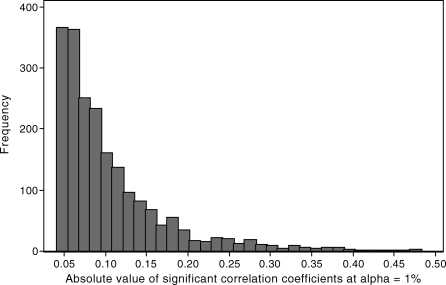
We estimated pairwise correlations between nongenetic baseline variables and genetic variables in a cross-sectional study comparing the number of correlations that were statistically significant at the 5%, 1%, and 0.01% level (alpha = 0.05, 0.01, and 0.0001, respectively) with the number expected by chance if all variables were in fact uncorrelated, using a two-sided binomial exact test. We demonstrate that behavioural, socioeconomic, and physiological factors are strongly interrelated, with 45% of all possible pairwise associations between 96 nongenetic characteristics (n = 4,560 correlations) being significant at the p < 0.01 level (the ratio of observed to expected significant associations was 45; p-value for difference between observed and expected < 0.000001). Similar findings were observed for other levels of significance. In contrast, genetic variants showed no greater association with each other, or with the 96 behavioural, socioeconomic, and physiological factors, than would be expected by chance.
These data illustrate why observational studies have produced misleading claims regarding potentially causal factors for disease. The findings demonstrate the potential power of a methodology that utilizes genetic variants as indicators of exposure level when studying environmentally modifiable risk factors.
在传统流行病学中,感兴趣的暴露因素与生活方式或社会经济因素之间的混杂,以及疾病状态影响暴露而非相反的反向因果关系,可能会使对观察到的关联的因果解释无效。相反,基因变异不应与在传统观察性流行病学研究中扭曲关联的混杂因素相关。此外,疾病的发生不会影响基因型。因此,有人提出,已知与可改变的(非基因)风险因素相关的基因变异可用于帮助确定这种可改变的风险因素对疾病结局的因果效应。这种方法,即孟德尔随机化,在流行病学研究中越来越多地被应用。然而,对于基因型与疾病结局之间的关联不会被其他风险因素混杂这一潜在前提存在争议。我们研究了一方面基因变异与另一方面非基因环境暴露或表型特征之间相互关联的程度,以评估与孟德尔随机化研究相比,传统流行病学研究中存在的混杂程度。
在一项横断面研究中,我们估计了非基因基线变量与基因变量之间的成对相关性,使用双侧二项式精确检验,比较在5%、1%和0.01%水平(分别为α = 0.05、0.01和0.0001)具有统计学显著性的相关性数量与如果所有变量实际上不相关时按机会预期的数量。我们证明行为、社会经济和生理因素密切相关,96个非基因特征之间所有可能的成对关联中有45%(n = 4560个相关性)在p < 0.01水平具有显著性(观察到的与预期的显著关联之比为45;观察到的与预期的差异的p值 < 0.000001)。在其他显著性水平也观察到了类似的结果。相比之下,基因变异之间以及与96个行为、社会经济和生理因素之间的关联并不比按机会预期的更大。
这些数据说明了为什么观察性研究在关于疾病的潜在因果因素方面产生了误导性的说法。这些发现证明了一种方法的潜在力量,即在研究环境可改变的风险因素时,利用基因变异作为暴露水平的指标。