Qi Lu
Department of Nutrition, Harvard School of Public Health, Boston, Massachusetts, USA.
Nutr Rev. 2009 Aug;67(8):439-50. doi: 10.1111/j.1753-4887.2009.00218.x.
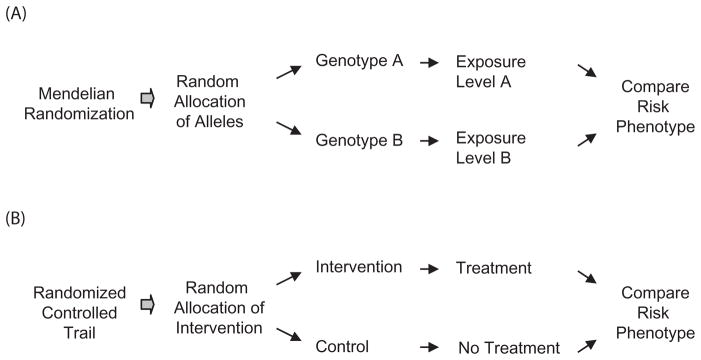
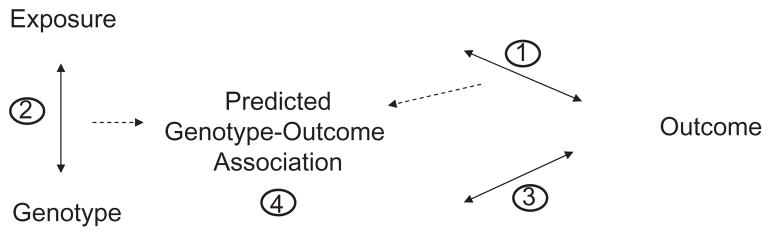
Nutritional epidemiology aims to identify dietary and lifestyle causes for human diseases. Causality inference in nutritional epidemiology is largely based on evidence from studies of observational design, and may be distorted by unmeasured or residual confounding and reverse causation. Mendelian randomization is a recently developed methodology that combines genetic and classical epidemiological analysis to infer causality for environmental exposures, based on the principle of Mendel's law of independent assortment. Mendelian randomization uses genetic variants as proxies for environmental exposures of interest. Associations derived from Mendelian randomization analysis are less likely to be affected by confounding and reverse causation. During the past 5 years, a body of studies examined the causal effects of diet/lifestyle factors and biomarkers on a variety of diseases. The Mendelian randomization approach also holds considerable promise in the study of intrauterine influences on offspring health outcomes. However, the application of Mendelian randomization in nutritional epidemiology has some limitations.
营养流行病学旨在确定人类疾病的饮食和生活方式成因。营养流行病学中的因果推断很大程度上基于观察性设计研究的证据,可能会因未测量或残留的混杂因素以及反向因果关系而产生偏差。孟德尔随机化是一种最近发展起来的方法,它结合了遗传分析和经典流行病学分析,基于孟德尔独立分配定律的原理来推断环境暴露的因果关系。孟德尔随机化使用基因变异作为感兴趣的环境暴露的替代指标。孟德尔随机化分析得出的关联受混杂因素和反向因果关系影响的可能性较小。在过去5年中,一系列研究探讨了饮食/生活方式因素和生物标志物对多种疾病的因果效应。孟德尔随机化方法在研究子宫内环境对后代健康结局的影响方面也具有很大的前景。然而,孟德尔随机化在营养流行病学中的应用存在一些局限性。