Okada Hideho, Lieberman Frank S, Walter Kevin A, Lunsford L Dade, Kondziolka Douglas S, Bejjani Ghassan K, Hamilton Ronald L, Torres-Trejo Alejandro, Kalinski Pawel, Cai Quan, Mabold Jennifer L, Edington Howard D, Butterfield Lisa H, Whiteside Theresa L, Potter Douglas M, Schold S Clifford, Pollack Ian F
Department of Neurological Surgery, University of Pittsburgh School of Medicine, Pittsburgh, PA, USA.
J Transl Med. 2007 Dec 19;5:67. doi: 10.1186/1479-5876-5-67.
The prognosis for malignant gliomas remains dismal. We addressed the safety, feasibility and preliminary clinical activity of the vaccinations using autologous glioma cells and interleukin (IL)-4 gene transfected fibroblasts.
In University of Pittsburgh Cancer Institute (UPCI) protocol 95-033, adult participants with recurrent glioblastoma multiforme (GBM) or anaplastic astrocytoma (AA) received gross total resection (GTR) of the recurrent tumors, followed by two vaccinations with autologous fibroblasts retrovirally transfected with TFG-IL4-Neo-TK vector admixed with irradiated autologous glioma cells. In UPCI 99-111, adult participants with newly diagnosed GBM or AA, following GTR and radiation therapy, received two intradermal vaccinations with the TFG-IL4-Neo-TK-transfected fibroblasts admixed with type-1 dendritic cells (DC) loaded with autologous tumor lysate. The participants were evaluated for occurrence of adverse events, immune response, and clinical response by radiological imaging.
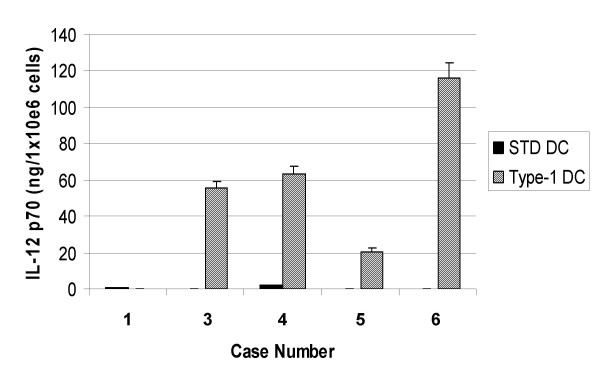
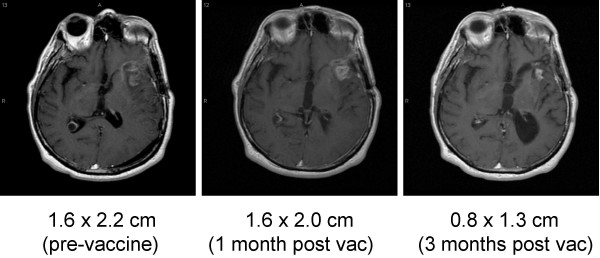
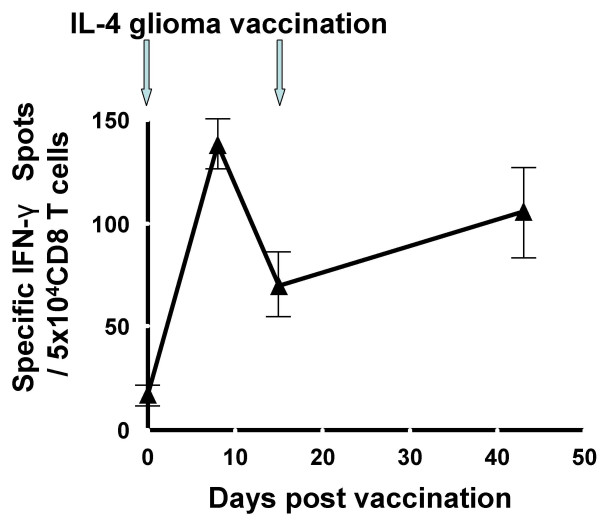
In UPCI 95-033, only 2 of 6 participants received the vaccinations. Four other participants were withdrawn from the trial because of tumor progression prior to production of the cellular vaccine. However, both participants who received two vaccinations demonstrated encouraging immunological and clinical responses. Biopsies from the local vaccine sites from one participant displayed IL-4 dose-dependent infiltration of CD4+ as well as CD8+ T cells. Interferon (IFN)-gamma Enzyme-Linked Immuno-SPOT (ELISPOT) assay in another human leukocyte antigen (HLA)-A2+ participant demonstrated systemic T-cell responses against an HLA-A2-restricted glioma-associated antigen (GAA) epitope EphA2883-891. Moreover, both participants demonstrated clinical and radiological improvement with no evidence of allergic encephalitis, although both participants eventually succumbed with the tumor recurrence. In 99-111, 5 of 6 enrolled participants received scheduled vaccinations with no incidence of major adverse events. Monocyte-derived DCs produced high levels of IL-12 p70. Treatment was well tolerated; however, we were unable to observe detectable IFN-gamma post-vaccine responses or prolonged progression-free survival in these participants.
Feasibility challenges inherent in the generation of a patient-specific gene transfection-based vaccine strongly suggests the need for more practical formulations that would allow for the timely administration of vaccines. Nevertheless, successful generation of type-1 DCs and preliminary safety in the current study provide a strong rationale for further efforts to develop novel glioma vaccines.
恶性胶质瘤的预后仍然很差。我们探讨了使用自体胶质瘤细胞和白细胞介素(IL)-4基因转染成纤维细胞进行疫苗接种的安全性、可行性和初步临床活性。
在匹兹堡大学癌症研究所(UPCI)的95-033方案中,患有复发性多形性胶质母细胞瘤(GBM)或间变性星形细胞瘤(AA)的成年参与者接受复发性肿瘤的全切除(GTR),然后用逆转录病毒转染了TFG-IL4-Neo-TK载体并与经辐照的自体胶质瘤细胞混合的自体成纤维细胞进行两次疫苗接种。在UPCI 99-111中,患有新诊断GBM或AA的成年参与者在接受GTR和放射治疗后,接受两次皮内接种,接种物为TFG-IL4-Neo-TK转染的成纤维细胞与负载自体肿瘤裂解物的1型树突状细胞(DC)混合。通过放射学成像评估参与者的不良事件发生情况、免疫反应和临床反应。
在UPCI 95-033中,6名参与者中只有2名接受了疫苗接种。另外4名参与者因在细胞疫苗生产前肿瘤进展而退出试验。然而,接受两次疫苗接种的两名参与者均表现出令人鼓舞的免疫和临床反应。一名参与者局部疫苗接种部位的活检显示CD4+以及CD8+T细胞的IL-4剂量依赖性浸润。另一名人类白细胞抗原(HLA)-A2+参与者的干扰素(IFN)-γ酶联免疫斑点(ELISPOT)分析显示,针对HLA-A2限制性胶质瘤相关抗原(GAA)表位EphA2883-891存在全身性T细胞反应。此外,两名参与者均表现出临床和影像学改善,且无变应性脑炎证据,尽管两名参与者最终均因肿瘤复发而死亡。在99-111中,6名登记参与者中有5名接受了计划的疫苗接种,未发生重大不良事件。单核细胞衍生的DC产生高水平的IL-12 p70。治疗耐受性良好;然而,我们未能在这些参与者中观察到可检测到的疫苗接种后IFN-γ反应或无进展生存期延长。
基于患者特异性基因转染的疫苗生产中固有的可行性挑战强烈表明,需要更实用的制剂,以便能够及时接种疫苗。尽管如此,本研究中成功生成1型DC以及初步安全性为进一步努力开发新型胶质瘤疫苗提供了有力的理论依据。