Stadel Rebecca, Yang Jun, Nalwalk Julia W, Phillips James G, Hough Lindsay B
Center for Neuropharmacology and Neuroscience, Albany Medical College MC-136, 47 New Scotland Ave, Albany, NY 12208, USA.
Drug Metab Dispos. 2008 Mar;36(3):614-21. doi: 10.1124/dmd.107.017889. Epub 2007 Dec 19.
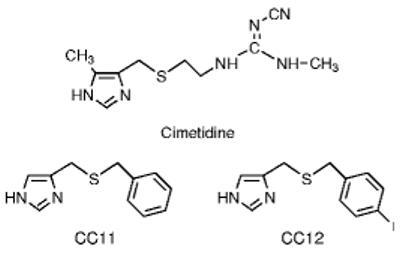
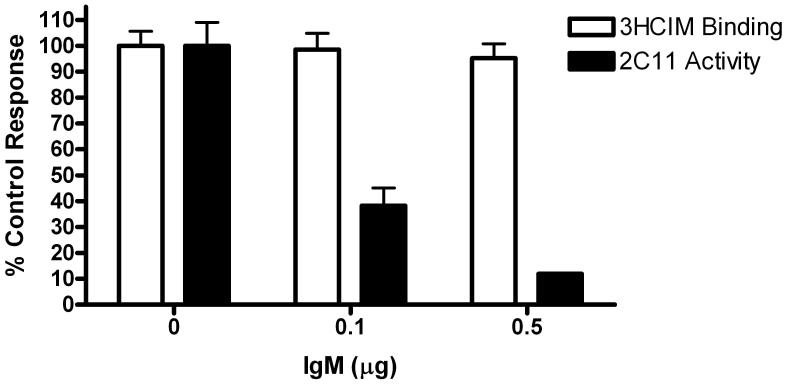
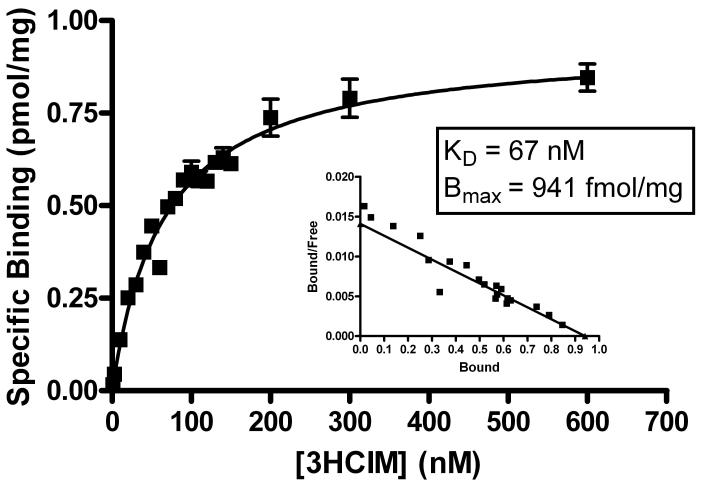
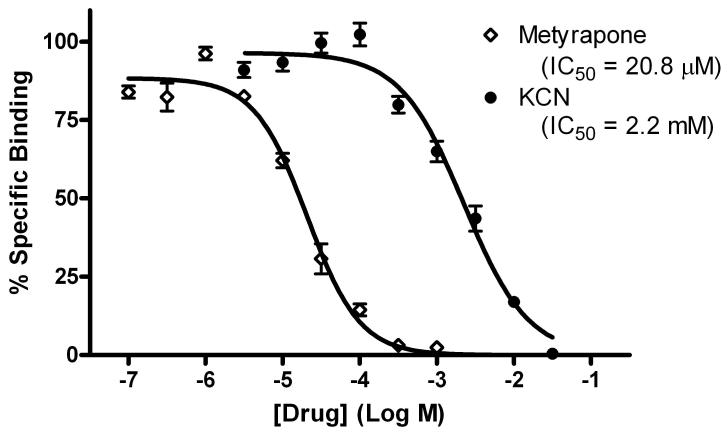
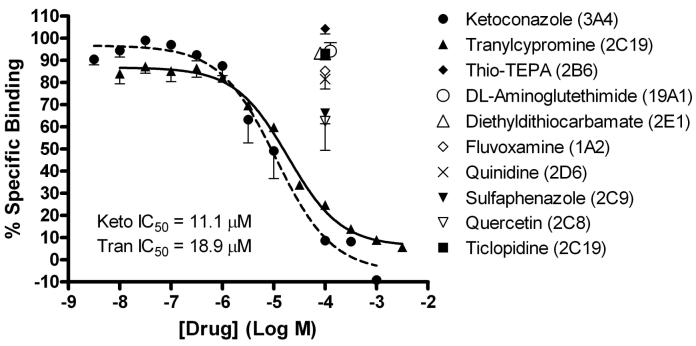
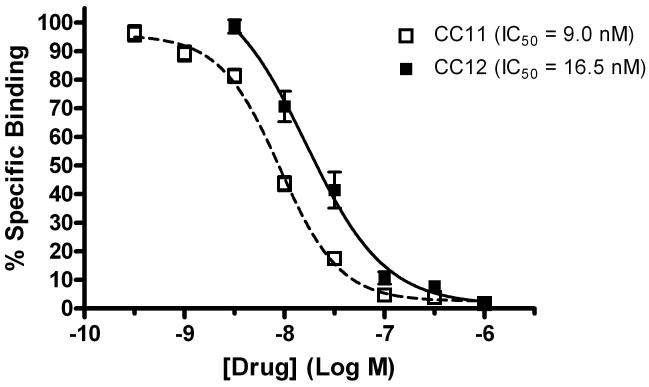
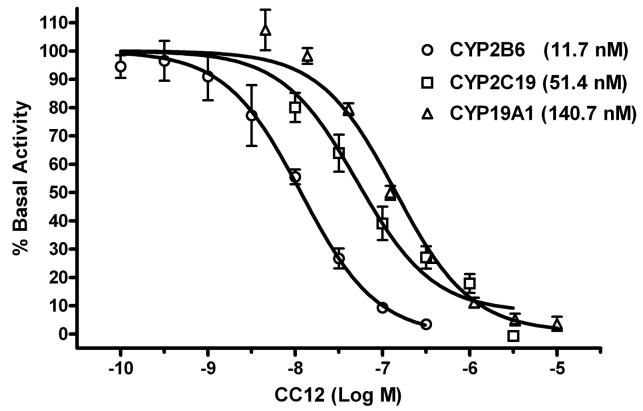
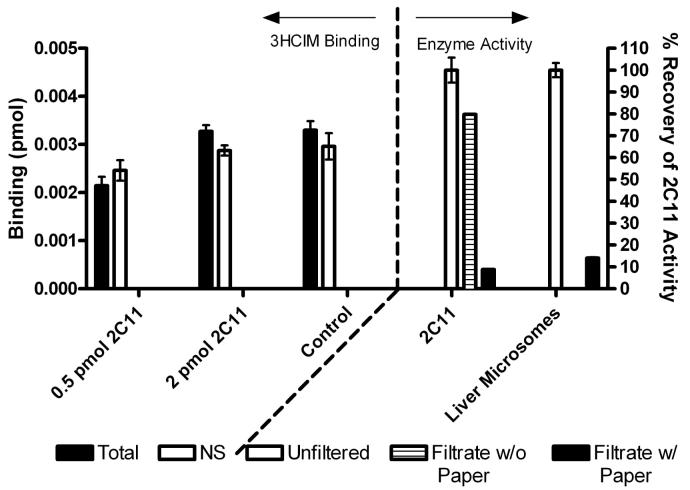
[(3)H]Cimetidine (3HCIM) specifically binds to an unidentified site in the rat brain. Because recently described ligands for this site have pharmacological activity, 3HCIM binding was characterized. 3HCIM binding was saturable, heat-labile, and distinct from the histamine H(2) receptor. To test the hypothesis that 3HCIM binds to a cytochrome P450 (P450), the effects of nonselective and isoform-selective P450 inhibitors were studied. The heme inhibitor KCN and the nonselective P450 inhibitor metyrapone both produced complete, concentration-dependent inhibition of 3HCIM binding (K(i) = 1.3 mM and 11.9 muM, respectively). Binding was largely unaffected by inhibitors of CYP1A2, 2B6, 2C8, 2C9, 2D6, 2E1, and 19A1 but was eliminated by inhibitors of CYP2C19 (tranylcypromine) and CYP3A4 (ketoconazole). Synthesis and testing of CC11 [4(5)-(benzylthiomethyl)-1H-imidazole] and CC12 [4(5)-((4-iodobenzyl)-thiomethyl)-1H-imidazole] confirmed both drugs to be high-affinity inhibitors of 3HCIM binding. On recombinant human P450s, CC12 was a potent inhibitor of CYP2B6 (IC(50) = 11.7 nM), CYP2C19 (51.4 nM), and CYP19A1 (140.7 nM) and had a range of activities (100-494 nM) on nine other isoforms. Although the 3HCIM binding site pharmacologically resembles some P450s, eight recombinant human P450s and three recombinant rat P450s did not exhibit 3HCIM binding. Inhibition by KCN and metyrapone suggests that 3HCIM binds to a heme-containing brain protein (possibly a P450). However, results with selective P450 inhibitors, recombinant P450 isoforms, and a P450 antibody did not identify a 3HCIM-binding P450 isoform. Finally, CC12 is a new, potent inhibitor of CYP2B6 and CYP2C19 that may be a valuable tool for P450 research.
[³H]西咪替丁(³HCIM)特异性结合大鼠脑中一个未明确的位点。由于最近描述的该位点配体具有药理活性,因此对³HCIM结合进行了表征。³HCIM结合具有饱和性、热不稳定性,且与组胺H₂受体不同。为了验证³HCIM与细胞色素P450(P450)结合的假说,研究了非选择性和同工型选择性P450抑制剂的作用。血红素抑制剂氰化钾(KCN)和非选择性P450抑制剂美替拉酮均产生了完全的、浓度依赖性的³HCIM结合抑制作用(抑制常数Ki分别为1.3 mM和11.9 μM)。CYP1A2、2B6、2C8、2C9、2D6、2E1和19A1的抑制剂对结合基本无影响,但CYP2C19(反苯环丙胺)和CYP3A4(酮康唑)的抑制剂可消除³HCIM结合。CC11 [4(5)-(苄硫基甲基)-1H-咪唑]和CC12 [4(5)-((4-碘苄基)-硫代甲基)-1H-咪唑]的合成及测试证实这两种药物都是³HCIM结合的高亲和力抑制剂。对于重组人P450,CC12是CYP2B₆(半数抑制浓度IC₅₀ = 11.7 nM)、CYP2C19(51.4 nM)和CYP19A1(140.7 nM)的强效抑制剂,并且对其他九种同工型具有一系列活性(100 - 494 nM)。尽管³HCIM结合位点在药理上类似于某些P450,但八种重组人P450和三种重组大鼠P450均未表现出³HCIM结合。KCN和美替拉酮的抑制作用表明³HCIM与一种含血红素的脑蛋白(可能是一种P450)结合。然而,选择性P450抑制剂、重组P450同工型和P450抗体的结果未能鉴定出³HCIM结合的P450同工型。最后,CC12是一种新型强效CYP2B6和CYP2C19抑制剂,可能是P450研究的一种有价值的工具。