Björkdahl Ann, Sunnerhagen Katharina Stibrant
Institute of Neuroscience and Physiology-Rehabilitation Medicine, Göteborg University, Sweden.
BMC Health Serv Res. 2007 Dec 21;7:209. doi: 10.1186/1472-6963-7-209.
In recent years a number of costs of stroke studies have been conducted based on incidence or prevalence and estimating costs at a given time. As there still is a need for a deeper understanding of factors influencing these costs the aim of this study was to calculate the direct and indirect costs in a younger (<65) sample of stroke patients and to explore factors affecting the costs.
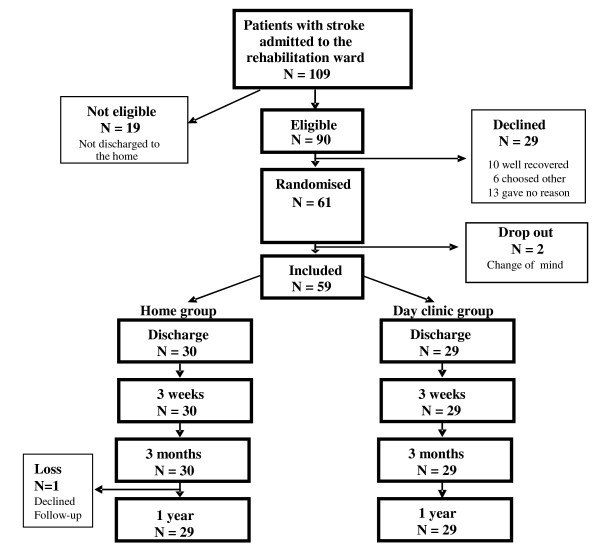
Fifty-eight patients included in a study of home rehabilitation and followed for 1 year after discharge from the rehabilitation unit, were interviewed about their use of health care services, assistance, medications and assistive devices. Costs (defined as the cost for society) were calculated. A linear regression of cost and variables of functioning, ability, community integration and health-related quality of life was done.
Inpatient care contributed substantially to the direct cost with a mean length of stay of 92 days. Rehabilitation during the first year constituted of an average of 28 days in day clinics, 38 physiotherapy sessions and 20 occupational therapy sessions. The total direct mean cost was 80 020 euro and the indirect cost 35 129 euro. The direct costs were influenced by the process skill (the ability to plan and perform a given task and to adapt when needed) and presence of aphasia. Indirect costs for informal care giving increased for patients with a lower health-related quality of life as well as a low score on home integration.
Costs are high in this group of young (< 65 years) stroke patients compared to other studies, partly due to the length of the stay and partly to loss of productivity.
近年来,已经开展了一些基于发病率或患病率的中风研究成本分析,并估算特定时间的成本。由于仍需要更深入地了解影响这些成本的因素,本研究的目的是计算较年轻(<65岁)中风患者样本的直接和间接成本,并探讨影响成本的因素。
纳入一项家庭康复研究的58名患者在从康复单元出院后随访1年,就其医疗服务、援助、药物和辅助设备的使用情况接受访谈。计算成本(定义为社会成本)。对成本与功能、能力、社区融入和健康相关生活质量的变量进行线性回归分析。
住院护理对直接成本贡献巨大,平均住院时间为92天。第一年的康复包括平均28天的日间门诊、38次物理治疗和20次职业治疗。直接平均总成本为80020欧元,间接成本为35129欧元。直接成本受过程技能(计划和执行给定任务以及在需要时进行调整的能力)和失语症的影响。健康相关生活质量较低以及家庭融入得分较低的患者,非正式护理的间接成本增加。
与其他研究相比,这组年轻(<65岁)中风患者的成本较高,部分原因是住院时间,部分原因是生产力损失。