Yang Jie, Wang Zhen Long, Zhao Xin Quan, Wang De Peng, Qi De Lin, Xu Bao Hong, Ren Yong Hong, Tian Hui Fang
Key Laboratory of Qinghai-Tibetan Plateau Biological Evolution and Adaptation, Northwest Institute of Plateau Biology, The Chinese Academy of Sciences, Xining, Qinghai, China.
PLoS One. 2008 Jan 23;3(1):e1472. doi: 10.1371/journal.pone.0001472.
Environmental stress can accelerate the evolutionary rate of specific stress-response proteins and create new functions specialized for different environments, enhancing an organism's fitness to stressful environments. Pikas (order Lagomorpha), endemic, non-hibernating mammals in the modern Holarctic Region, live in cold regions at either high altitudes or high latitudes and have a maximum distribution of species diversification confined to the Qinghai-Tibet Plateau. Variations in energy metabolism are remarkable for them living in cold environments. Leptin, an adipocyte-derived hormone, plays important roles in energy homeostasis.
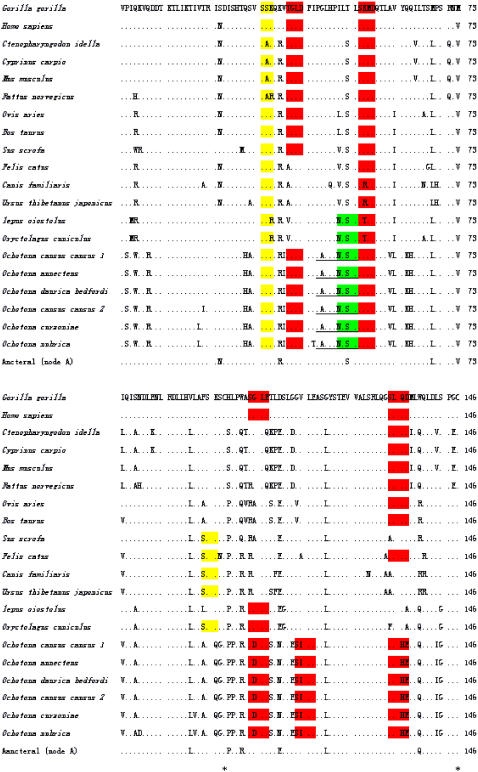
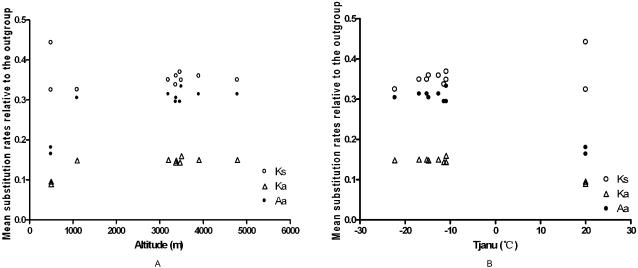
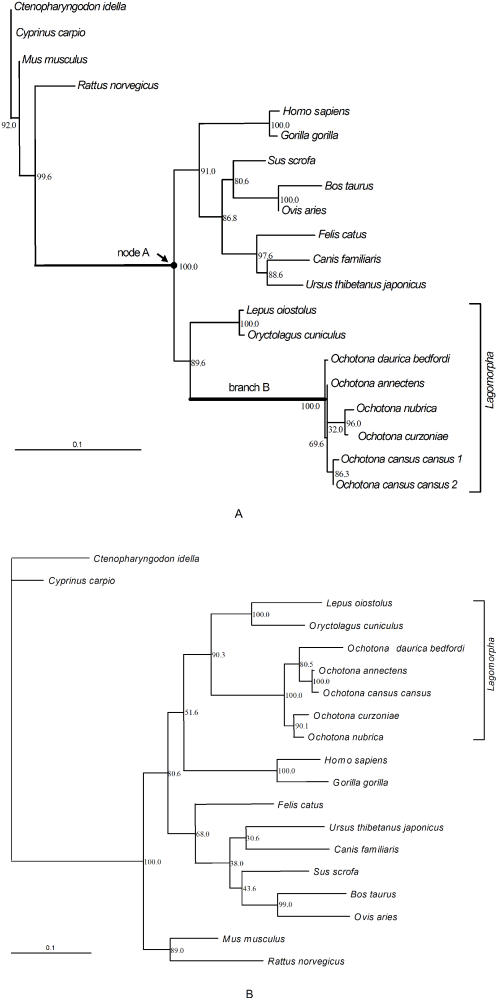
METHODOLOGY/PRINCIPAL FINDINGS: To examine the extent of leptin variations within the Ochotona family, we cloned the entire coding sequence of pika leptin from 6 species in two regions (Qinghai-Tibet Plateau and Inner Mongolia steppe in China) and the leptin sequences of plateau pikas (O. curzonia) from different altitudes on Qinghai-Tibet Plateau. We carried out both DNA and amino acid sequence analyses in molecular evolution and compared modeled spatial structures. Our results show that positive selection (PS) acts on pika leptin, while nine PS sites located within the functionally significant segment 85-119 of leptin and one unique motif appeared only in pika lineages-the ATP synthase alpha and beta subunit signature site. To reveal the environmental factors affecting sequence evolution of pika leptin, relative rate test was performed in pikas from different altitudes. Stepwise multiple regression shows that temperature is significantly and negatively correlated with the rates of non-synonymous substitution (Ka) and amino acid substitution (Aa), whereas altitude does not significantly affect synonymous substitution (Ks), Ka and Aa.
CONCLUSIONS/SIGNIFICANCE: Our findings support the viewpoint that adaptive evolution may occur in pika leptin, which may play important roles in pikas' ecological adaptation to extreme environmental stress. We speculate that cold, and probably not hypoxia, may be the primary environmental factor for driving adaptive evolution of pika leptin.
环境压力能够加速特定应激反应蛋白的进化速率,并产生针对不同环境的新功能,从而增强生物体在压力环境中的适应性。鼠兔(兔形目)是现代全北区特有的非冬眠哺乳动物,生活在高海拔或高纬度的寒冷地区,其物种多样化的最大分布局限于青藏高原。由于它们生活在寒冷环境中,能量代谢的变化非常显著。瘦素是一种由脂肪细胞分泌的激素,在能量平衡中发挥着重要作用。
方法/主要发现:为了研究鼠兔科内瘦素的变异程度,我们从中国两个地区(青藏高原和内蒙古草原)的6个物种中克隆了鼠兔瘦素的完整编码序列,以及青藏高原不同海拔高度的高原鼠兔(高原鼠兔)的瘦素序列。我们在分子进化方面进行了DNA和氨基酸序列分析,并比较了模拟的空间结构。我们的结果表明,正选择作用于鼠兔瘦素,而9个正选择位点位于瘦素功能重要片段85 - 119内,并且有一个独特的基序仅出现在鼠兔谱系中——ATP合酶α和β亚基特征位点。为了揭示影响鼠兔瘦素序列进化的环境因素,我们对不同海拔高度的鼠兔进行了相对速率测试。逐步多元回归表明,温度与非同义替换率(Ka)和氨基酸替换率(Aa)显著负相关,而海拔高度对同义替换率(Ks)、Ka和Aa没有显著影响。
结论/意义:我们的研究结果支持了鼠兔瘦素可能发生适应性进化的观点,这可能在鼠兔对极端环境压力的生态适应中发挥重要作用。我们推测寒冷,而可能不是缺氧,可能是驱动鼠兔瘦素适应性进化的主要环境因素。