Dal Canto M C, Rabinowitz S G, Johnson T C
Br J Exp Pathol. 1976 Jun;57(3):321-30.
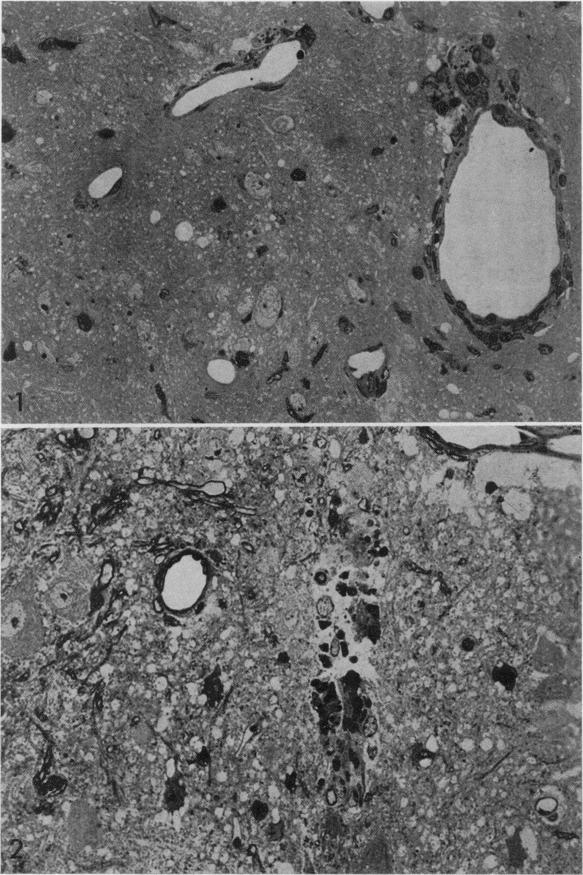
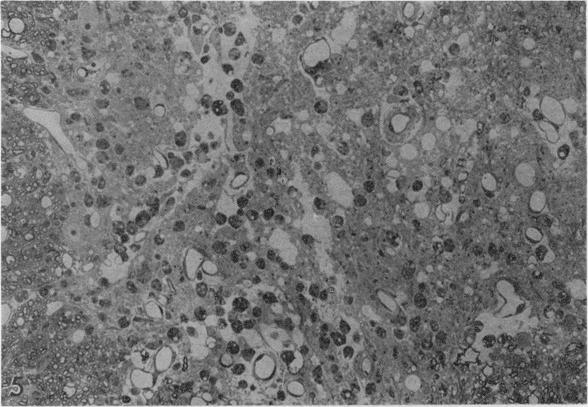
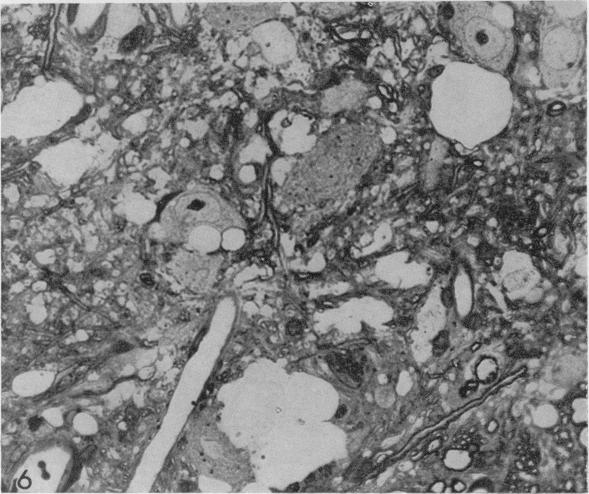
Mice infected intracerebrally (i.c.) with wild-type (wt) VSV or temperature-sensitive (ts) mutants, ts 11, ts 22, ts 31 and ts 41, were studied for the development of histopathological lesions in the central nervous system (CNS). Mice infected i.c. with wt VSV exhibited histopathological lesions consisting principally of occasional foci of perivascular mononuclear cell infiltration and rare foci of necrosis. All wt VSV infected mice died within 2 days of i.c. inoculation. In contrast, mice infected i.c. with ts 22 and ts 31 developed spongiform lesions limited to the grey matter of the spinal cord beginning 4 days after inoculation. The spongiform lesions rapidly spread to involve the entire grey matter of the spinal cord by 5-7 days after infection. Vacuolar changes were restricted principally to neuronal processes and astrocytes. Ts 22 and ts 31 infected mice developed neurological illness beginning 4 days after infection and the majority of mice died by 7 days after infection. Mice infected with ts 11 and ts 41, on the other hand, remained clinically well and were devoid of neuro-pathological lesions at 4 and 8 days after infection.
对经脑内(i.c.)接种野生型(wt)水泡性口炎病毒(VSV)或温度敏感(ts)突变体ts 11、ts 22、ts 31和ts 41的小鼠,研究其在中枢神经系统(CNS)中组织病理学损伤的发展情况。经脑内接种wt VSV的小鼠表现出主要由偶尔的血管周围单核细胞浸润灶和罕见坏死灶组成的组织病理学损伤。所有经脑内接种wt VSV的小鼠在接种后2天内死亡。相比之下,经脑内接种ts 22和ts 31的小鼠在接种后4天开始出现仅限于脊髓灰质的海绵状病变。到感染后5 - 7天,海绵状病变迅速扩散至累及整个脊髓灰质。空泡变化主要局限于神经元突起和星形胶质细胞。感染ts 22和ts 31的小鼠在感染后4天开始出现神经疾病,大多数小鼠在感染后7天死亡。另一方面,感染ts 11和ts 41的小鼠在感染后4天和8天时临床状态良好,且没有神经病理学损伤。