Zhao Xinai, de Palma Justina, Oane Rowena, Gamuyao Rico, Luo Ming, Chaudhury Abdul, Hervé Philippe, Xue Qingzhong, Bennett John
College of Agriculture and Biotechnology, Zhejiang University, Hangzhou, China.
Plant J. 2008 May;54(3):375-87. doi: 10.1111/j.1365-313X.2008.03426.x. Epub 2008 Jan 31.
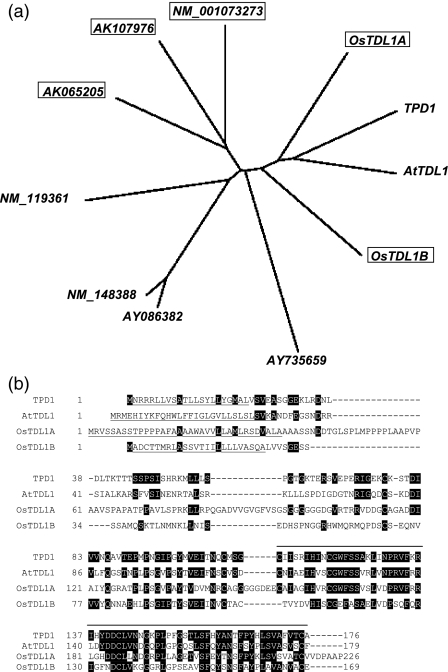
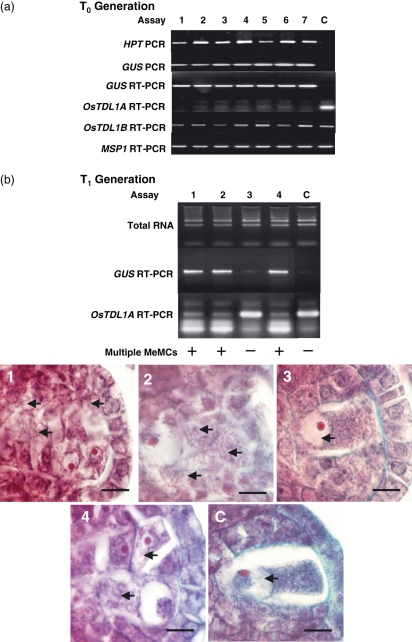
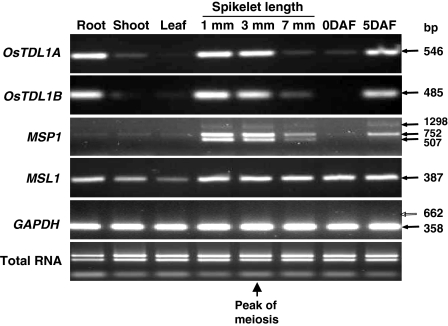
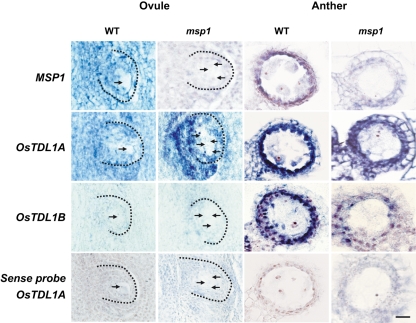
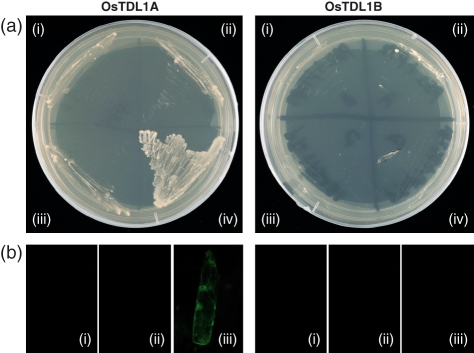
Hybrids lose heterotic yield advantage when multiplied sexually via meiosis. A potential alternative breeding system for hybrids is apospory, where female gametes develop without meiosis. Common among grasses, apospory begins in the nucellus, where aposporous initials (AIs) appear near the sexual megaspore mother cell (MeMC). The cellular origin of AIs is obscure, but one possibility, suggested by the mac1 and msp1 mutants of maize and rice, is that AIs are apomeiotic derivatives of the additional MeMCs that appear when genetic control over sporocyte numbers is relaxed. MULTIPLE SPOROCYTES1 (MSP1) encodes a leucine-rich-repeat receptor kinase, which is orthologous to EXS/EMS1 in Arabidopsis. Like mac1 and msp1, exs/ems1 mutants produce extra sporocytes in the anther instead of a tapetum, causing male sterility. This phenotype is copied in mutants of TAPETUM DETERMINANT1 (TPD1), which encodes a small protein hypothesized to be an extracellular ligand of EXS/EMS1. Here we show that rice contains two TPD1-like genes, OsTDL1A and OsTDL1B. Both are co-expressed with MSP1 in anthers during meiosis, but only OsTDL1A and MSP1 are co-expressed in the ovule. OsTDL1A binds to the leucine-rich-repeat domain of MSP1 in yeast two-hybrid assays and bimolecular fluorescence complementation in onion cells; OsTDL1B lacks this capacity. When driven by the maize Ubiquitin1 promoter, RNA interference against OsTDL1A phenocopies msp1 in the ovule but not in the anther. Thus, RNAi produces multiple MeMCs without causing male sterility. We conclude that OsTDL1A binds MSP1 in order to limit sporocyte numbers. OsTDL1A-RNAi lines may be suitable starting points for achieving synthetic apospory in rice.
杂种通过减数分裂进行有性繁殖时会失去杂种优势产量优势。一种潜在的杂种替代育种系统是无孢子生殖,即雌配子不经过减数分裂发育。无孢子生殖在禾本科植物中很常见,它始于珠心,在那里无孢子初始细胞(AIs)出现在有性大孢子母细胞(MeMC)附近。AIs的细胞起源尚不清楚,但玉米和水稻的mac1和msp1突变体表明,一种可能性是AIs是当对孢子母细胞数量的遗传控制放松时出现的额外MeMC的无融合生殖衍生物。多个孢子母细胞1(MSP1)编码一种富含亮氨酸重复序列的受体激酶,它与拟南芥中的EXS/EMS1是直系同源物。与mac1和msp1一样,exs/ems1突变体在花药中产生额外的孢子母细胞而不是绒毡层,导致雄性不育。这种表型在绒毡层决定因子1(TPD1)的突变体中也有出现,TPD1编码一种小蛋白,被认为是EXS/EMS1的细胞外配体。在这里我们表明水稻含有两个类TPD1基因,OsTDL1A和OsTDL1B。在减数分裂期间,它们在花药中都与MSP1共表达,但只有OsTDL1A和MSP1在胚珠中共表达。在酵母双杂交试验和洋葱细胞中的双分子荧光互补试验中,OsTDL1A与MSP1的富含亮氨酸重复序列结构域结合;OsTDL1B缺乏这种能力。当由玉米泛素1启动子驱动时,针对OsTDL1A的RNA干扰在胚珠中模拟了msp1的表型,但在花药中没有。因此,RNA干扰产生多个MeMC而不导致雄性不育。我们得出结论,OsTDL1A与MSP1结合以限制孢子母细胞数量。OsTDL1A-RNAi系可能是在水稻中实现人工无孢子生殖的合适起点。