Lerebours Florence, Vacher Sophie, Andrieu Catherine, Espie Marc, Marty Michel, Lidereau Rosette, Bieche Ivan
Centre Rene Huguenin, FNCLCC, 35 rue Dailly, 92210, St-Cloud, France.
BMC Cancer. 2008 Feb 4;8:41. doi: 10.1186/1471-2407-8-41.
IBC (Inflammatory Breast cancer) is a rare form of breast cancer with a particular phenotype. New molecular targets are needed to improve the treatment of this rapidly fatal disease. Given the role of NF-kappaB-related genes in cell proliferation, invasiveness, angiogenesis and inflammation, we postulated that they might be deregulated in IBC.
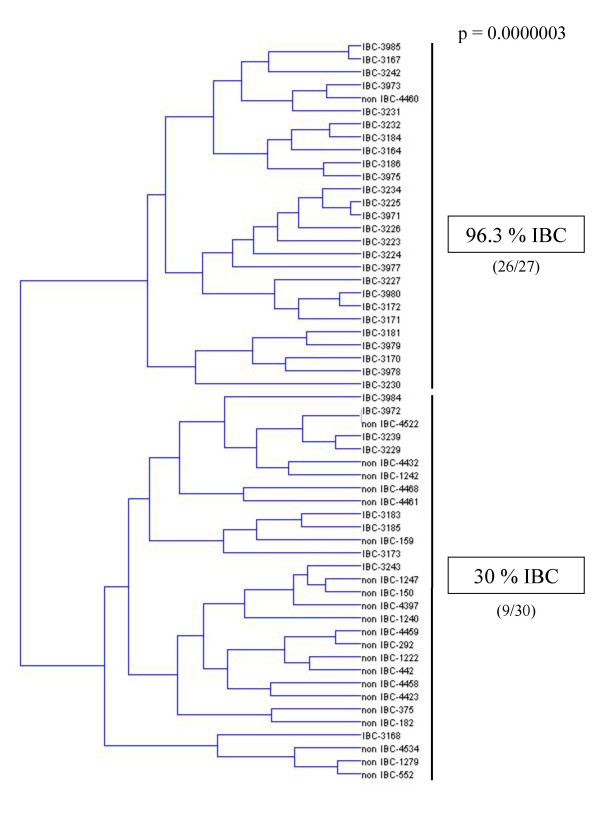
We measured the mRNA expression levels of 60 NF-kappaB-related genes by using real-time quantitative RT-PCR in a well-defined series of 35 IBCs, by comparison with 22 stage IIB and III non inflammatory breast cancers. Twenty-four distant metastases of breast cancer served as "poor prognosis" breast tumor controls.
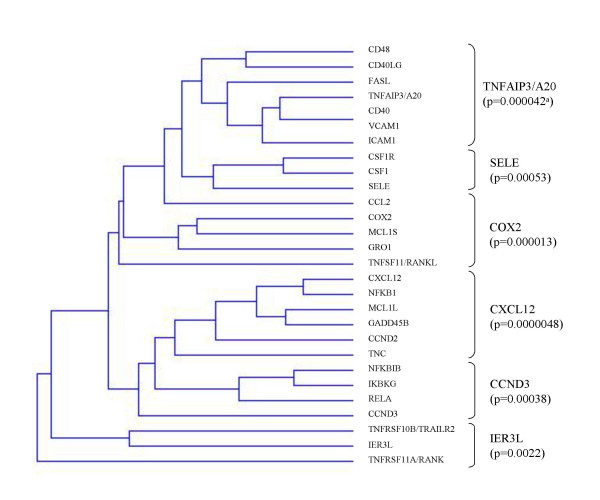
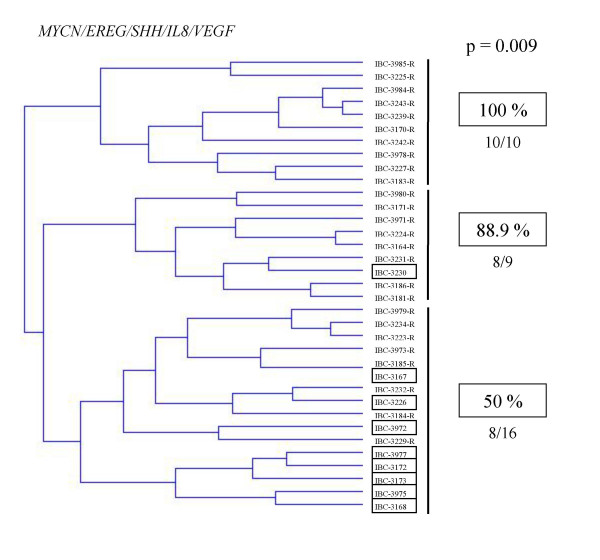
Thirty-five (58%) of the 60 NF-kappaB-related genes were significantly upregulated in IBC compared with non IBC. The upregulated genes were NF-kappaB genes (NFKB1, RELA, IKBKG, NFKBIB, NFKB2, REL, CHUK), apoptosis genes (MCL1L, TNFAIP3/A20, GADD45B, FASLG, MCL1S, IER3L, TNFRSF10B/TRAILR2), immune response genes (CD40, CD48, TNFSF11/RANKL, TNFRSF11A/RANK, CCL2/MCP-1, CD40LG, IL15, GBP1), proliferation genes (CCND2, CCND3, CSF1R, CSF1, SOD2), tumor-promoting genes (CXCL12, SELE, TNC, VCAM1, ICAM1, PLAU/UPA) or angiogenesis genes (PTGS2/COX2, CXCL1/GRO1). Only two of these 35 genes (PTGS2/COX2 and CXCL1/GRO1)were also upregulated in breast cancer metastases. We identified a five-gene molecular signature that matched patient outcomes, consisting of IL8 and VEGF plus three NF-kappaB-unrelated genes that we had previously identified as prognostic markers in the same series of IBC.
The NF-kappaB pathway appears to play a major role in IBC, possibly contributing to the unusual phenotype and aggressiveness of this form of breast cancer. Some upregulated NF-kappaB-related genes might serve as novel therapeutic targets in IBC.
炎性乳腺癌(IBC)是一种具有特殊表型的罕见乳腺癌形式。需要新的分子靶点来改善这种快速致命疾病的治疗。鉴于核因子κB(NF-κB)相关基因在细胞增殖、侵袭性、血管生成和炎症中的作用,我们推测它们在IBC中可能失调。
我们使用实时定量逆转录聚合酶链反应(RT-PCR)检测了35例明确诊断的IBC中60个NF-κB相关基因的mRNA表达水平,并与22例IIB期和III期非炎性乳腺癌进行比较。24例乳腺癌远处转移灶作为“预后不良”的乳腺肿瘤对照。
与非IBC相比,60个NF-κB相关基因中的35个(58%)在IBC中显著上调。上调的基因包括NF-κB基因(NFKB1、RELA、IKBKG、NFKBIB、NFKB2、REL、CHUK)、凋亡基因(MCL1L、TNFAIP3/A20、GADD45B、FASLG、MCL1S、IER3L、TNFRSF10B/TRAILR2)、免疫反应基因(CD40、CD48、TNFSF11/RANKL、TNFRSF11A/RANK、CCL2/MCP-1、CD40LG、IL15GBP1)、增殖基因(CCND2、CCND3、CSF1R、CSF1、SOD2)、肿瘤促进基因(CXCL12、SELE、TNC、VCAM1、ICAM1、PLAU/UPA)或血管生成基因(PTGS2/COX2、CXCL1/GRO1)。在乳腺癌转移灶中,这35个基因中只有两个(PTGS2/COX2和CXCL1/GRO1)也上调。我们确定了一个与患者预后相符的五基因分子特征,由IL8和VEGF加上我们之前在同一组IBC中确定为预后标志物的三个与NF-κB无关的基因组成。
NF-κB通路似乎在IBC中起主要作用,可能导致这种乳腺癌形式的异常表型和侵袭性。一些上调的NF-κB相关基因可能成为IBC的新型治疗靶点。