Hoberg Eric P, Polley Lydden, Jenkins Emily J, Kutz Susan J, Veitch Alasdair M, Elkin Brett T
U.S. National Parasite Collection and Animal Parasitic Diseases Laboratory, U.S. Department of Agriculture Agricultural Research Service, Beltsville, MD 20705, USA.
Emerg Infect Dis. 2008 Jan;14(1):10-7. doi: 10.3201/eid1401.071119.
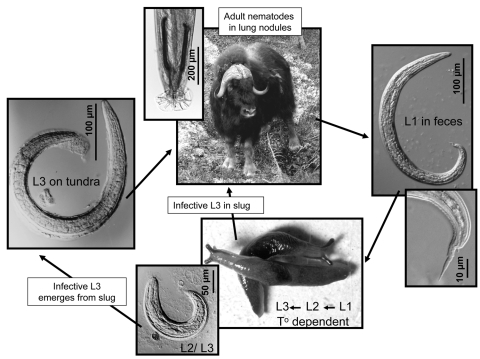
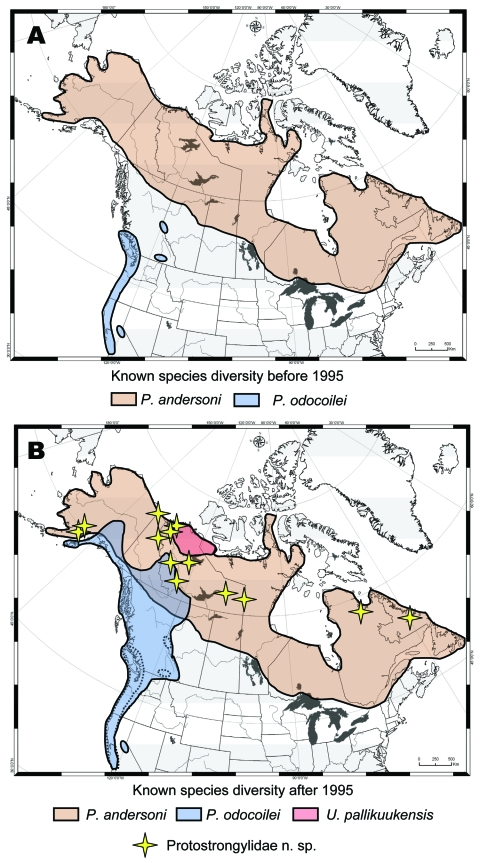
The North is a frontier for exploration of emerging infectious diseases and the large-scale drivers influencing distribution, host associations, and evolution of pathogens among persons, domestic animals, and wildlife. Leading into the International Polar Year 2007-2008, we outline approaches, protocols, and empirical models derived from a decade of integrated research on northern host-parasite systems. Investigations of emerging infectious diseases associated with parasites in northern wildlife involved a network of multidisciplinary collaborators and incorporated geographic surveys, archival collections, historical foundations for diversity, and laboratory and field studies exploring the interface for hosts, parasites, and the environment. In this system, emergence of parasitic disease was linked to geographic expansion, host switching, resurgence due to climate change, and newly recognized parasite species. Such integrative approaches serve as cornerstones for detection, prediction, and potential mitigation of emerging infectious diseases in wildlife and persons in the North and elsewhere under a changing global climate.
北方地区是探索新发传染病以及影响病原体在人类、家畜和野生动物之间分布、宿主关联及进化的大规模驱动因素的前沿地带。在进入2007 - 2008年国际极地年之际,我们概述了源自对北方宿主 - 寄生虫系统十年综合研究的方法、方案和实证模型。对北方野生动物中与寄生虫相关的新发传染病的调查涉及一个多学科合作网络,并纳入了地理调查、档案收集、多样性的历史基础以及探索宿主、寄生虫与环境界面的实验室和野外研究。在这个系统中,寄生虫病的出现与地理扩张、宿主转换、气候变化导致的复发以及新发现的寄生虫物种有关。这种综合方法是在全球气候变化背景下检测、预测和潜在缓解北方及其他地区野生动物和人类新发传染病的基石。