Eisenhut Belinda, Wittwer Aline, Schnyder Manuela, Oehm Andreas W
Institute of Parasitology, Vetsuisse Faculty, University of Zurich, Zurich, Switzerland.
Graduate School for Cellular and Biomedical Sciences, University of Bern, Bern, Switzerland.
Front Cell Infect Microbiol. 2025 Jun 3;15:1584663. doi: 10.3389/fcimb.2025.1584663. eCollection 2025.
Canine angiostrongylosis, caused by , affects dogs and red foxes, with dogs developing cardiopulmonary and coagulation disorders, while foxes remain mostly subclinical.
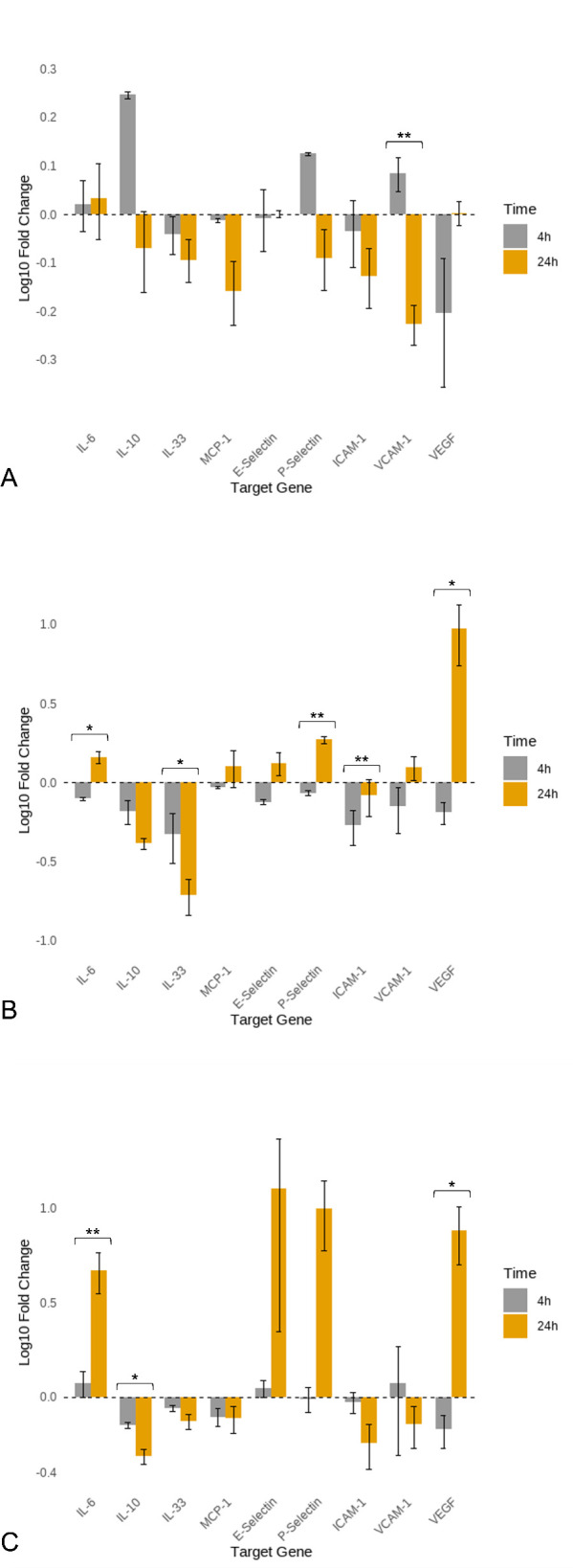
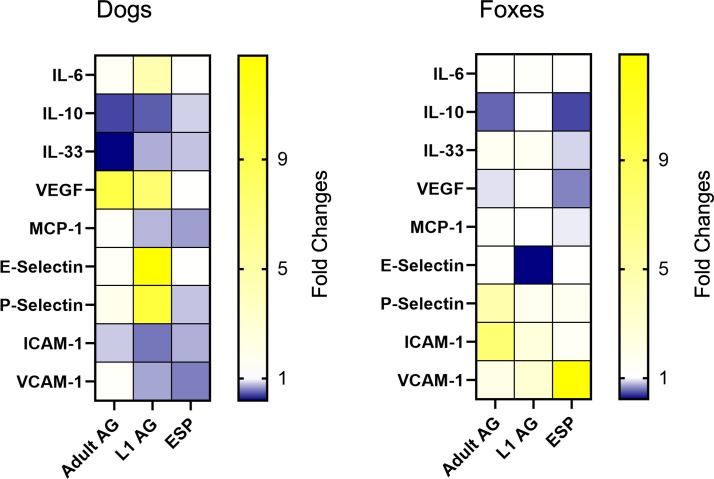
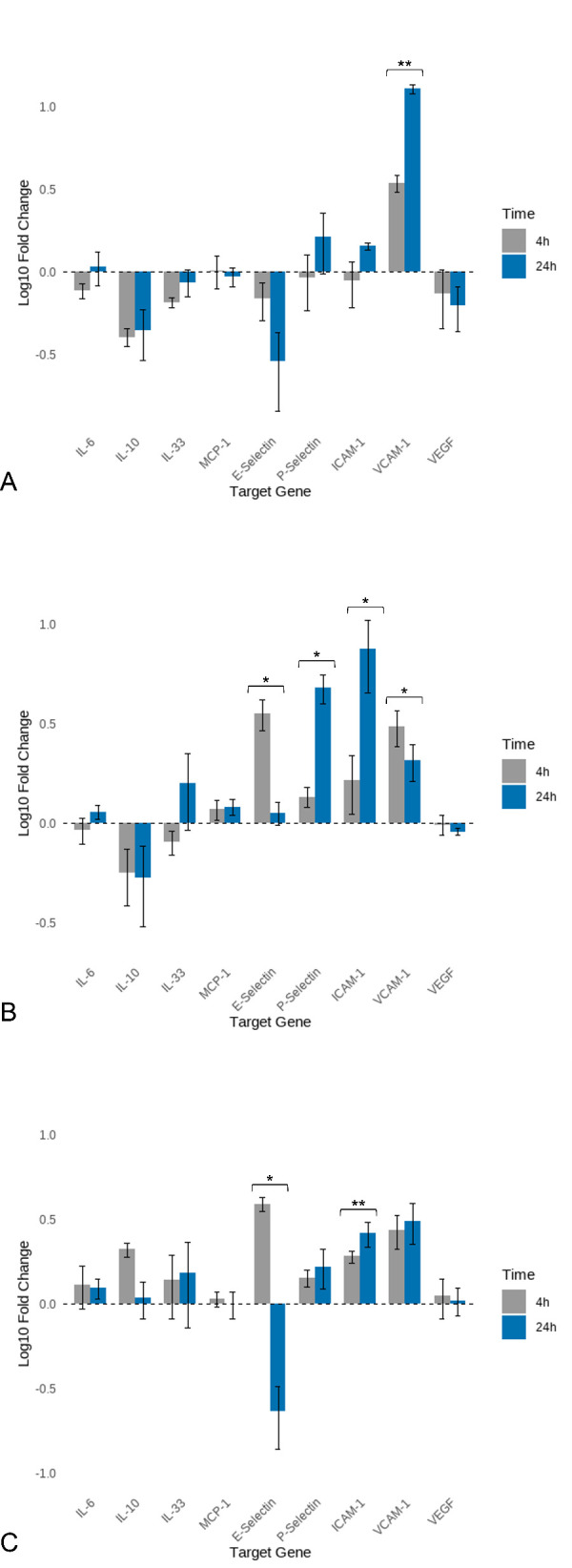
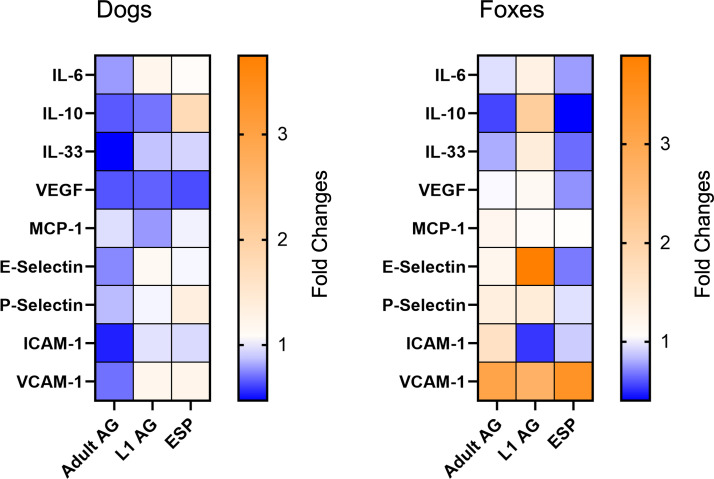
This study examined aortic endothelial cell responses from both species to adult full somatic antigen extracts, first-stage larval (L1) antigen, and adult excretory-secretory products (ESP). Differential gene expression of interleukins (IL) -6, -10, and -33, intercellular adhesion molecule 1 (ICAM-1), vascular adhesion molecule 1 (VCAM-1), endothelial selectin (E-selectin), platelet selectin (P-selectin), vascular endothelial growth factor (VEGF), and monocyte chemoattractant protein 1 (MCP-1) was assessed via reverse transcription quantitative PCR (RT qPCR) after four and 24 hours of antigen exposure.
Four hours post ESP stimulation, IL-10 increased in dogs (1.8-fold) but decreased in foxes (0.4-fold). IL-33 declined in both, (0.9-fold vs. 0.7-fold, respectively). VCAM-1 was upregulated more in foxes (3.5-fold vs. 1.2 in dogs). Following adult antigen exposure, P-selectin, ICAM-1, and VCAM-1 increased in fox more than in dog cells (1.4, 1.7, and 3.1-fold vs. 0.9, 0.5, and 0.7-fold, respectively). L1 antigen downregulated IL-10 and MCP-1 in dogs (0.7 and 0.8-fold) but upregulated them in foxes (2.1 and 1.1-fold). Twenty-four hours after ESP stimulation, ICAM-1 decreased in dogs (0.8-fold) but increased in foxes (1.4-fold). VCAM-1 was downregulated in dogs (0.6-fold) but upregulated in foxes (12.9-fold). Adult antigen exposure upregulated P-selectin in both species, more in foxes (4.8-fold) than in dogs (1.9-fold). ICAM-1 was downregulated in dogs (0.8-fold) but upregulated 7.5-fold in foxes. L1 antigen stimulation caused the most substantial differences between species: IL-6 was upregulated more in dogs (4.7-fold) than foxes (1.2-fold). E-Selectin was upregulated in dogs (12.8-fold) but downregulated in foxes (0.2-fold). P-selectin increased more in dogs (10.0-fold) than in foxes (1.7-fold). ICAM-1 was downregulated in dogs (0.6-fold) but upregulated in foxes (2.6-fold), as was VCAM-1 (0.7-fold and 3.1-fold). VEGF was upregulated 9.5-fold in dogs after adult antigen exposure, and 7.6-fold after L1 antigen exposure, while it remained rather unchanged in foxes (0.9-fold and 1.0-fold, respectively).
These findings corroborate that foxes have developed mechanisms for a regulated immune response following exposure, while dogs exhibit a higher pro-inflammatory reaction, contributing to severe clinical outcomes. Host-parasite co-evolution may explain differences in the pathogenesis and clinical presentation of canid angiostrongylosis.
由[病原体名称未给出]引起的犬血管圆线虫病会影响犬类和赤狐,犬类会出现心肺和凝血功能障碍,而狐狸大多处于亚临床状态。
本研究检测了两个物种的主动脉内皮细胞对成虫全虫体细胞抗原提取物、第一期幼虫(L1)抗原和成虫排泄分泌产物(ESP)的反应。在抗原暴露4小时和24小时后,通过逆转录定量PCR(RT qPCR)评估白细胞介素(IL)-6、-10和-33、细胞间黏附分子1(ICAM-1)、血管黏附分子1(VCAM-1)、内皮选择素(E-选择素)、血小板选择素(P-选择素)、血管内皮生长因子(VEGF)和单核细胞趋化蛋白1(MCP-1)的差异基因表达。
ESP刺激后4小时,犬类体内IL-10升高(1.8倍),而狐狸体内下降(0.4倍)。IL-33在两者中均下降(分别为0.9倍和0.7倍)。VCAM-1在狐狸体内上调幅度更大(3.5倍,而犬类为1.2倍)。成虫抗原暴露后,狐狸细胞中P-选择素、ICAM-1和VCAM-1的增加幅度大于犬类细胞(分别为1.4倍、1.7倍和3.1倍,而犬类为0.9倍、0.5倍和0.7倍)。L1抗原使犬类体内IL-10和MCP-1下调(0.7倍和0.8倍),但在狐狸体内上调(2.1倍和1.1倍)。ESP刺激24小时后,犬类体内ICAM-1下降(0.8倍),而狐狸体内增加(1.4倍)。VCAM-1在犬类体内下调(0.6倍),但在狐狸体内上调(12.9倍)。成虫抗原暴露使两个物种的P-选择素均上调,狐狸上调幅度更大(4.8倍),犬类为(1.9倍)。犬类体内ICAM-1下调(0.8倍),而狐狸体内上调7.5倍。L1抗原刺激导致两个物种之间差异最为显著:犬类体内IL-6上调幅度大于狐狸(4.7倍对1.2倍)。E-选择素在犬类体内上调(12.8倍),但在狐狸体内下调(0.2倍)。犬类体内P-选择素增加幅度大于狐狸(10.0倍对1.7倍)。犬类体内ICAM-1下调(0.6倍),而狐狸体内上调(分别为0.7倍和三1倍)。成虫抗原暴露后,犬类体内VEGF上调9.5倍,L1抗原暴露后上调7.6倍,而狐狸体内变化不大(分别为0.9倍和1.0倍)。
这些发现证实,狐狸在暴露于[病原体名称未给出]后已形成调节免疫反应的机制,而犬类表现出更高的促炎反应,导致严重的临床后果。宿主-寄生虫共同进化可能解释犬血管圆线虫病发病机制和临床表现的差异。