Yandek Lindsay E, Pokorny Antje, Almeida Paulo F F
Department of Chemistry and Biochemistry, University of North Carolina Wilmington, Wilmington, North Carolina 28403, USA.
Biochemistry. 2008 Mar 4;47(9):3051-60. doi: 10.1021/bi702205r. Epub 2008 Feb 9.
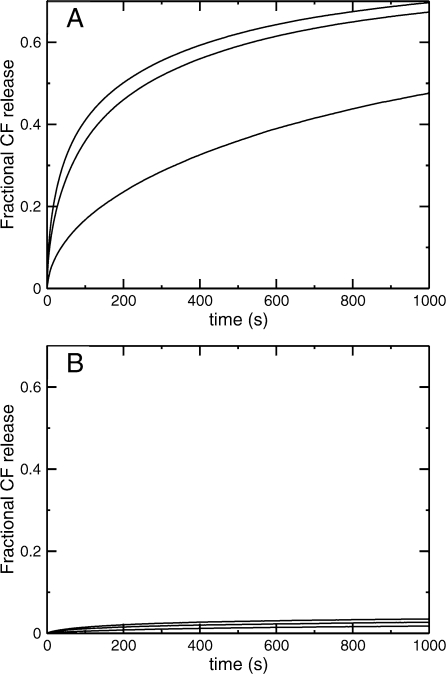
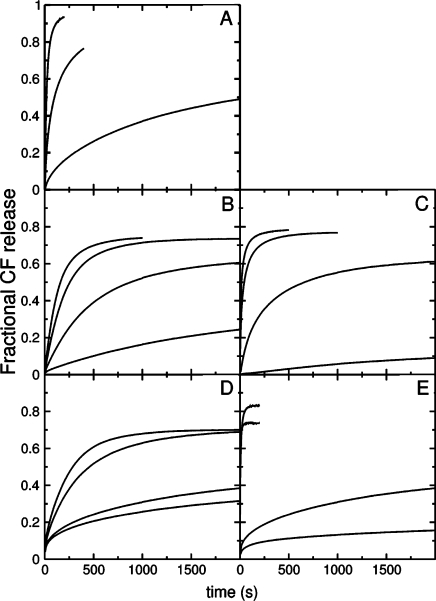
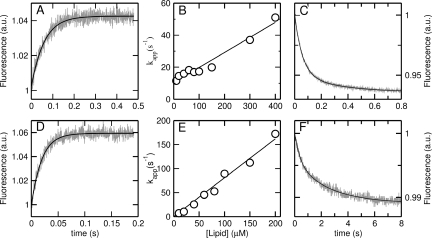
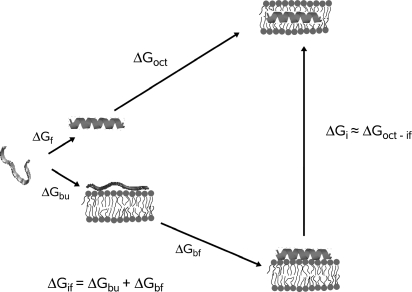
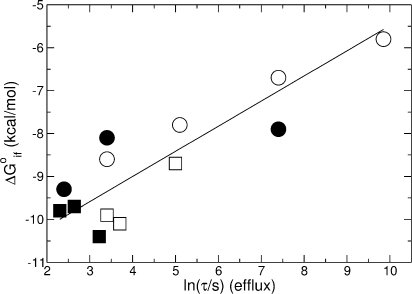
The kinetics and thermodynamics of binding of transportan 10 (tp10) and four of its variants to phospholipid vesicles, and the kinetics of peptide-induced dye efflux, were compared. Tp10 is a 21-residue, amphipathic, cationic, cell-penetrating peptide similar to helical antimicrobial peptides. The tp10 variants examined include amidated and free peptides, and replacements of tyrosine by tryptophan. Carboxy-terminal amidation or substitution of tryptophan for tyrosine enhance binding and activity. The Gibbs energies of peptide binding to membranes determined experimentally and calculated from the interfacial hydrophobicity scale are in good agreement. The Gibbs energy for insertion into the bilayer core was calculated using hydrophobicity scales of residue transfer from water to octanol and to the membrane/water interface. Peptide-induced efflux becomes faster as the Gibbs energies for binding and insertion of the tp10 variants decrease. If anionic lipids are included, binding and efflux rate increase, as expected because all tp10 variants are cationic and an electrostatic component is added. Whether the most important effect of peptide amidation is the change in charge or an enhancement of helical structure, however, still needs to be established. Nevertheless, it is clear that the changes in efflux rate reflect the differences in the thermodynamics of binding and insertion of the free and amidated peptide groups.
比较了转运蛋白10(tp10)及其四个变体与磷脂囊泡结合的动力学和热力学,以及肽诱导的染料外排动力学。Tp10是一种21个残基的两亲性阳离子细胞穿透肽,类似于螺旋抗菌肽。所研究的tp10变体包括酰胺化肽和游离肽,以及色氨酸取代酪氨酸的情况。羧基末端酰胺化或色氨酸取代酪氨酸可增强结合和活性。通过实验测定并根据界面疏水性标度计算得到的肽与膜结合的吉布斯自由能吻合良好。利用残基从水转移到辛醇以及到膜/水界面的疏水性标度,计算了插入双层核心的吉布斯自由能。随着tp10变体结合和插入的吉布斯自由能降低,肽诱导的外排变得更快。如果加入阴离子脂质,结合和外排速率会增加,正如预期的那样,因为所有tp10变体都是阳离子的,增加了静电作用。然而,肽酰胺化最重要的影响是电荷变化还是螺旋结构增强,仍有待确定。尽管如此,很明显外排速率的变化反映了游离肽基团和酰胺化肽基团结合和插入热力学的差异。