Betts Richard, Sanderson Michael, Woodward Stephanie
Met Office Hadley Centre, Exeter EX1 3PB, UK.
Philos Trans R Soc Lond B Biol Sci. 2008 May 27;363(1498):1873-80. doi: 10.1098/rstb.2007.0027.
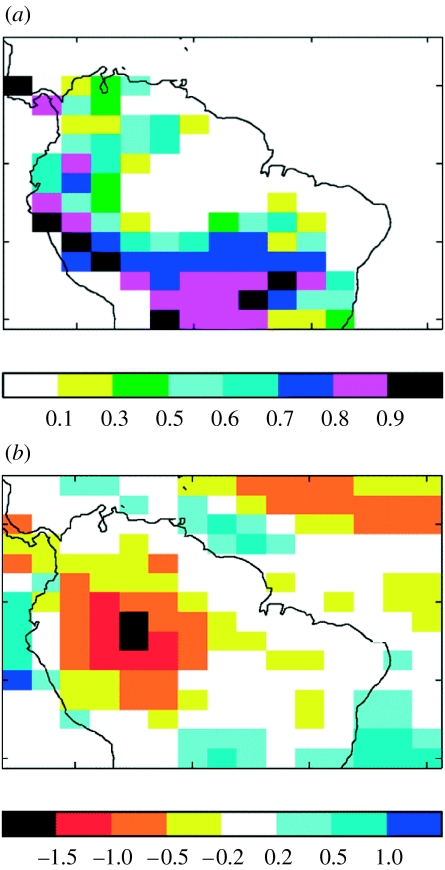
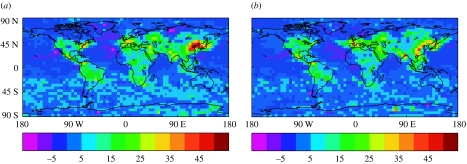
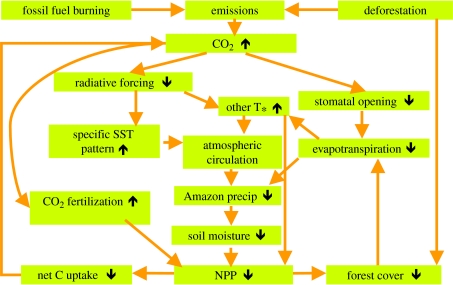
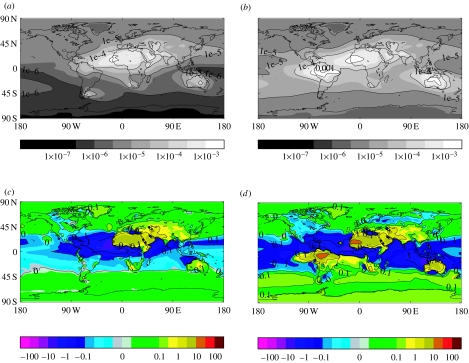
Loss of large areas of Amazonian forest, through either direct human impact or climate change, could exert a number of influences on the regional and global climates. In the Met Office Hadley Centre coupled climate-carbon cycle model, a severe drying of this region initiates forest loss that exerts a number of feedbacks on global and regional climates, which magnify the drying and the forest degradation. This paper provides an overview of the multiple feedback process in the Hadley Centre model and discusses the implications of the results for the case of direct human-induced deforestation. It also examines additional potential effects of forest loss through changes in the emissions of mineral dust and biogenic volatile organic compounds. The implications of ecosystem-climate feedbacks for climate change mitigation and adaptation policies are also discussed.
由于直接的人类影响或气候变化,亚马逊大片森林的丧失可能会对区域和全球气候产生多种影响。在英国气象局哈德利中心的耦合气候-碳循环模型中,该地区的严重干旱引发森林丧失,进而对全球和区域气候产生多种反馈,加剧干旱和森林退化。本文概述了哈德利中心模型中的多重反馈过程,并讨论了这些结果对直接人为导致森林砍伐情况的影响。它还研究了通过矿物粉尘和生物源挥发性有机化合物排放变化导致森林丧失的其他潜在影响。此外,还讨论了生态系统-气候反馈对气候变化缓解和适应政策的影响。