Opiyo Newton, Were Fred, Govedi Fridah, Fegan Greg, Wasunna Aggrey, English Mike
Kenya Medical Research Institute (KEMRI)/Wellcome Trust Research Programme, Nairobi, Kenya.
PLoS One. 2008 Feb 13;3(2):e1599. doi: 10.1371/journal.pone.0001599.
Birth asphyxia kills 0.7 to 1.6 million newborns a year globally with 99% of deaths in developing countries. Effective newborn resuscitation could reduce this burden of disease but the training of health-care providers in low income settings is often outdated. Our aim was to determine if a simple one day newborn resuscitation training (NRT) alters health worker resuscitation practices in a public hospital setting in Kenya.
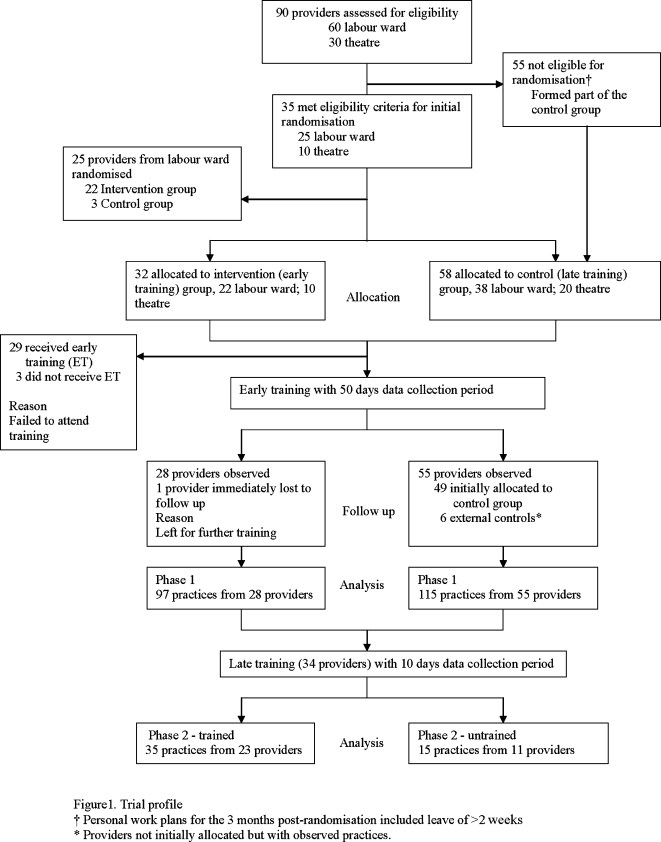
METHODS/PRINCIPAL FINDINGS: We conducted a randomised, controlled trial with health workers receiving early training with NRT (n = 28) or late training (the control group, n = 55). The training was adapted locally from the approach of the UK Resuscitation Council. The primary outcome was the proportion of appropriate initial resuscitation steps with the frequency of inappropriate practices as a secondary outcome. Data were collected on 97 and 115 resuscitation episodes over 7 weeks after early training in the intervention and control groups respectively. Trained providers demonstrated a higher proportion of adequate initial resuscitation steps compared to the control group (trained 66% vs control 27%; risk ratio 2.45, [95% CI 1.75-3.42], p<0.001, adjusted for clustering). In addition, there was a statistically significant reduction in the frequency of inappropriate and potentially harmful practices per resuscitation in the trained group (trained 0.53 vs control 0.92; mean difference 0.40, [95% CI 0.13-0.66], p = 0.004).
CONCLUSIONS/SIGNIFICANCE: Implementation of a simple, one day newborn resuscitation training can be followed immediately by significant improvement in health workers' practices. However, evidence of the effects on long term performance or clinical outcomes can only be established by larger cluster randomised trials.
Controlled-Trials.com ISRCTN92218092.
全球每年有70万至160万新生儿死于出生窒息,其中99%的死亡发生在发展中国家。有效的新生儿复苏可减轻这种疾病负担,但低收入地区医护人员的培训往往过时。我们的目的是确定在肯尼亚一家公立医院环境中,为期一天的简单新生儿复苏培训(NRT)是否会改变医护人员的复苏操作。
方法/主要发现:我们进行了一项随机对照试验,医护人员分为早期接受NRT培训组(n = 28)和晚期培训组(对照组,n = 55)。培训在当地采用了英国复苏委员会的方法。主要结局是适当的初始复苏步骤的比例,不适当操作的频率作为次要结局。分别在干预组和对照组早期培训后的7周内,收集了97次和115次复苏事件的数据。与对照组相比,接受培训的人员在初始复苏步骤中表现出更高比例的充分操作(培训组为66%,对照组为27%;风险比2.45,[95%置信区间1.75 - 3.42],p<0.001,经聚类调整)。此外,培训组每次复苏中不适当和潜在有害操作的频率有统计学显著降低(培训组为0.53,对照组为0.92;平均差异0.40,[95%置信区间0.13 - 0.66],p = 0.004)。
结论/意义:实施为期一天的简单新生儿复苏培训后,医护人员的操作可立即得到显著改善。然而,对长期表现或临床结局影响的证据只能通过更大规模的整群随机试验来确定。
Controlled-Trials.com ISRCTN92218092