Kochzius M, Nölte M, Weber H, Silkenbeumer N, Hjörleifsdottir S, Hreggvidsson G O, Marteinsson V, Kappel K, Planes S, Tinti F, Magoulas A, Garcia Vazquez E, Turan C, Hervet C, Campo Falgueras D, Antoniou A, Landi M, Blohm D
Centre for Applied Gene Sensor Technology (CAG), University of Bremen, Bremen, Germany.
Mar Biotechnol (NY). 2008 Mar-Apr;10(2):207-17. doi: 10.1007/s10126-007-9068-3. Epub 2008 Feb 13.
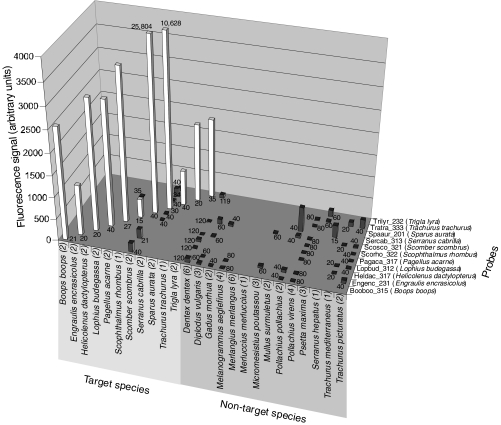
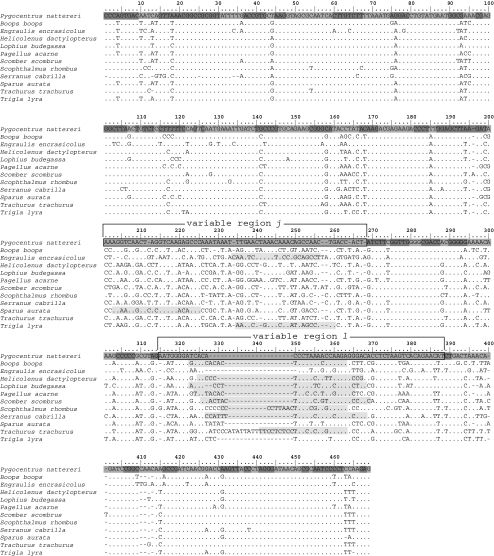
In many cases marine organisms and especially their diverse developmental stages are difficult to identify by morphological characters. DNA-based identification methods offer an analytically powerful addition or even an alternative. In this study, a DNA microarray has been developed to be able to investigate its potential as a tool for the identification of fish species from European seas based on mitochondrial 16S rDNA sequences. Eleven commercially important fish species were selected for a first prototype. Oligonucleotide probes were designed based on the 16S rDNA sequences obtained from 230 individuals of 27 fish species. In addition, more than 1200 sequences of 380 species served as sequence background against which the specificity of the probes was tested in silico. Single target hybridisations with Cy5-labelled, PCR-amplified 16S rDNA fragments from each of the 11 species on microarrays containing the complete set of probes confirmed their suitability. True-positive, fluorescence signals obtained were at least one order of magnitude stronger than false-positive cross-hybridisations. Single nontarget hybridisations resulted in cross-hybridisation signals at approximately 27% of the cases tested, but all of them were at least one order of magnitude lower than true-positive signals. This study demonstrates that the 16S rDNA gene is suitable for designing oligonucleotide probes, which can be used to differentiate 11 fish species. These data are a solid basis for the second step to create a "Fish Chip" for approximately 50 fish species relevant in marine environmental and fisheries research, as well as control of fisheries products.
在许多情况下,海洋生物尤其是其不同的发育阶段,很难通过形态特征来识别。基于DNA的识别方法提供了一种分析能力强大的补充手段,甚至可作为一种替代方法。在本研究中,已开发出一种DNA微阵列,以便能够基于线粒体16S rDNA序列研究其作为识别欧洲海域鱼类物种工具的潜力。选择了11种具有商业重要性的鱼类作为首个原型。根据从27种鱼类的230个个体获得的16S rDNA序列设计了寡核苷酸探针。此外,380个物种的1200多个序列用作序列背景,在计算机上测试探针的特异性。在包含全套探针的微阵列上,对来自11个物种中每个物种的用Cy5标记的PCR扩增16S rDNA片段进行单靶标杂交,证实了它们的适用性。获得的真阳性荧光信号比假阳性交叉杂交信号至少强一个数量级。单非靶标杂交在约27%的测试案例中产生交叉杂交信号,但所有这些信号都比真阳性信号至少低一个数量级。本研究表明,16S rDNA基因适用于设计寡核苷酸探针,可用于区分11种鱼类。这些数据为第二步创建一个针对海洋环境和渔业研究以及渔业产品控制中约50种相关鱼类的“鱼类芯片”奠定了坚实基础。