
用促黄体生成素释放激素激动剂和拮抗剂治疗后,邓宁R3327前列腺癌中嗜银核仁组织区数量减少。
Decrease in the AgNOR number in Dunning R3327 prostate cancers after treatment with an agonist and antagonist of luteinizing hormone-releasing hormone.
作者信息
Szepeshazi K, Korkut E, Schally A V
机构信息
Endocrine, Polypeptide and Cancer Institute, Veterans Affairs Medical Center, New Orleans, Louisiana 70146.
出版信息
Am J Pathol. 1991 May;138(5):1273-7.
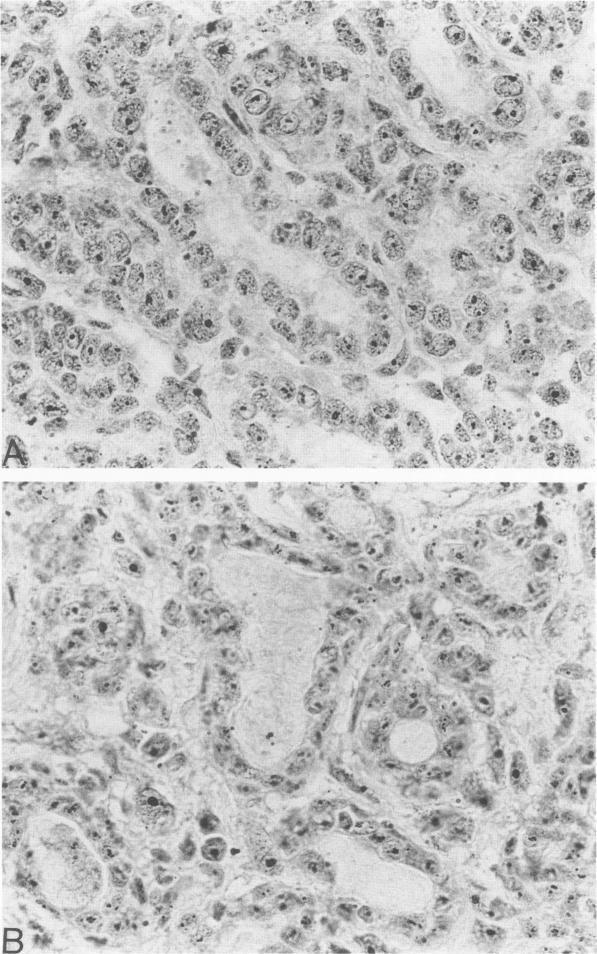
The argyrophilic staining of the nucleolar organizer region (AgNOR) in cells of Dunning R3327 rat prostate tumors was studied and the effect of hormonal treatments on their appearance was analyzed. The nuclei of the control tumor cells contained 4.1 +/- 0.17 AgNOR granules. Treatment of rats for 8 weeks with luteinizing hormone-releasing hormone (LH-RH) agonist (D-Trp-6-LH-RH) and antagonist SB-75 induced a marked inhibition of tumor growth and decreased significantly (P less than 0.01) the number of Ag-NORs in the tumors to 2.89 +/- 0.10 AgNOR granules/cell in the group given the agonist and to 2.82 +/- 0.10 after therapy with the highest dose of the antagonist. A reduced AgNOR number (3.14 +/- 0.16) also was found after 3 days of treatment with SB-75 (P less than 0.05), but the AgNORs returned to near control values 1 week after the short-term therapy, showing the reversibility of these changes. These results suggest that the AgNOR method, which was widely tested on human tumors in the past few years, can be a valuable technique in experimental tumor pathology and useful in the evaluation of the effects of various treatments.
研究了Dunning R3327大鼠前列腺肿瘤细胞中核仁组成区嗜银染色(AgNOR)情况,并分析了激素治疗对其表现的影响。对照肿瘤细胞的细胞核含有4.1±0.17个AgNOR颗粒。用促黄体生成素释放激素(LH-RH)激动剂(D-Trp-6-LH-RH)和拮抗剂SB-75对大鼠进行8周治疗,可显著抑制肿瘤生长,肿瘤中的AgNOR数量显著减少(P<0.01),在给予激动剂的组中降至2.89±0.10个AgNOR颗粒/细胞,在用最高剂量拮抗剂治疗后降至2.82±0.10个。用SB-75治疗3天后也发现AgNOR数量减少(3.14±0.16)(P<0.05),但短期治疗1周后AgNOR恢复到接近对照值,表明这些变化具有可逆性。这些结果表明,过去几年在人类肿瘤上广泛测试的AgNOR方法,在实验肿瘤病理学中可能是一种有价值的技术,有助于评估各种治疗的效果。
 Zotero 插件