Mueller-Bierl Bernd Michael, Uludag Kamil, Pereira Philippe L, Schick Fritz
Max-Planck Institute for Biological Cybernetics, Spemannstrasse 41, 72076 Tübingen, Germany.
Int J Biomed Imaging. 2007;2007:70309. doi: 10.1155/2007/70309.
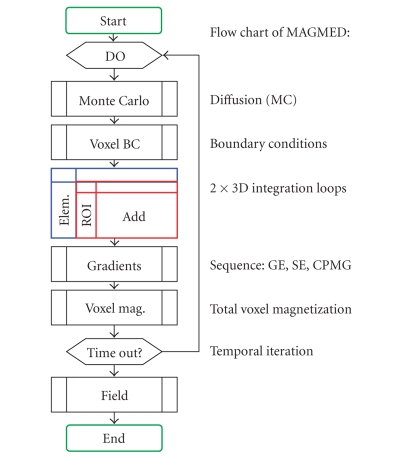
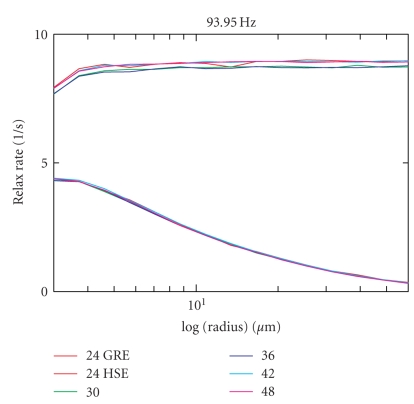
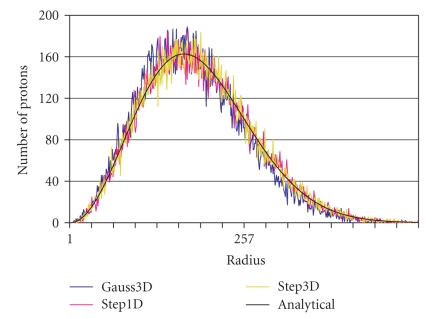
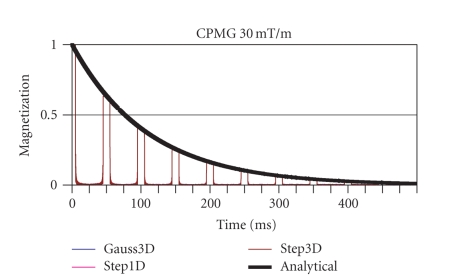
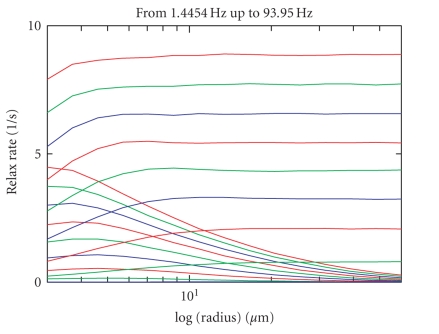
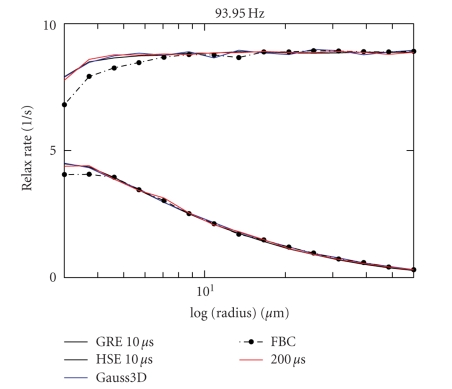
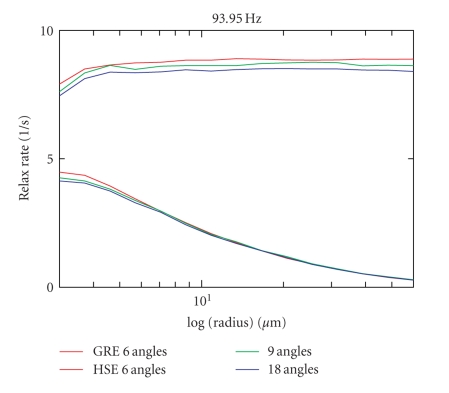
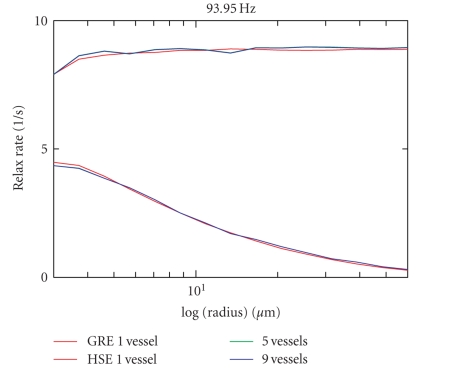
Extravascular signal decay rate R2 or R2 * as a function of blood oxygenation, geometry, and field strength was calculated using a Monte Carlo (MC) algorithm for a wider parameter range than hitherto by others. The relaxation rates of gradient-recalled-echo (GRE) and Hahn-spin-echo (HSE) imaging in the presence of blood vessels (ranging from capillaries to veins) have been computed for a wide range of field strengths up to 9.4T and 50% blood deoxygenation. The maximum HSE decay was found to be shifted to lower radii in higher compared to lower field strengths. For GRE, however, the relaxation rate was greatest for large vessels at any field strength. In addition, assessments of computational reliability have been carried out by investigating the influence of the time step, the Monte Carlo step procedure, boundary conditions, the number of angles between the vessel and the exterior field B0, the influence of neighboring vessels having the same orientation as the central vessel, and the number of proton spins. The results were compared with those obtained from a field distribution of the vessel computed by an analytic formula describing the field distribution of an ideal object (an infinitely long cylinder). It was found that the time step is not critical for values equal to or lower than 200 microseconds. The choice of the MC step procedure (three-dimensional Gaussian diffusion, constant one- or three-dimensional diffusion step) also failed to influence the results significantly; in contrast, the free boundary conditions, as well as taking too few angles into account, did introduce errors. Next neighbor vessels with the same orientation as the main vessel did not contribute significantly to signal decay. The total number of particles simulated was also found to play a minor role in computing R2/ R2 *.
使用蒙特卡罗(MC)算法,在比其他人迄今所采用的更宽参数范围内,计算了作为血液氧合、几何形状和场强函数的血管外信号衰减率R2或R2*。对于高达9.4T的宽范围场强和50%的血液脱氧情况,已计算了存在血管(从毛细血管到静脉)时梯度回波(GRE)和哈恩自旋回波(HSE)成像的弛豫率。与低场强相比,发现高场强下最大HSE衰减向更小半径偏移。然而,对于GRE,在任何场强下大血管的弛豫率最大。此外,通过研究时间步长、蒙特卡罗步长程序、边界条件、血管与外部场B0之间的角度数量、与中心血管具有相同取向的相邻血管的影响以及质子自旋数量的影响,对计算可靠性进行了评估。将结果与通过描述理想物体(无限长圆柱体)场分布的解析公式计算的血管场分布所获得的结果进行了比较。发现对于等于或低于200微秒的值,时间步长并不关键。MC步长程序(三维高斯扩散、恒定的一维或三维扩散步长)的选择也未对结果产生显著影响;相反,自由边界条件以及考虑的角度过少确实会引入误差。与主血管具有相同取向的相邻血管对信号衰减的贡献不显著。还发现模拟的粒子总数在计算R2/R2*中起次要作用。