Woditschka Stephan, Haag Jill D, Mau Bob, Lubet Ronald A, Gould Michael N
McArdle Laboratory for Cancer Research, University of Wisconsin, 1400 University Avenue, Madison, WI 53706, USA.
Breast Cancer Res. 2008;10(1):R18. doi: 10.1186/bcr1864. Epub 2008 Feb 15.
While current breast cancer chemoprevention strategies using selective estrogen response modulators and aromatase inhibitors are quite successful, their effects are limited to hormonally responsive breast cancer. Hormonally nonresponsive breast cancer (including estrogen receptor-negative cancer) is associated with poor prognosis for patients, and few chemoprevention agents exist for this type of cancer. The cyclooxygenase-2 inhibitor celecoxib (Celebrex) is a nonsteroidal anti-inflammatory drug and as such is a potential candidate for the prevention of hormonally nonresponsive breast cancer.
The chemopreventive effects of celecoxib were evaluated in the neu-induced retroviral rat mammary carcinogenesis model, to assess the efficacy of celecoxib on hormonally responsive and hormonally nonresponsive mammary carcinomas.
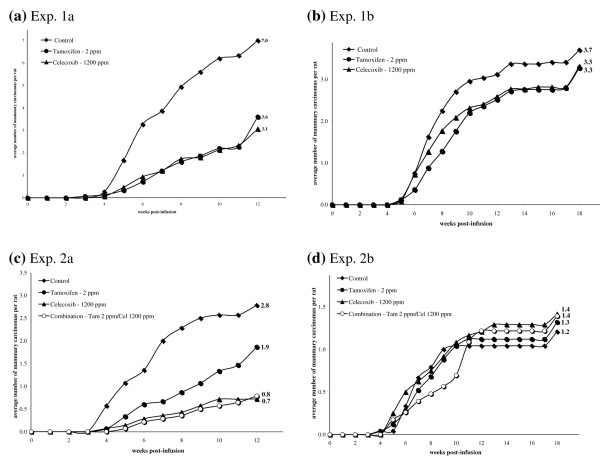
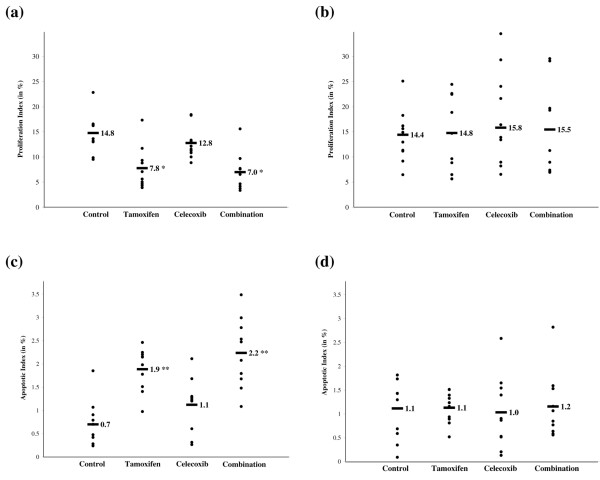
Dietary celecoxib at 1,200 mg/kg diet was highly efficacious in the prevention of hormonally responsive mammary carcinomas in intact rats, decreasing tumor multiplicity by 56% (P < 0.0001) and by 74% (P = 0.0002) in two independent experiments. No significant effect was found, however, on hormonally nonresponsive mammary carcinomas of ovariectomized rats. Treatment with a combination diet, consisting of tamoxifen at 2 mg/kg diet and celecoxib at 1,200 mg/kg diet, reduced tumor multiplicity by 72% (P = 0.0002) in intact rats. This reduction was not statistically different from that observed with celecoxib alone. Furthermore, long-term treatment with celecoxib was not associated with reductions in tumor volume in either intact rats or ovariectomized rats. In contrast, tamoxifen treatment and the combination regimen caused significant reductions in tumor volumes in intact rats (P = 0.01 and P = 0.004, respectively). Consistent with these data, decreases in proliferation and increases in apoptosis were detected in tamoxifen-treated and combination diet-treated tumors. No such modulations were observed in celecoxib-treated tumors.
The chemopreventive effects of celecoxib appear to be limited to modulations in multiplicity of hormonally responsive mammary carcinomas. The fact that no synergistic or additive effects were observed in combination diet-treated rats raises the question of whether celecoxib is suitable for the prevention of hormonally nonresponsive breast cancer or for use in combination therapy with selective estrogen response modulators or aromatase inhibitors.
虽然目前使用选择性雌激素反应调节剂和芳香化酶抑制剂的乳腺癌化学预防策略相当成功,但其效果仅限于激素反应性乳腺癌。激素无反应性乳腺癌(包括雌激素受体阴性癌)与患者的不良预后相关,针对这类癌症的化学预防药物很少。环氧化酶-2抑制剂塞来昔布(西乐葆)是一种非甾体抗炎药,因此是预防激素无反应性乳腺癌的潜在候选药物。
在neu诱导的逆转录病毒大鼠乳腺癌发生模型中评估塞来昔布的化学预防效果,以评估塞来昔布对激素反应性和激素无反应性乳腺癌的疗效。
在完整大鼠中,饮食中添加1200毫克/千克的塞来昔布对预防激素反应性乳腺癌非常有效,在两项独立实验中,肿瘤多发性分别降低了56%(P<0.0001)和74%(P=0.0002)。然而,对去卵巢大鼠的激素无反应性乳腺癌没有发现显著影响。用含2毫克/千克饮食的他莫昔芬和1200毫克/千克饮食的塞来昔布的联合饮食治疗,使完整大鼠的肿瘤多发性降低了72%(P=0.0002)。这种降低与单独使用塞来昔布时观察到的情况在统计学上没有差异。此外,长期用塞来昔布治疗对完整大鼠或去卵巢大鼠的肿瘤体积均无减小作用。相比之下,他莫昔芬治疗和联合治疗方案使完整大鼠的肿瘤体积显著减小(分别为P=0.01和P=0.004)。与这些数据一致,在他莫昔芬治疗和联合饮食治疗的肿瘤中检测到增殖减少和凋亡增加。在塞来昔布治疗的肿瘤中未观察到此类调节。
塞来昔布的化学预防作用似乎仅限于对激素反应性乳腺癌多发性的调节。联合饮食治疗的大鼠未观察到协同或相加作用这一事实,引发了塞来昔布是否适合预防激素无反应性乳腺癌或与选择性雌激素反应调节剂或芳香化酶抑制剂联合使用的问题。