Mullins Chris, Lucia M Scott, Hayward Simon W, Lee Jeannette Y, Levitt Jonathan M, Lin Victor K, Liu Brian C-S, Chinnaiyan Arul M, Rubin Mark A, Slawin Kevin, Star Robert A, Getzenberg Robert H
National Institute of Diabetes and Digestive and Kidney Diseases, National Institutes of Health, Bethesda, Maryland, USA.
J Urol. 2008 Apr;179(4):1243-56. doi: 10.1016/j.juro.2007.11.049. Epub 2008 Feb 20.
Clinical benign prostatic hyperplasia is primarily diagnosed based on a diverse array of progressive lower urinary tract symptoms and is likely distinct from histological benign prostatic hyperplasia, which is detected by the presence of nonmalignant proliferation of prostate cells but may or may not be associated with symptoms. Pharmacological management of lower urinary tract symptoms has emerged as an effective initial treatment for clinical benign prostatic hyperplasia due to the introduction of new drug therapies shown to be effective in recent large clinical trials. Despite advances in symptom management and research into disease pathology, diagnostic strategies for the prediction of benign prostatic hyperplasia progression and response to drug modalities are lacking, and questions remain as to the molecular differences underlying clinical (symptomatic) vs histological (nonsymptomatic) benign prostatic hyperplasia.
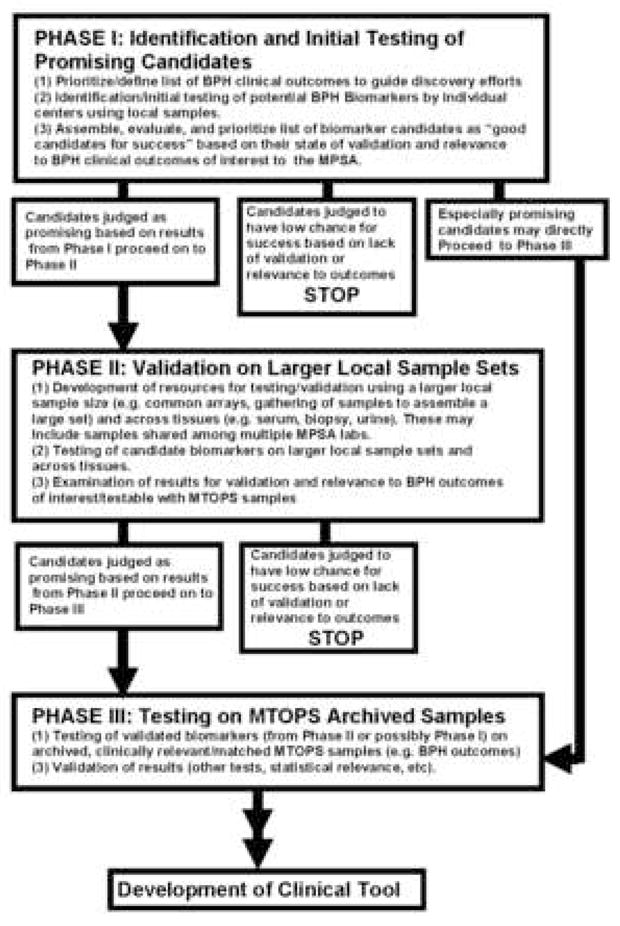
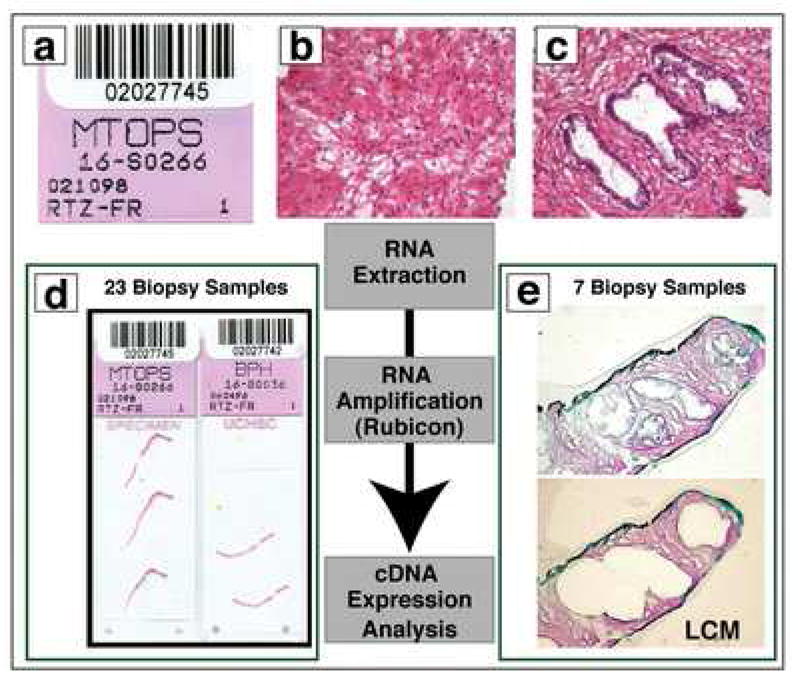
As part of the Medical Therapy of Prostatic Symptoms (MTOPS) clinical trial, which demonstrated the effectiveness of combination drug therapy in slowing benign prostatic hyperplasia progression, an archive of biological specimens linked to clinical data was collected for future profiling of disease pathology and changes associated with response to drug therapy. The MTOPS Prostatic Samples Analysis (MPSA) Consortium was established to identify and validate molecular markers that may better define benign prostatic hyperplasia related pathologies, identify risk of progression of lower urinary tract symptoms, and predict response to drug therapy using the MTOPS archive. The cooperating MPSA Biomarker Discovery Sites and Pathology Coordinating Center use diverse methodologies and scientific approaches as well as unique expertise to address the goals of the Consortium.
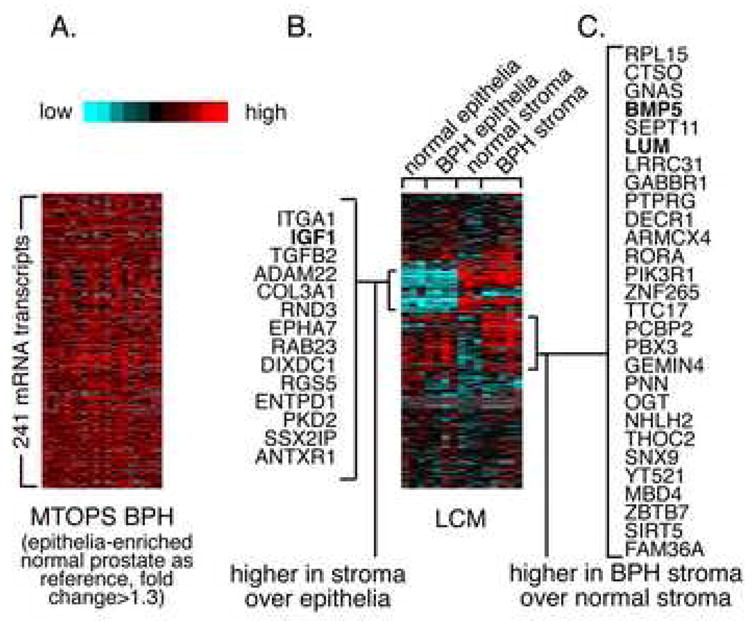
To date the MPSA has identified a number of promising biomarkers as well as other molecular and cellular changes associated with benign prostatic hyperplasia.
These findings and ongoing Consortium discovery efforts have the potential to provide a greater understanding of the defects underlying disease pathology, and may lead to the development of early and more effective pharmacological treatment strategies for benign prostatic hyperplasia.
临床良性前列腺增生主要依据一系列逐渐加重的下尿路症状进行诊断,可能与组织学良性前列腺增生不同,后者通过前列腺细胞的非恶性增殖来检测,但可能伴有或不伴有症状。由于近期大型临床试验表明新药疗法有效,下尿路症状的药物治疗已成为临床良性前列腺增生的有效初始治疗方法。尽管在症状管理和疾病病理学研究方面取得了进展,但仍缺乏预测良性前列腺增生进展及对药物治疗反应的诊断策略,关于临床(有症状)与组织学(无症状)良性前列腺增生潜在的分子差异也仍存在疑问。
作为前列腺症状医学治疗(MTOPS)临床试验的一部分,该试验证明了联合药物治疗在减缓良性前列腺增生进展方面的有效性,收集了与临床数据相关的生物标本存档,以备将来对疾病病理学及与药物治疗反应相关的变化进行分析。成立了MTOPS前列腺样本分析(MPSA)联盟,以识别和验证分子标志物,这些标志物可能更好地界定与良性前列腺增生相关的病理学特征,确定下尿路症状进展的风险,并利用MTOPS存档预测对药物治疗的反应。合作的MPSA生物标志物发现站点和病理学协调中心使用多种方法和科学途径以及独特的专业知识来实现联盟的目标。
迄今为止,MPSA已识别出一些有前景的生物标志物以及与良性前列腺增生相关的其他分子和细胞变化。
这些发现以及联盟正在进行的探索工作有可能更深入地了解疾病病理学的潜在缺陷,并可能促成开发针对良性前列腺增生的早期且更有效的药物治疗策略。