Mlisana Koleka, Auld Sara C, Grobler Anneke, van Loggerenberg Francois, Williamson Carolyn, Iriogbe Itua, Sobieszczyk Magdalena E, Abdool Karim Salim S
Centre for the AIDS Programme of Research in South Africa (CAPRISA), University of KwaZulu-Natal, Durban, South Africa.
PLoS One. 2008 Feb 20;3(2):e1626. doi: 10.1371/journal.pone.0001626.
The high prevalence of anaemia and the increased morbidity and mortality associated with anaemia during AIDS has been well described yet there has been little information about anaemia and changes in haemoglobin levels during acute and early HIV-1 infection.
HIV-negative women (n = 245) were enrolled into an observational cohort as part of the Centre for the AIDS Programme of Research in South Africa (CAPRISA) Acute Infection Study. Acute infection was diagnosed following a positive HIV RNA PCR in the absence of antibodies, or detection of HIV-1 antibodies within 3 months of a previously negative antibody test. Haemotologic parameters were assessed before infection and at regular intervals in the first twelve months of HIV infection.
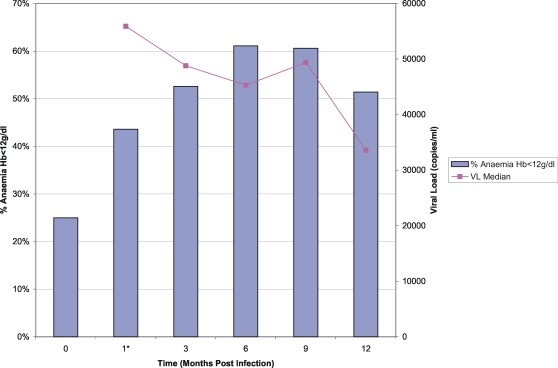
Fifty-seven participants with acute HIV infection were identified at a median of 14.5 days post-infection (range 10-81) and were enrolled in the CAPRISA Acute Infection cohort at a median of 41 days post-infection (range 15-104). Mean haemoglobin prior to HIV-1 infection was 12.7 g/dL, with a mean decline of 0.46 g/dL following infection. The prevalence of anaemia increased from 25.0% prior to HIV-1 infection to 52.6% at 3 months post-infection, 61.1% at 6 months post-infection, and 51.4% at 12 months post-infection.
Haematologic derangements and anaemia with a trend towards iron deficiency are common with acute HIV-1 subtype C infection in this small cohort. The negative impact of anaemia concurrent with established HIV infection upon morbidity and mortality has been well documented but the prognostic potential and long-term effects of anaemia during acute HIV-1 infection remain unknown.
贫血在艾滋病患者中的高患病率以及与贫血相关的发病率和死亡率增加已得到充分描述,但关于急性和早期HIV-1感染期间的贫血及血红蛋白水平变化的信息却很少。
作为南非艾滋病研究中心(CAPRISA)急性感染研究的一部分,245名HIV阴性女性被纳入一个观察性队列。在没有抗体的情况下,HIV RNA PCR检测呈阳性,或在先前抗体检测为阴性后的3个月内检测到HIV-1抗体,即可诊断为急性感染。在感染前以及HIV感染的前十二个月定期评估血液学参数。
在感染后中位数14.5天(范围10 - 81天)时确定了57名急性HIV感染参与者,并在感染后中位数41天(范围15 - 104天)时将其纳入CAPRISA急性感染队列。HIV-1感染前的平均血红蛋白为12.7 g/dL,感染后平均下降0.46 g/dL。贫血患病率从HIV-1感染前的25.0%增加到感染后3个月的52.6%、感染后6个月的61.1%和感染后12个月的51.4%。
在这个小队列中,急性HIV-1 C亚型感染常见血液学紊乱和缺铁性贫血趋势。已充分证明与已确诊的HIV感染并发的贫血对发病率和死亡率有负面影响,但急性HIV-1感染期间贫血的预后潜力和长期影响仍然未知。