Andersen Mads Hald, Sørensen Rikke Baek, Schrama David, Svane Inge Marie, Becker Jürgen C, Thor Straten Per
Department of Hematology, Center for Cancer Immune Therapy (CCIT), Herlev University Hospital, 54P4, Herlev Ringvej 75, 2730 Herlev, Denmark.
Cancer Immunol Immunother. 2008 Nov;57(11):1735-43. doi: 10.1007/s00262-008-0480-y. Epub 2008 Feb 20.
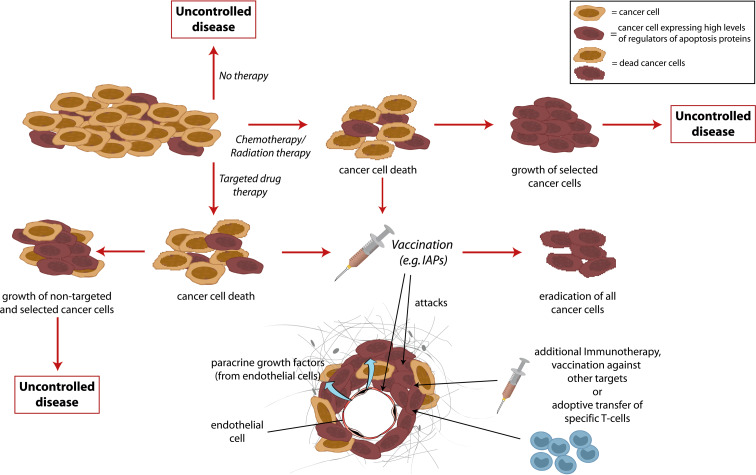
Harnessing of the immune system by the development of 'therapeutic' vaccines, for the battle against cancer has been the focus of tremendous research efforts over the past two decades. As an illustration of the impressive amounts of data gathered over the past years, numerous antigens expressed on the surface of cancer cells, have been characterized. To this end, recent years research has focussed on characterization of antigens that play an important role for the growth and survival of cancer cells. Anti-apoptotic molecules like survivin that enhance the survival of cancer cells and facilitate their escape from cytotoxic therapies represent prime vaccination candidates. The characterization of a high number of tumor antigens allow the concurrent or serial immunological targeting of different proteins associated with such cancer traits. Moreover, while vaccination in itself is a promising new approach to fight cancer, the combination with additional therapy could create a number of synergistic effects. Herein we discuss the possibilities and prospects of vaccination when combined with other treatments. In this regard, cell death upon drug exposure may be immunogenic or non-immunogenic depending on the specific chemotherapeutics. Also, chemotherapy represents one of several options available for clearance of CD4+ Foxp3+ regulatory T cells. Moreover, therapies based on monoclonal antibodies may have synergistic potential in combination with vaccination, both when used for targeting of tumor cells and endothelial cells. The efficacy of therapeutic vaccination against cancer will over the next few years be studied in settings taking advantage of strategies in which vaccination is combined with other treatment modalities. These combinations should be based on current knowledge not only regarding the biology of the cancer cell per se, but also considering how treatment may influence the malignant cell population as well as the immune system.
在过去二十年中,通过开发“治疗性”疫苗来利用免疫系统对抗癌症一直是大量研究工作的重点。作为过去几年收集的大量数据的一个例证,癌细胞表面表达的众多抗原已得到表征。为此,近年来的研究集中在对癌细胞生长和存活起重要作用的抗原的表征上。像生存素这样的抗凋亡分子可增强癌细胞的存活并促进其逃避细胞毒性疗法,是主要的疫苗接种候选物。大量肿瘤抗原的表征使得能够同时或相继对与这些癌症特征相关的不同蛋白质进行免疫靶向。此外,虽然疫苗接种本身是一种有前景的抗癌新方法,但与其他疗法联合使用可能会产生多种协同效应。在此我们讨论疫苗接种与其他治疗联合使用时的可能性和前景。在这方面,药物暴露后的细胞死亡可能根据具体的化疗药物而具有免疫原性或非免疫原性。此外,化疗是清除CD4 + Foxp3 +调节性T细胞的几种可用选择之一。而且,基于单克隆抗体的疗法在与疫苗接种联合使用时可能具有协同潜力,无论是用于靶向肿瘤细胞还是内皮细胞。未来几年将在利用疫苗接种与其他治疗方式联合策略的环境中研究治疗性癌症疫苗接种的疗效。这些联合应不仅基于目前关于癌细胞本身生物学的知识,还要考虑治疗如何影响恶性细胞群体以及免疫系统。