Yau Douglas M, Sethakorn Nan, Taurin Sebastien, Kregel Steven, Sandbo Nathan, Camoretti-Mercado Blanca, Sperling Anne I, Dulin Nickolai O
Section of Pulmonary and Critical Care Medicine, the University of Chicago Department of Medicine, 5841 S. Maryland Ave, MC 6076, Chicago, IL 60637, USA.
Mol Pharmacol. 2008 May;73(5):1356-61. doi: 10.1124/mol.108.044990. Epub 2008 Feb 20.
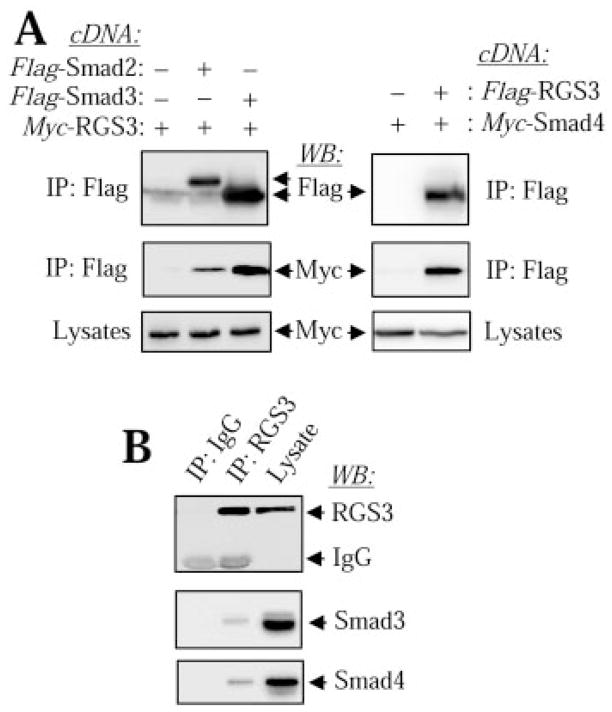
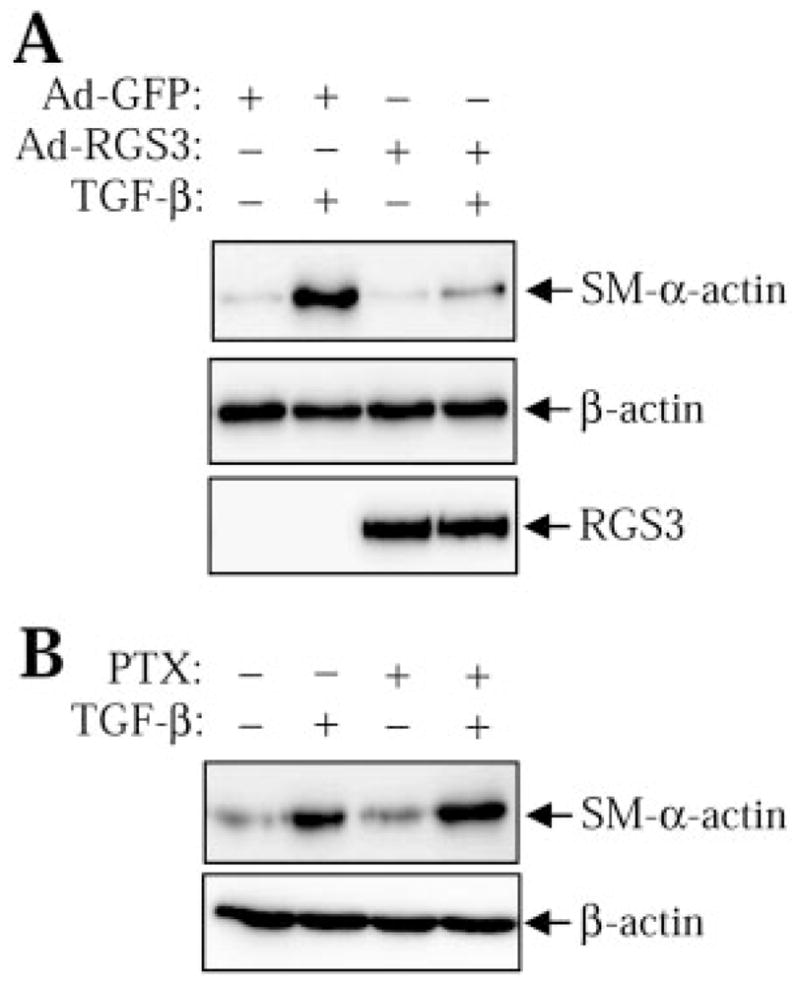
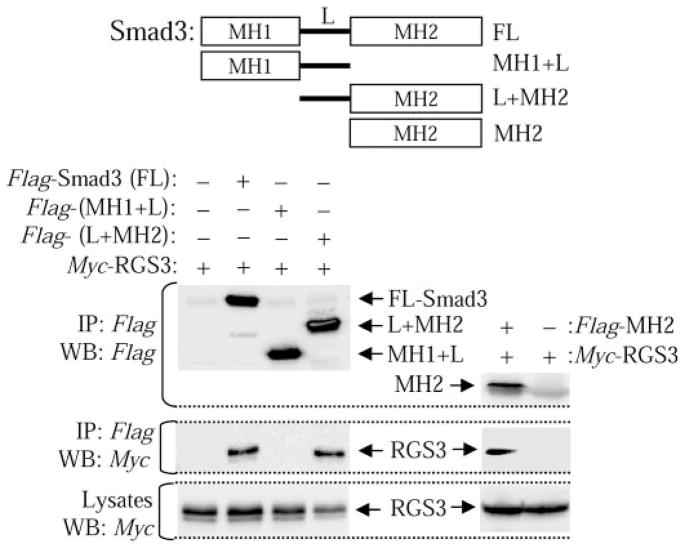
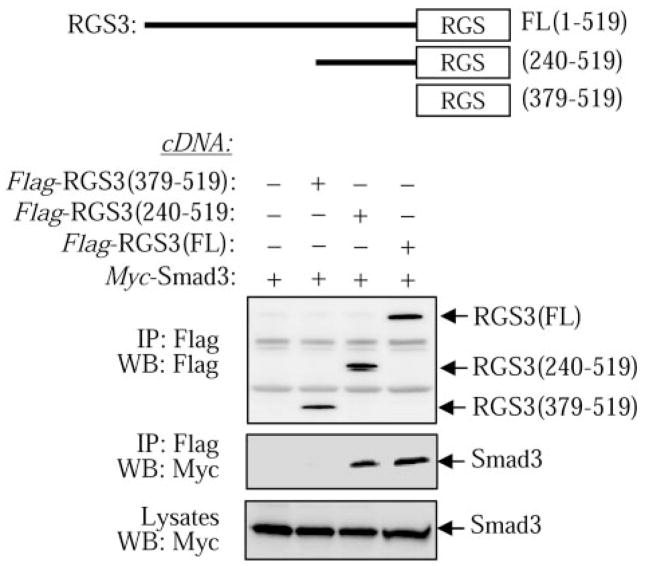
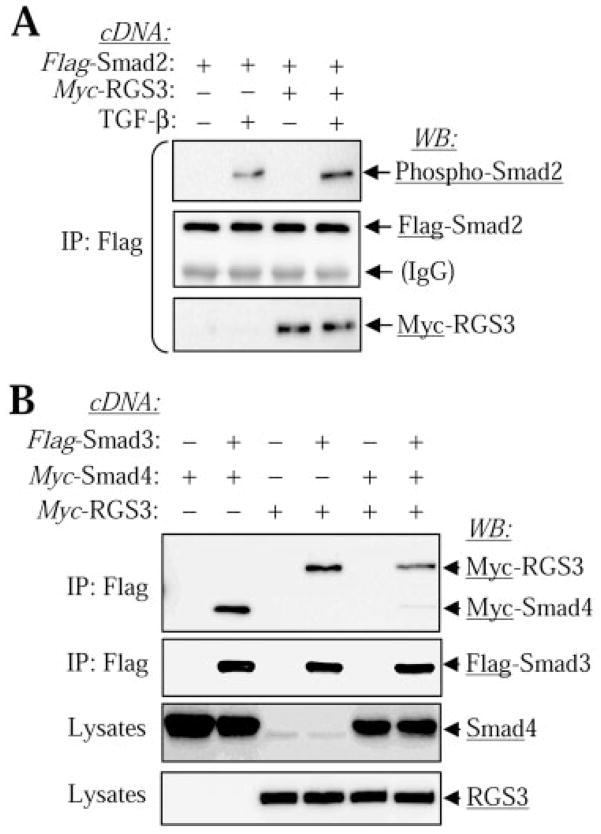
Regulator of G protein signaling (RGS) proteins are united into a family by the presence of the homologous RGS domain that binds the alpha subunits of heterotrimeric G proteins and accelerates their GTPase activity. A member of this family, RGS3 regulates the signaling mediated by G(q) and G(i) proteins by binding the corresponding Galpha subunits. Here we show that RGS3 interacts with the novel partners Smad2, Smad3, and Smad4-the transcription factors that are activated through a transforming growth factor-beta (TGF-beta) receptor signaling. This interaction is mediated by the region of RGS3 outside of the RGS domain and by Smad's Mad homology 2 domain. Overexpression of RGS3 results in inhibition of Smad-mediated gene transcription. RGS3 does not affect TGF-beta-induced Smad phosphorylation, but it prevents heteromerization of Smad3 with Smad4, which is required for transcriptional activity of Smads. This translates to functional inhibition of TGF-beta-induced myofibroblast differentiation by RGS3. In conclusion, this study identifies a novel, noncanonical role of RGS3 in regulation of TGF-beta signaling through its interaction with Smads and interfering with Smad heteromerization.
G蛋白信号调节因子(RGS)蛋白因存在同源的RGS结构域而被归为一个家族,该结构域可结合异源三聚体G蛋白的α亚基并加速其GTP酶活性。这个家族的成员RGS3通过结合相应的Gα亚基来调节由G(q)和G(i)蛋白介导的信号传导。在此我们表明,RGS3与新型伙伴Smad2、Smad3和Smad4相互作用,Smad2、Smad3和Smad4是通过转化生长因子-β(TGF-β)受体信号传导而被激活的转录因子。这种相互作用由RGS结构域之外的RGS3区域以及Smad的Mad同源2结构域介导。RGS3的过表达导致Smad介导的基因转录受到抑制。RGS3不影响TGF-β诱导的Smad磷酸化,但它阻止Smad3与Smad4异源二聚化,而这是Smad转录活性所必需的。这转化为RGS3对TGF-β诱导的成肌纤维细胞分化的功能抑制。总之,本研究通过RGS3与Smads相互作用并干扰Smad异源二聚化,确定了RGS3在调节TGF-β信号传导中的一种新的非经典作用。