Benbrahim-Tallaa Lamia, Waalkes Michael P
Inorganic Carcinogenesis Section, Laboratory of Comparative Carcinogenesis, National Cancer Institute at the National Institute of Environmental Health Sciences, NIH/DHHS, 111 Alexander Drive, Research Triangle Park, NC 27709, USA.
Environ Health Perspect. 2008 Feb;116(2):158-64. doi: 10.1289/ehp.10423.
We critically evaluated the etiologic role of inorganic arsenic in human prostate cancer.
We assessed data from relevant epidemiologic studies concerning environmental inorganic arsenic exposure. Whole animal studies were evaluated as were in vitro model systems of inorganic arsenic carcinogenesis in the prostate.
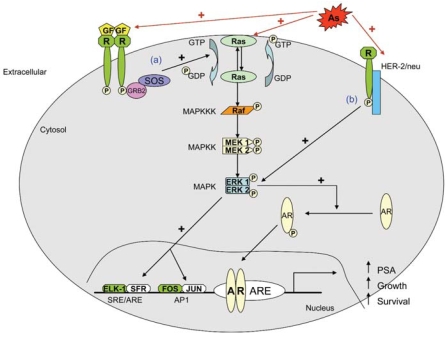
Multiple studies in humans reveal an association between environmental inorganic arsenic exposure and prostate cancer mortality or incidence. Many of these human studies provide clear evidence of a dose-response relationship. Relevant whole animal models showing a relationship between inorganic arsenic and prostate cancer are not available. However, cellular model systems indicate arsenic can induce malignant transformation of human prostate epithelial cells in vitro. Arsenic also appears to impact prostate cancer cell progression by precipitating events leading to androgen independence in vitro.
Available evidence in human populations and human cells in vitro indicates that the prostate is a target for inorganic arsenic carcinogenesis. A role for this common environmental contaminant in human prostate cancer initiation and/or progression would be very important.
我们严格评估了无机砷在人类前列腺癌中的病因学作用。
我们评估了有关环境无机砷暴露的相关流行病学研究数据。对全动物研究以及前列腺无机砷致癌作用的体外模型系统进行了评估。
多项人体研究揭示了环境无机砷暴露与前列腺癌死亡率或发病率之间的关联。这些人体研究中有许多提供了明确的剂量反应关系证据。目前尚无显示无机砷与前列腺癌之间存在关系的相关全动物模型。然而,细胞模型系统表明砷可在体外诱导人前列腺上皮细胞发生恶性转化。砷似乎还通过促成导致体外雄激素非依赖性的事件来影响前列腺癌细胞的进展。
人群和体外人体细胞中的现有证据表明,前列腺是无机砷致癌作用的靶器官。这种常见环境污染物在人类前列腺癌发生和/或进展中的作用将非常重要。