Okada Hideshi, Takemura Genzou, Li Yiwen, Ohno Takamasa, Li Longhu, Maruyama Rumi, Esaki Masayasu, Miyata Shusaku, Kanamori Hiromitsu, Ogino Atsushi, Nakagawa Munehiro, Minatoguchi Shinya, Fujiwara Takako, Fujiwara Hisayoshi
Division of Cardiology, Gifu University Graduate School of Medicine, Gifu, Japan.
J Cell Mol Med. 2008 Aug;12(4):1272-83. doi: 10.1111/j.1582-4934.2008.00294.x. Epub 2008 Feb 24.
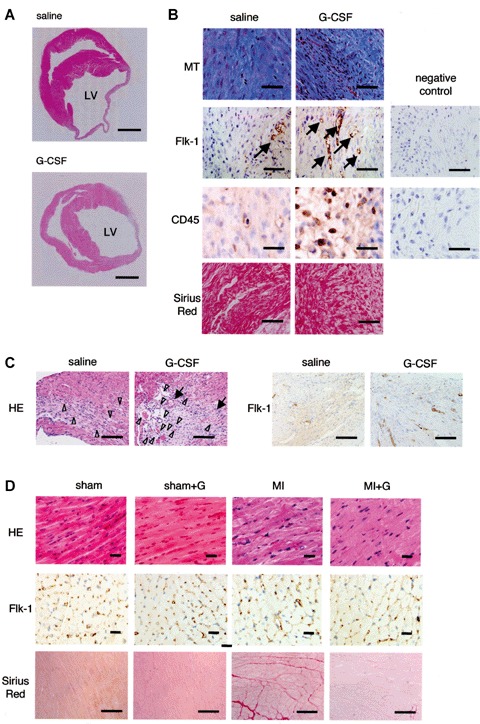
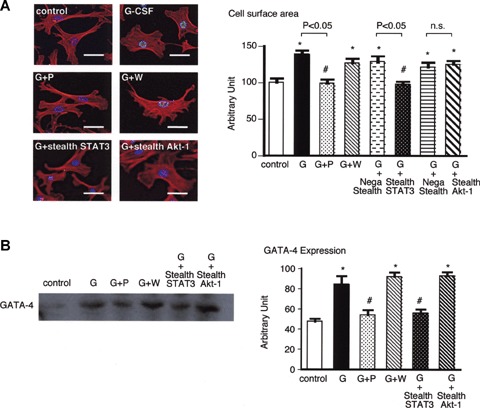
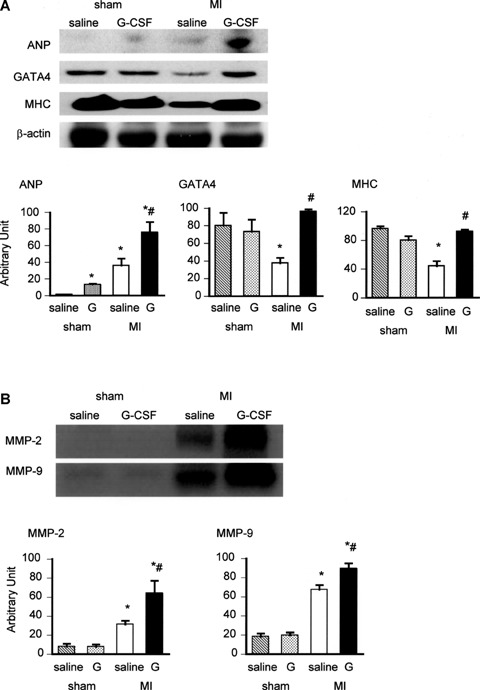
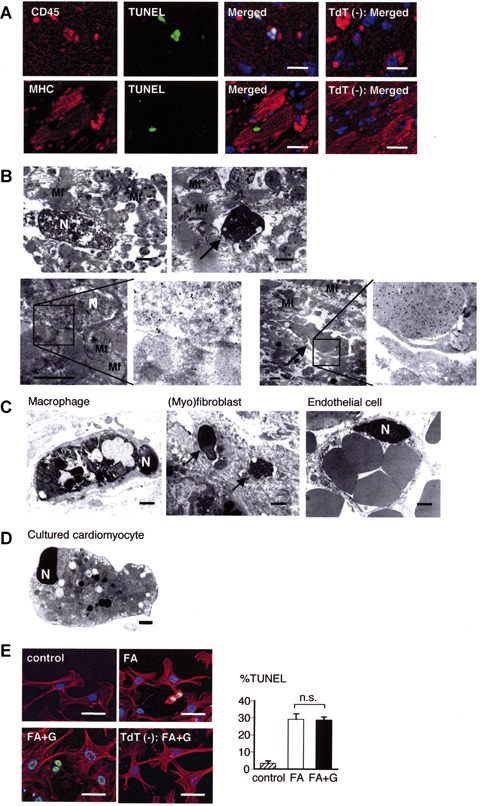
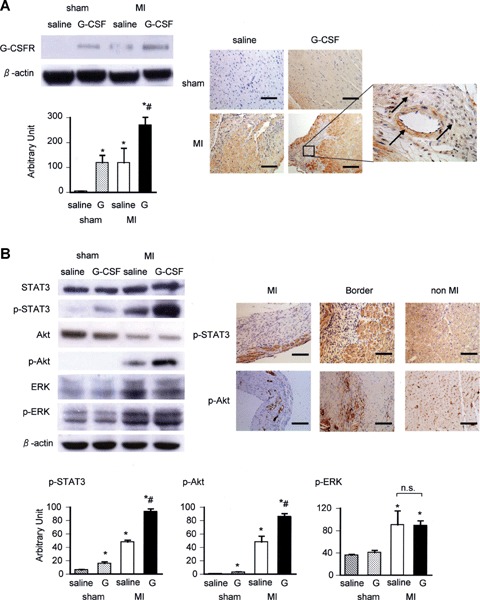
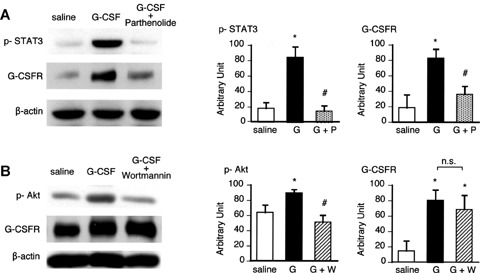
Although beneficial effects of granulocyte colony-stimulating factor (G-CSF) have been demonstrated on post-myocardia infarction (MI) process, the mechanisms and feasibility are not fully agreed yet. We investigated effects of a long-term treatment with a low-dose G-CSF started 1 day after the onset of MI, on post-infarction process. One day after being made MI by left coronary ligation, mice were given G-CSF (10 microg/kg/day) for 4 weeks. The G-CSF treatment resulted in a significant mitigation of cardiac remodelling and dysfunction. In the G-CSF-treated hearts, the infarcted scar was smaller with less fibrosis and abundant vessels while in the non-infarcted area, hypertrophic cardiomyocytes with attenuated degenerative changes and reduced fibrosis were apparent. These effects were accompanied by activation of signal transducer and activator of transcription 3 (STAT3) and Akt and also by up-regulation of GATA-4, myosin heavy chain and matrix metalloproteinases-2 and -9. Apoptosis of cardiomyocytes appeared insignificant at any stages. Parthenolide, a STAT3 inhibitor, completely abolished the beneficial effects of G-CSF on cardiac function and remodelling with loss of effect on both anti-cardiomyocyte degeneration and anti-fibrosis. In contrast, wortmannin, an Akt inhibitor, did not affect G-CSF-induced benefits despite cancelling vessel increase. In conclusion, treatment with G-CSF at a small dose but for a long duration beneficially affects the post-infarction process possibly through STAT3-mediated anti-cardiomyocyte degeneration and anti-fibrosis, but not through anti-cardiomyocyte apoptosis or Akt-mediated angio-genesis. The findings may also imply a more feasible way of G-CSF administration in the clinical settings.
尽管粒细胞集落刺激因子(G-CSF)对心肌梗死后(MI)的进程具有有益作用,但其机制和可行性尚未完全达成共识。我们研究了在心肌梗死发病1天后开始长期低剂量G-CSF治疗对梗死后进程的影响。通过左冠状动脉结扎造成心肌梗死后1天,给予小鼠G-CSF(10微克/千克/天),持续4周。G-CSF治疗显著减轻了心脏重塑和功能障碍。在接受G-CSF治疗的心脏中,梗死瘢痕较小,纤维化较少且血管丰富,而在非梗死区域,肥大的心肌细胞退行性变化减轻且纤维化减少。这些作用伴随着信号转导和转录激活因子3(STAT3)和Akt的激活,以及GATA-4、肌球蛋白重链和基质金属蛋白酶-2和-9的上调。在任何阶段,心肌细胞凋亡均不明显。STAT3抑制剂小白菊内酯完全消除了G-CSF对心脏功能和重塑的有益作用,同时失去了对心肌细胞变性和抗纤维化的作用。相比之下,Akt抑制剂渥曼青霉素尽管消除了血管增加,但并未影响G-CSF诱导的益处。总之,小剂量但长期使用G-CSF治疗可能通过STAT3介导的抗心肌细胞变性和抗纤维化对梗死后进程产生有益影响,但不是通过抗心肌细胞凋亡或Akt介导的血管生成。这些发现也可能暗示了在临床环境中更可行的G-CSF给药方式。