Milenkovic Vladimir M, Langmann Thomas, Schreiber Rainer, Kunzelmann Karl, Weber Bernhard H F
Institute of Human Genetics, University of Regensburg, Regensburg, Germany.
BMC Evol Biol. 2008 Feb 28;8:72. doi: 10.1186/1471-2148-8-72.
Mutations in human bestrophin 1 are associated with at least three autosomal-dominant macular dystrophies including Best disease, adult onset vitelliform macular dystrophy and autosomal dominant vitreo-retinochoroidopathy. The protein is integral to the membrane and is likely involved in Ca2+-dependent transport of chloride ions across cellular membranes. Bestrophin 1 together with its three homologues forms a phylogenetically highly conserved family of proteins.
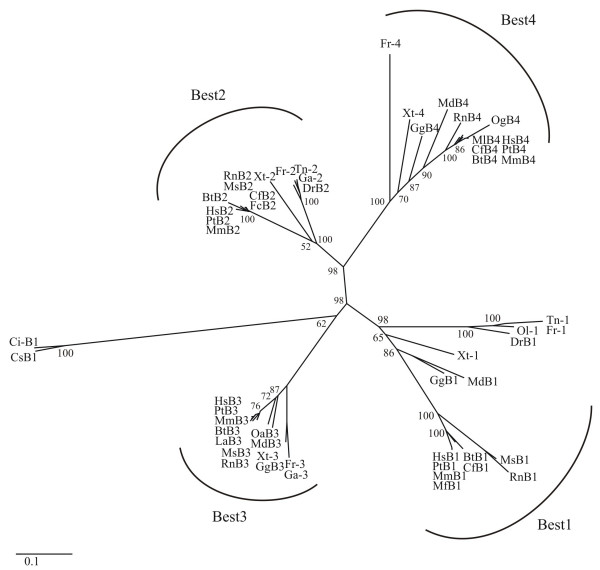
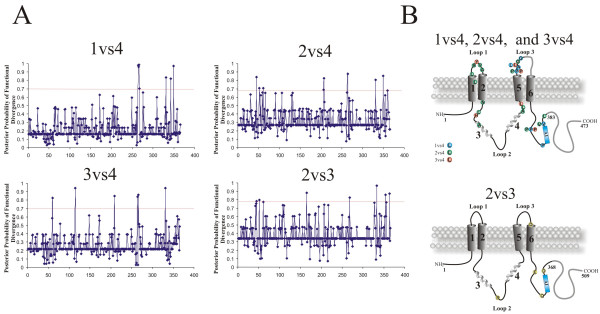
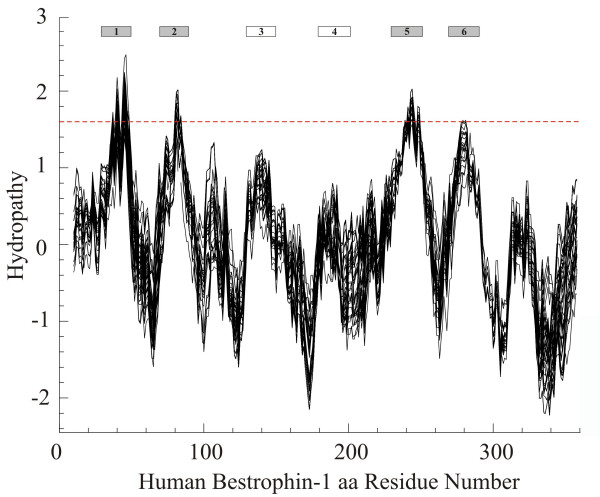
A bioinformatics study was performed to investigate the phylogenetic relationship among the bestrophin family members and to statistically evaluate sequence conservation and functional divergence. Phylogenetic tree assembly with all available eukaryotic bestrophin sequences suggests gene duplication events in the lineage leading to the vertebrates. A common N-terminal topology which includes four highly conserved transmembrane domains is shared by the members of the four paralogous groups of vertebrate bestrophins and has been constrained by purifying selection. Pairwise comparison shows that altered functional constraints have occurred at specific amino acid positions after phylogenetic diversification of the paralogues. Most notably, significant functional divergence was found between bestrophin 4 and the other family members, as well as between bestrophin 2 and bestrophin 3. Site-specific profiles were established by posterior probability analysis revealing significantly divergent clusters mainly in two hydrophilic loops and a region immediately adjacent to the last predicted transmembrane domain. Strikingly, codons 279 and 347 of human bestrophin 4 reveal high divergence when compared to the paralogous positions strongly indicating the functional importance of these residues for the bestrophin 4 protein. None of the functionally divergent amino acids were found to reside within obvious sequences patterns or motifs.
Our study highlights the molecular evolution of the bestrophin family of transmembrane proteins and indicates amino acid residues likely relevant for distinct functional properties of the paralogues. These findings may provide a starting point for further experimental verifications.
人类贝斯特罗芬蛋白1(Bestrophin 1)的突变与至少三种常染色体显性黄斑营养不良相关,包括贝斯特病、成人型卵黄样黄斑营养不良和常染色体显性玻璃体视网膜脉络膜病变。该蛋白是膜的组成部分,可能参与氯离子跨细胞膜的钙依赖性转运。Bestrophin 1与其三个同源物形成了一个在系统发育上高度保守的蛋白家族。
进行了一项生物信息学研究,以调查Bestrophin家族成员之间的系统发育关系,并对序列保守性和功能差异进行统计学评估。用所有可用的真核生物Bestrophin序列构建系统发育树表明,在导致脊椎动物的谱系中发生了基因复制事件。脊椎动物Bestrophin的四个旁系同源组的成员共享一个常见的N端拓扑结构,其中包括四个高度保守的跨膜结构域,并且受到纯化选择的限制。成对比较表明,在旁系同源物系统发育多样化后,特定氨基酸位置发生了功能限制的改变。最显著的是,在Bestrophin 4与其他家族成员之间,以及Bestrophin 2和Bestrophin 3之间发现了显著的功能差异。通过后验概率分析建立了位点特异性图谱,揭示了主要在两个亲水环和紧邻最后一个预测跨膜结构域的区域存在显著不同的簇。引人注目的是,与旁系同源位置相比,人类Bestrophin 4的第279和347密码子显示出高度差异,强烈表明这些残基对Bestrophin 4蛋白具有功能重要性。没有发现功能不同的氨基酸位于明显的序列模式或基序内。
我们的研究突出了跨膜蛋白Bestrophin家族的分子进化,并指出了可能与旁系同源物不同功能特性相关的氨基酸残基。这些发现可能为进一步的实验验证提供一个起点。