Diogo Rui, Hinits Yaniv, Hughes Simon M
MRC Centre for Developmental Neurobiology and Randall Division for Cell and Molecular Biophysics, New Hunt's House, King's College London SE1 1UL, UK.
BMC Dev Biol. 2008 Feb 28;8:24. doi: 10.1186/1471-213X-8-24.
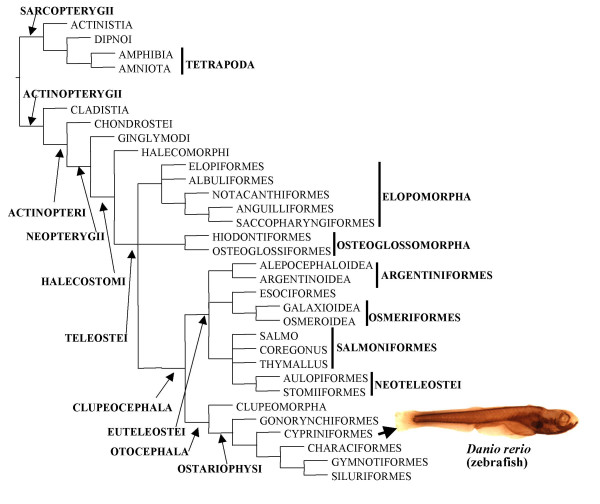
During vertebrate head evolution, muscle changes accompanied radical modification of the skeleton. Recent studies have suggested that muscles and their innervation evolve less rapidly than cartilage. The freshwater teleostean zebrafish (Danio rerio) is the most studied actinopterygian model organism, and is sometimes taken to represent osteichthyans as a whole, which include bony fishes and tetrapods. Most work concerning zebrafish cranial muscles has focused on larval stages. We set out to describe the later development of zebrafish head muscles and compare muscle homologies across the Osteichthyes.
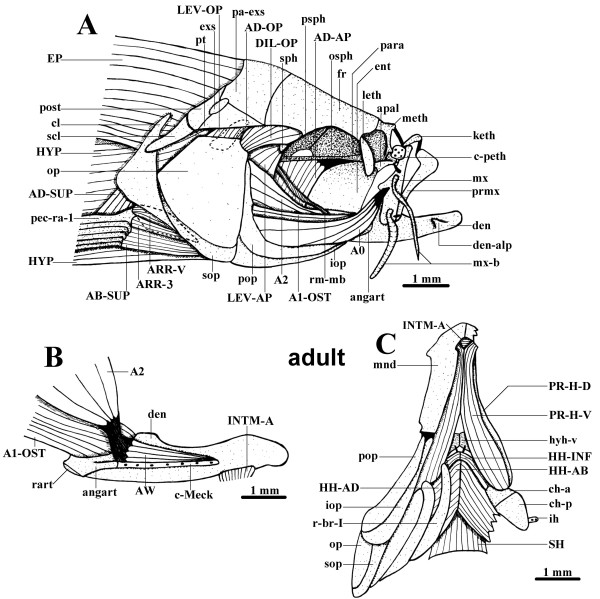
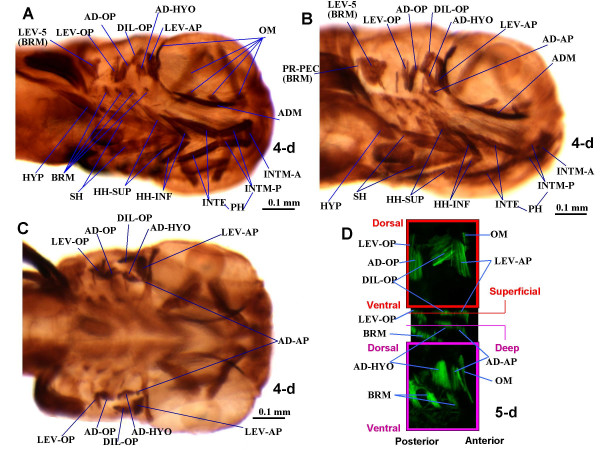
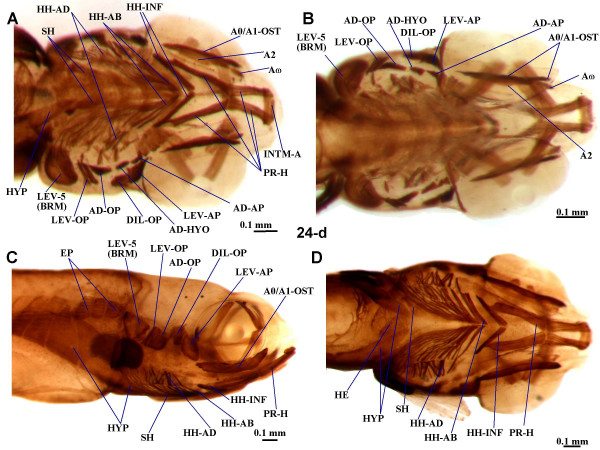
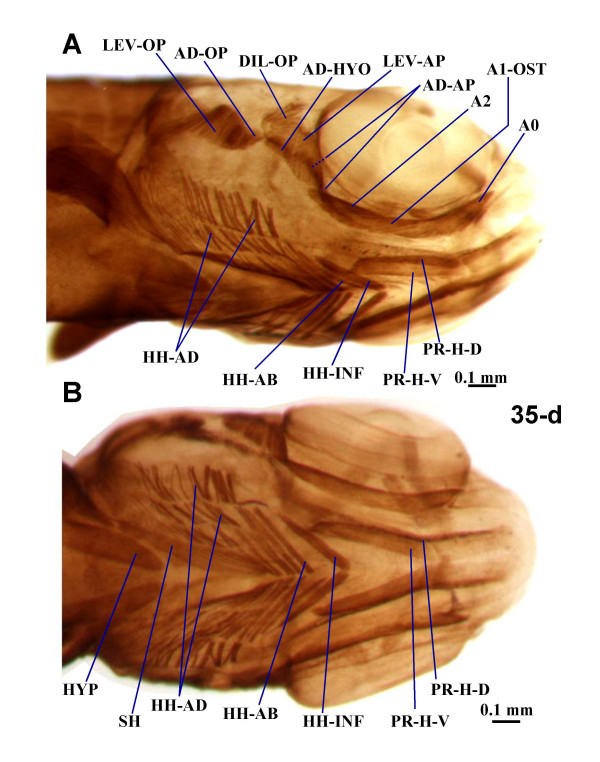
We describe one new muscle and show that the number of mandibular, hyoid and hypobranchial muscles found in four day-old zebrafish larvae is similar to that found in the adult. However, the overall configuration and/or the number of divisions of these muscles change during development. For example, the undivided adductor mandibulae of early larvae gives rise to the adductor mandibulae sections A0, A1-OST, A2 and Aomega, and the protractor hyoideus becomes divided into dorsal and ventral portions in adults. There is not always a correspondence between the ontogeny of these muscles in the zebrafish and their evolution within the Osteichthyes. All of the 13 mandibular, hyoid and hypobranchial muscles present in the adult zebrafish are found in at least some other living teleosts, and all except the protractor hyoideus are found in at least some extant non-teleost actinopterygians. Of these muscles, about a quarter (intermandibularis anterior, adductor mandibulae, sternohyoideus) are found in at least some living tetrapods, and a further quarter (levator arcus palatini, adductor arcus palatini, adductor operculi) in at least some extant sarcopterygian fish.
Although the zebrafish occupies a rather derived phylogenetic position within actinopterygians and even within teleosts, with respect to the mandibular, hyoid and hypobranchial muscles it seems justified to consider it an appropriate representative of these two groups. Among these muscles, the three with clear homologues in tetrapods and the further three identified in sarcopterygian fish are particularly appropriate for comparisons of results between the actinopterygian zebrafish and the sarcopterygians.
在脊椎动物头部进化过程中,肌肉变化伴随着骨骼的剧烈改变。最近的研究表明,肌肉及其神经支配的进化速度比软骨慢。淡水硬骨鱼斑马鱼(Danio rerio)是研究最多的辐鳍鱼模型生物,有时被视为整个硬骨鱼类的代表,硬骨鱼类包括硬骨鱼和四足动物。大多数关于斑马鱼头部肌肉的研究都集中在幼体阶段。我们着手描述斑马鱼头部肌肉的后期发育,并比较硬骨鱼类之间的肌肉同源性。
我们描述了一块新肌肉,并表明在4日龄斑马鱼幼体中发现的下颌、舌骨和鳃下肌肉的数量与成体中发现的数量相似。然而,这些肌肉的整体构型和/或分支数量在发育过程中会发生变化。例如,早期幼体中未分开的下颌收肌会发育为下颌收肌的A0、A1 - OST、A2和Aω部分,而成体中的舌骨前牵肌会分为背侧和腹侧部分。斑马鱼中这些肌肉的个体发育与其在硬骨鱼类中的进化并不总是一致的。成年斑马鱼中存在的所有13块下颌、舌骨和鳃下肌肉在至少一些其他现存硬骨鱼中也有发现,除舌骨前牵肌外,所有这些肌肉在至少一些现存的非硬骨鱼辐鳍鱼中也有发现。在这些肌肉中,约四分之一(前颌间肌、下颌收肌、胸骨舌骨肌)在至少一些现存四足动物中存在,另有四分之一(腭骨提肌、腭骨收肌、鳃盖收肌)在至少一些现存肉鳍鱼中存在。
尽管斑马鱼在辐鳍鱼甚至硬骨鱼中占据了一个较为特化的系统发育位置,但就下颌、舌骨和鳃下肌肉而言,将其视为这两类的合适代表似乎是合理的。在这些肌肉中,在四足动物中有明确同源物的三块肌肉以及在肉鳍鱼中确定的另外三块肌肉特别适合用于比较辐鳍鱼斑马鱼和肉鳍鱼之间的结果。