McKean Kurt A, Yourth Christopher P, Lazzaro Brian P, Clark Andrew G
Department of Biological Sciences, SUNY at Albany, Albany NY 12222, USA.
BMC Evol Biol. 2008 Mar 3;8:76. doi: 10.1186/1471-2148-8-76.
The evolution of disease resistance and immune function may be limited if increased immunocompetence comes at the expense of other fitness-determining traits. Both the maintenance of an immune system and the deployment of an immune response can be costly, and the observed costs may be evaluated as either physiological or evolutionary in origin. Evolutionary costs of immunological maintenance are revealed as negative genetic correlations between immunocompetence and fitness in the absence of infection. Costs of deployment are most often studied as physiological costs associated with immune system induction, however, evolutionary costs of deployment may also be present if genotypes vary in the extent of the physiological cost experienced.
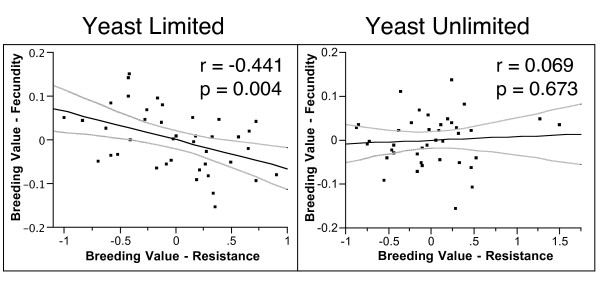
In this study we analyzed evolutionary and physiological costs of immunity in two environments representing food-limited and food-unlimited conditions. Patterns of genetic variation were estimated in females from 40 'hemiclone families' isolated from a population of D. melanogaster. Phenotypes evaluated included fecundity, weight measures at different time periods and resistance to Providencia rettgeri, a naturally occurring Gram-negative pathogen of D. melanogaster. In the food-limited environment we found a negative genetic correlation between fecundity in the absence of infection and resistance, indicative of an evolutionary cost of maintenance. No such correlation was observed in the food-unlimited environment, and the slopes of these correlations significantly differed, demonstrating a genotype-by-environment interaction for the cost of maintenance. Physiological costs of deployment were also observed, but costs were primarily due to wounding. Deployment costs were slightly exaggerated in the food-limited environment. Evolutionary costs of immunological deployment on fecundity were not observed, and there was only marginally significant genetic variation in the cost expressed by changes in dry weight.
Our results suggest that the costs of immunity may be an important factor limiting the evolution of resistance in food-limited environments. However, the significant genotype-by-environment interaction for maintenance costs, combined with the observation that deployment costs were partially mitigated in the food-unlimited environment, emphasizes the importance of considering environmental variation when estimating patterns of genetic variance and covariance, and the dubious nature of predicting evolutionary responses to selection from quantitative genetic estimates carried out in a single environment.
如果免疫能力的增强是以牺牲其他决定适应性的性状为代价,那么抗病性和免疫功能的进化可能会受到限制。维持免疫系统和展开免疫反应都可能代价高昂,而且观察到的这些代价可以从生理或进化起源的角度进行评估。免疫维持的进化代价表现为在无感染情况下免疫能力与适应性之间的负遗传相关性。展开免疫反应的代价通常作为与免疫系统诱导相关的生理代价来研究,然而,如果不同基因型在经历的生理代价程度上存在差异,那么展开免疫反应的进化代价也可能存在。
在本研究中,我们分析了在代表食物受限和食物不受限条件的两种环境中免疫的进化代价和生理代价。从黑腹果蝇种群中分离出40个“半克隆家族”的雌性个体,估计其遗传变异模式。评估的表型包括繁殖力、不同时间段的体重测量值以及对普罗威登斯菌(一种黑腹果蝇天然存在的革兰氏阴性病原体)的抗性。在食物受限环境中,我们发现无感染情况下的繁殖力与抗性之间存在负遗传相关性,这表明存在维持的进化代价。在食物不受限环境中未观察到这种相关性,并且这些相关性的斜率存在显著差异,这表明维持代价存在基因型与环境的相互作用。还观察到了展开免疫反应的生理代价,但代价主要是由于创伤。在食物受限环境中,展开免疫反应的代价略有夸大。未观察到免疫展开对繁殖力的进化代价,并且干重变化所表示的代价中只有略微显著的遗传变异。
我们的结果表明,免疫代价可能是限制食物受限环境中抗性进化的一个重要因素。然而,维持代价存在显著的基因型与环境相互作用,再加上观察到在食物不受限环境中展开免疫反应的代价部分得到缓解,这强调了在估计遗传方差和协方差模式时考虑环境变异的重要性,以及从单一环境中进行的数量遗传学估计预测对选择的进化反应的可疑性质。