• 文献检索
  • 文档翻译
  • 深度研究
  • 学术资讯
  • Suppr Zotero 插件Zotero 插件
  • 邀请有礼
  • 套餐&价格
  • 历史记录
应用&插件
Suppr Zotero 插件Zotero 插件浏览器插件Mac 客户端Windows 客户端微信小程序
定价
高级版会员购买积分包购买API积分包
服务
文献检索文档翻译深度研究API 文档MCP 服务
关于我们
关于 Suppr公司介绍联系我们用户协议隐私条款
关注我们

Suppr 超能文献

核心技术专利:CN118964589B侵权必究
粤ICP备2023148730 号-1Suppr @ 2026

文献检索

告别复杂PubMed语法,用中文像聊天一样搜索,搜遍4000万医学文献。AI智能推荐,让科研检索更轻松。

立即免费搜索

文件翻译

保留排版,准确专业,支持PDF/Word/PPT等文件格式,支持 12+语言互译。

免费翻译文档

深度研究

AI帮你快速写综述,25分钟生成高质量综述,智能提取关键信息,辅助科研写作。

立即免费体验

系统发育树上的生死先验与快速约会。

Birth-death prior on phylogeny and speed dating.

作者信息

Akerborg Orjan, Sennblad Bengt, Lagergren Jens

机构信息

Stockholm Bioinformatics Centre, Albanova, Stockholm University, SE-10691 Stockholm, Sweden.

出版信息

BMC Evol Biol. 2008 Mar 4;8:77. doi: 10.1186/1471-2148-8-77.

DOI:10.1186/1471-2148-8-77
PMID:18318893
原文链接:https://pmc.ncbi.nlm.nih.gov/articles/PMC2270800/
Abstract

BACKGROUND

In recent years there has been a trend of leaving the strict molecular clock in order to infer dating of speciations and other evolutionary events. Explicit modeling of substitution rates and divergence times makes formulation of informative prior distributions for branch lengths possible. Models with birth-death priors on tree branching and auto-correlated or iid substitution rates among lineages have been proposed, enabling simultaneous inference of substitution rates and divergence times. This problem has, however, mainly been analysed in the Markov chain Monte Carlo (MCMC) framework, an approach requiring computation times of hours or days when applied to large phylogenies.

RESULTS

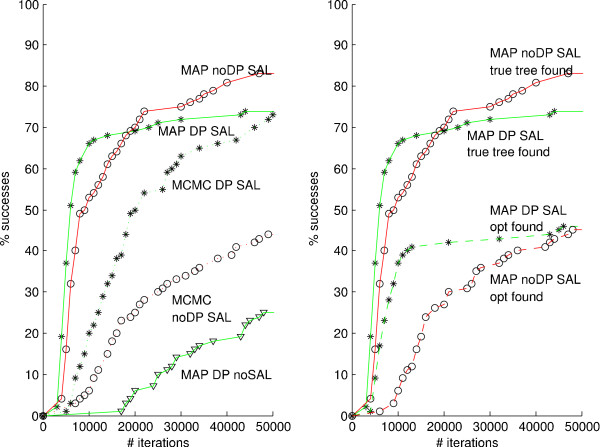
We demonstrate that a hill-climbing maximum a posteriori (MAP) adaptation of the MCMC scheme results in considerable gain in computational efficiency. We demonstrate also that a novel dynamic programming (DP) algorithm for branch length factorization, useful both in the hill-climbing and in the MCMC setting, further reduces computation time. For the problem of inferring rates and times parameters on a fixed tree, we perform simulations, comparisons between hill-climbing and MCMC on a plant rbcL gene dataset, and dating analysis on an animal mtDNA dataset, showing that our methodology enables efficient, highly accurate analysis of very large trees. Datasets requiring a computation time of several days with MCMC can with our MAP algorithm be accurately analysed in less than a minute. From the results of our example analyses, we conclude that our methodology generally avoids getting trapped early in local optima. For the cases where this nevertheless can be a problem, for instance when we in addition to the parameters also infer the tree topology, we show that the problem can be evaded by using a simulated-annealing like (SAL) method in which we favour tree swaps early in the inference while biasing our focus towards rate and time parameter changes later on.

CONCLUSION

Our contribution leaves the field open for fast and accurate dating analysis of nucleotide sequence data. Modeling branch substitutions rates and divergence times separately allows us to include birth-death priors on the times without the assumption of a molecular clock. The methodology is easily adapted to take data from fossil records into account and it can be used together with a broad range of rate and substitution models.

摘要

背景

近年来,出现了一种不再严格依赖分子钟来推断物种形成及其他进化事件时间的趋势。明确地对替换率和分歧时间进行建模,使得为分支长度制定信息丰富的先验分布成为可能。已经提出了在树分支上具有生灭先验以及谱系间自相关或独立同分布替换率的模型,从而能够同时推断替换率和分歧时间。然而,这个问题主要是在马尔可夫链蒙特卡罗(MCMC)框架下进行分析的,当应用于大型系统发育树时,这种方法需要数小时甚至数天的计算时间。

结果

我们证明,对MCMC方案进行爬山最大后验(MAP)调整可显著提高计算效率。我们还证明,一种用于分支长度分解的新型动态规划(DP)算法,在爬山和MCMC设置中都很有用,进一步减少了计算时间。对于在固定树上推断速率和时间参数的问题,我们进行了模拟,在植物rbcL基因数据集上对爬山法和MCMC进行了比较,并在动物线粒体DNA数据集上进行了年代测定分析,结果表明我们的方法能够对非常大的树进行高效、高精度的分析。使用MCMC需要数天计算时间的数据集,通过我们的MAP算法可以在不到一分钟的时间内准确分析。从我们的示例分析结果来看,我们得出结论,我们的方法通常能避免过早陷入局部最优。对于那些仍然可能出现这个问题的情况,例如当我们除了参数之外还推断树拓扑结构时,我们表明可以通过使用一种类似模拟退火(SAL)的方法来规避这个问题,在这种方法中,我们在推断早期倾向于树的交换,而在后期将重点偏向于速率和时间参数的变化。

结论

我们的贡献为核苷酸序列数据的快速准确年代测定分析开辟了道路。分别对分支替换率和分歧时间进行建模,使我们能够在不假设分子钟的情况下纳入关于时间的生灭先验。该方法很容易调整以考虑化石记录中的数据,并且可以与广泛的速率和替换模型一起使用。
https://cdn.ncbi.nlm.nih.gov/pmc/blobs/1492/2270800/ff7ef45fa8aa/1471-2148-8-77-6.jpg
https://cdn.ncbi.nlm.nih.gov/pmc/blobs/1492/2270800/6259adc903d4/1471-2148-8-77-1.jpg
https://cdn.ncbi.nlm.nih.gov/pmc/blobs/1492/2270800/c7917b11f06e/1471-2148-8-77-2.jpg
https://cdn.ncbi.nlm.nih.gov/pmc/blobs/1492/2270800/156c4be616dc/1471-2148-8-77-3.jpg
https://cdn.ncbi.nlm.nih.gov/pmc/blobs/1492/2270800/5356d943e377/1471-2148-8-77-4.jpg
https://cdn.ncbi.nlm.nih.gov/pmc/blobs/1492/2270800/f271ba40ff9f/1471-2148-8-77-5.jpg
https://cdn.ncbi.nlm.nih.gov/pmc/blobs/1492/2270800/ff7ef45fa8aa/1471-2148-8-77-6.jpg
https://cdn.ncbi.nlm.nih.gov/pmc/blobs/1492/2270800/6259adc903d4/1471-2148-8-77-1.jpg
https://cdn.ncbi.nlm.nih.gov/pmc/blobs/1492/2270800/c7917b11f06e/1471-2148-8-77-2.jpg
https://cdn.ncbi.nlm.nih.gov/pmc/blobs/1492/2270800/156c4be616dc/1471-2148-8-77-3.jpg
https://cdn.ncbi.nlm.nih.gov/pmc/blobs/1492/2270800/5356d943e377/1471-2148-8-77-4.jpg
https://cdn.ncbi.nlm.nih.gov/pmc/blobs/1492/2270800/f271ba40ff9f/1471-2148-8-77-5.jpg
https://cdn.ncbi.nlm.nih.gov/pmc/blobs/1492/2270800/ff7ef45fa8aa/1471-2148-8-77-6.jpg

相似文献

1
Birth-death prior on phylogeny and speed dating.系统发育树上的生死先验与快速约会。
BMC Evol Biol. 2008 Mar 4;8:77. doi: 10.1186/1471-2148-8-77.
2
Bayesian dating of shallow phylogenies with a relaxed clock.使用松弛时钟对浅系谱进行贝叶斯日期推断。
Syst Biol. 2010 Mar;59(2):119-31. doi: 10.1093/sysbio/syp082. Epub 2009 Dec 10.
3
Dating phylogenies with sequentially sampled tips.基于顺序采样枝点的亲缘关系推断。
Syst Biol. 2013 Sep;62(5):674-88. doi: 10.1093/sysbio/syt030. Epub 2013 Apr 28.
4
Bayesian random local clocks, or one rate to rule them all.贝叶斯随机局部时钟,或一统天下的单一速率。
BMC Biol. 2010 Aug 31;8:114. doi: 10.1186/1741-7007-8-114.
5
Approximate likelihood calculation on a phylogeny for Bayesian estimation of divergence times.基于贝叶斯估计分歧时间的系统发育近似似然计算。
Mol Biol Evol. 2011 Jul;28(7):2161-72. doi: 10.1093/molbev/msr045. Epub 2011 Feb 10.
6
Characterization of the uncertainty of divergence time estimation under relaxed molecular clock models using multiple loci.利用多个基因座在宽松分子钟模型下对分歧时间估计的不确定性进行表征。
Syst Biol. 2015 Mar;64(2):267-80. doi: 10.1093/sysbio/syu109. Epub 2014 Dec 11.
7
Improving the performance of Bayesian phylogenetic inference under relaxed clock models.提高松弛时钟模型下贝叶斯系统发育推断的性能。
BMC Evol Biol. 2020 May 14;20(1):54. doi: 10.1186/s12862-020-01609-4.
8
Inferring speciation times under an episodic molecular clock.基于间歇性分子钟推断物种形成时间。
Syst Biol. 2007 Jun;56(3):453-66. doi: 10.1080/10635150701420643.
9
Adaptive dating and fast proposals: Revisiting the phylogenetic relaxed clock model.自适应约会和快速提议:重新审视系统发生钟模型。
PLoS Comput Biol. 2021 Feb 2;17(2):e1008322. doi: 10.1371/journal.pcbi.1008322. eCollection 2021 Feb.
10
Bayesian coestimation of phylogeny and sequence alignment.系统发育与序列比对的贝叶斯联合估计
BMC Bioinformatics. 2005 Apr 1;6:83. doi: 10.1186/1471-2105-6-83.

引用本文的文献

1
Bayesian Phylogenetic Inference using Relaxed-clocks and the Multispecies Coalescent.贝叶斯系统发育推断使用松弛时钟和多物种 coalescent。
Mol Biol Evol. 2022 Aug 3;39(8). doi: 10.1093/molbev/msac161.
2
Log Transformation Improves Dating of Phylogenies.对数转换可改善系统发育树的定年。
Mol Biol Evol. 2021 Mar 9;38(3):1151-1167. doi: 10.1093/molbev/msaa222.
3
Megaphylogeny resolves global patterns of mushroom evolution.巨系统发生学解析了蘑菇进化的全球模式。

本文引用的文献

1
A general comparison of relaxed molecular clock models.松弛分子钟模型的一般比较。
Mol Biol Evol. 2007 Dec;24(12):2669-80. doi: 10.1093/molbev/msm193. Epub 2007 Sep 21.
2
Inferring speciation times under an episodic molecular clock.基于间歇性分子钟推断物种形成时间。
Syst Biol. 2007 Jun;56(3):453-66. doi: 10.1080/10635150701420643.
3
Relaxed phylogenetics and dating with confidence.轻松的系统发育学与可靠的年代测定。
Nat Ecol Evol. 2019 Apr;3(4):668-678. doi: 10.1038/s41559-019-0834-1. Epub 2019 Mar 18.
4
The combinatorics of discrete time-trees: theory and open problems.离散时间树的组合学:理论与开放问题
J Math Biol. 2018 Apr;76(5):1101-1121. doi: 10.1007/s00285-017-1167-9. Epub 2017 Jul 29.
5
Advances in Time Estimation Methods for Molecular Data.分子数据时间估计方法的进展
Mol Biol Evol. 2016 Apr;33(4):863-9. doi: 10.1093/molbev/msw026. Epub 2016 Feb 16.
6
Fast Dating Using Least-Squares Criteria and Algorithms.使用最小二乘准则和算法的快速匹配
Syst Biol. 2016 Jan;65(1):82-97. doi: 10.1093/sysbio/syv068. Epub 2015 Sep 30.
7
On the age of eukaryotes: evaluating evidence from fossils and molecular clocks.真核生物的时代:从化石和分子钟证据评估。
Cold Spring Harb Perspect Biol. 2014 Aug 1;6(8):a016139. doi: 10.1101/cshperspect.a016139.
8
Efficient exploration of the space of reconciled gene trees.高效探索协调基因树空间。
Syst Biol. 2013 Nov;62(6):901-12. doi: 10.1093/sysbio/syt054. Epub 2013 Aug 6.
9
Simultaneous Bayesian gene tree reconstruction and reconciliation analysis.同时进行贝叶斯基因树重建与和解分析。
Proc Natl Acad Sci U S A. 2009 Apr 7;106(14):5714-9. doi: 10.1073/pnas.0806251106. Epub 2009 Mar 19.
PLoS Biol. 2006 May;4(5):e88. doi: 10.1371/journal.pbio.0040088. Epub 2006 Mar 14.
4
Bayesian estimation of species divergence times under a molecular clock using multiple fossil calibrations with soft bounds.使用具有软边界的多个化石校准,在分子钟下对物种分化时间进行贝叶斯估计。
Mol Biol Evol. 2006 Jan;23(1):212-26. doi: 10.1093/molbev/msj024. Epub 2005 Sep 21.
5
Estimating divergence times in phylogenetic trees without a molecular clock.在没有分子钟的情况下估计系统发育树中的分歧时间。
Syst Biol. 2005 Jun;54(3):500-7. doi: 10.1080/10635150590947311.
6
Branch-length prior influences Bayesian posterior probability of phylogeny.分支长度先验影响系统发育的贝叶斯后验概率。
Syst Biol. 2005 Jun;54(3):455-70. doi: 10.1080/10635150590945313.
7
Divergence dates for Malagasy lemurs estimated from multiple gene loci: geological and evolutionary context.根据多个基因位点估计的马达加斯加狐猴的分化时间:地质与进化背景
Mol Ecol. 2004 Apr;13(4):757-73. doi: 10.1046/j.1365-294x.2004.02106.x.
8
A simple, fast, and accurate algorithm to estimate large phylogenies by maximum likelihood.一种通过最大似然法估计大型系统发育树的简单、快速且准确的算法。
Syst Biol. 2003 Oct;52(5):696-704. doi: 10.1080/10635150390235520.
9
Bayesian gene/species tree reconciliation and orthology analysis using MCMC.使用马尔可夫链蒙特卡罗方法进行贝叶斯基因/物种树和解与直系同源分析。
Bioinformatics. 2003;19 Suppl 1:i7-15. doi: 10.1093/bioinformatics/btg1000.
10
Effects of models of rate evolution on estimation of divergence dates with special reference to the metazoan 18S ribosomal RNA phylogeny.速率进化模型对分歧时间估计的影响,特别参考后生动物18S核糖体RNA系统发育
Syst Biol. 2002 Oct;51(5):703-14. doi: 10.1080/10635150290102375.