Li Feifeng, Wang Shuzhen, Gao Chang, Liu Shiguo, Zhao Baojian, Zhang Meng, Huang Shangzhi, Zhu Siquan, Ma Xu
Graduate School, Peking Union Medical College, Beijing, China.
Mol Vis. 2008 Mar 4;14:378-86.
We sought to identify the genetic defect in a four-generation Chinese family with autosomal dominant congenital coralliform cataracts and demonstrate the functional analysis of a candidate gene in the family.
Family history data were recorded. Clinical and ophthalmologic examinations were performed on affected and unaffected family members. All the members were genotyped with microsatellite markers at loci considered to be associated with cataracts. Two-point LOD scores were calculated using the Linkage software after genotyping. A mutation was detected by direct sequencing, using gene-specific primers. Wild-type and mutant proteins were analyzed with online software.
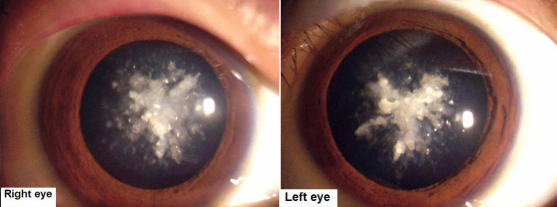
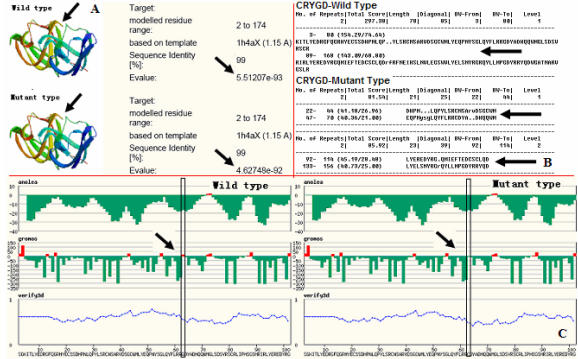
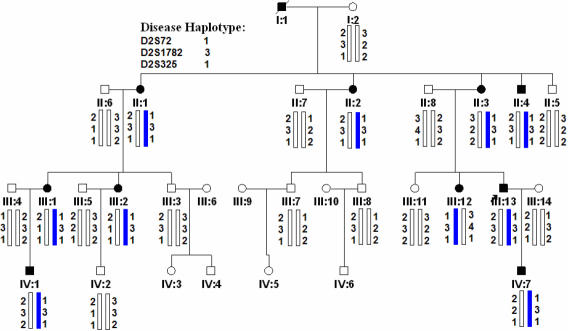
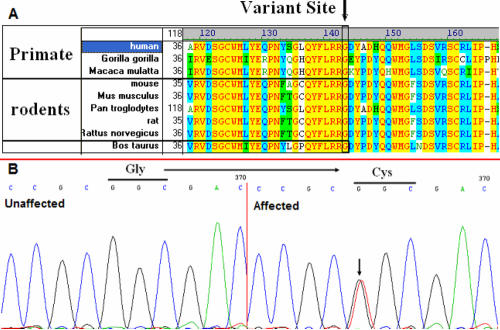
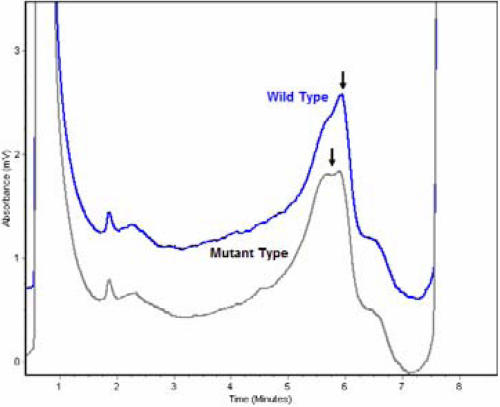
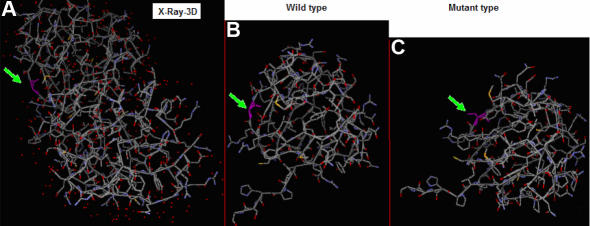
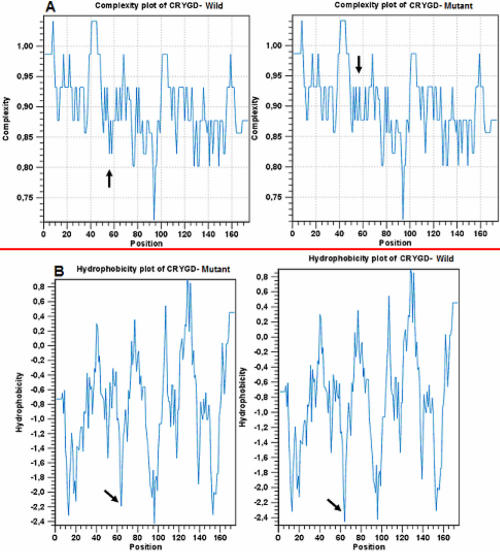
Affected members of this family had coralliform cataracts. Linkage analysis was obtained at markers, D2S72 (LOD score [Z]=3.31, recombination fraction [theta]=0.0) and D2S1782 (Z=3.01, theta=0.0). Haplotype analysis indicated that the cataract gene was closely linked to these two markers. Sequencing the gammaD-crystallin gene (CRYGD) revealed a G>T transversion in exon 2, which caused a conservative substitution of Gly to Cys at codon 61 (P.G61C). This mutation co-segregated with the disease phenotype in all affected individuals and was not observed in any of the unaffected or 100 normal, unrelated individuals. Bioinformatic analyses showed that a highly conserved region was located around Gly61. Data generated with online software revealed that the mutation altered the protein's stability, solvent-accessibility, and interactions with other proteins.
This is the first reported case of a congenital coralliform cataract phenotype associated with the mutation of Gly61Cys (P.G61C) in the CRYGD gene; it demonstrates a possible mechanism of action for the mutant gene.
我们试图确定一个四代中国家系中常染色体显性遗传性先天性珊瑚状白内障的基因缺陷,并对该家系中的一个候选基因进行功能分析。
记录家族史数据。对患病和未患病的家庭成员进行临床和眼科检查。使用被认为与白内障相关位点的微卫星标记对所有成员进行基因分型。基因分型后,使用Linkage软件计算两点连锁分析的对数优势(LOD)分数。使用基因特异性引物通过直接测序检测突变。利用在线软件分析野生型和突变型蛋白质。
该家系的患病成员患有珊瑚状白内障。在标记D2S72(LOD分数[Z]=3.31,重组率[θ]=0.0)和D2S1782(Z=3.01,θ=0.0)处获得连锁分析结果。单倍型分析表明,白内障基因与这两个标记紧密连锁。对γD-晶状体蛋白基因(CRYGD)进行测序,发现在外显子2中有一个G>T的颠换,导致第61位密码子处的甘氨酸保守替换为半胱氨酸(P.G61C)。该突变在所有患病个体中与疾病表型共分离,在任何未患病个体或100名正常无关个体中均未观察到。生物信息学分析表明,高度保守区域位于甘氨酸61周围。在线软件生成的数据显示,该突变改变了蛋白质的稳定性、溶剂可及性以及与其他蛋白质的相互作用。
这是首次报道的与CRYGD基因中甘氨酸61半胱氨酸(P.G61C)突变相关的先天性珊瑚状白内障表型病例;它证明了突变基因可能的作用机制。