Chambers T J, Grakoui A, Rice C M
Department of Molecular Microbiology, Washington University School of Medicine, St. Louis, Missouri 63110-1093.
J Virol. 1991 Nov;65(11):6042-50. doi: 10.1128/JVI.65.11.6042-6050.1991.
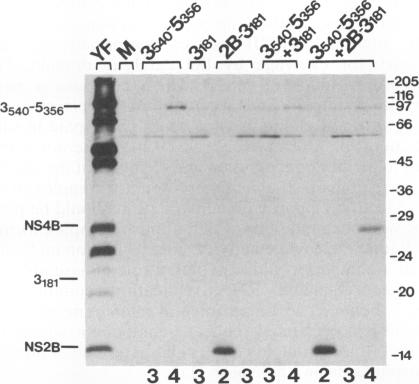
The vaccinia virus-T7 transient expression system was used to further examine the role of the NS3 proteinase in processing of the yellow fever (YF) virus nonstructural polyprotein in BHK cells. YF virus-specific polyproteins and cleavage products were identified by immunoprecipitation with region-specific antisera, by size, and by comparison with authentic YF virus polypeptides. A YF virus polyprotein initiating with a signal sequence derived from the E protein fused to the N terminus of NS2A and extending through the N-terminal 356 amino acids of NS5 exhibited processing at the 2A-2B, 2B-3, 3-4A, 4A-4B, and 4B-5 cleavage sites. Similar results were obtained with polyproteins whose N termini began within NS2A (position 110) or with NS2B. When the NS3 proteinase domain was inactivated by replacing the proposed catalytic Ser-138 with Ala, processing at all sites was abolished. The results suggest that an active NS3 proteinase domain is necessary for cleavage at the diabasic nonstructural cleavage sites and that cleavage at the proposed 4A-4B signalase site requires prior cleavage at the 4B-5 site. Cleavages were not observed with a polyprotein whose N terminus began with NS3, but cleavage at the 4B-5 site could be restored by supplying the the NS2B protein in trans. Several experimental results suggested that trans cleavage at the 4B-5 site requires association of NS2B and the NS3 proteinase domain. Coexpression of different proteinases and catalytically inactive polyprotein substrates revealed that trans cleavage at the 2B-3 and 4B-5 sites was relatively efficient when compared with trans cleavage at the 2A-2B and 3-4A sites.
痘苗病毒-T7瞬时表达系统被用于进一步研究NS3蛋白酶在BHK细胞中对黄热病毒非结构多聚蛋白加工过程中的作用。通过用区域特异性抗血清进行免疫沉淀、根据大小以及与真实黄热病毒多肽进行比较,鉴定了黄热病毒特异性多聚蛋白和裂解产物。一种起始于源自E蛋白的信号序列、与NS2A的N末端融合并延伸至NS5的N末端356个氨基酸的黄热病毒多聚蛋白,在2A-2B、2B-3、3-4A、4A-4B和4B-5裂解位点处发生了加工。对于N末端始于NS2A(第110位)或始于NS2B的多聚蛋白,也获得了类似结果。当通过将假定的催化性丝氨酸-138替换为丙氨酸而使NS3蛋白酶结构域失活时,所有位点的加工均被消除。结果表明,活性NS3蛋白酶结构域对于在双碱性非结构裂解位点处的裂解是必需的,并且在假定的4A-4B信号酶位点处的裂解需要先在4B-5位点处进行裂解。对于一种N末端始于NS3的多聚蛋白未观察到裂解,但通过反式提供NS2B蛋白可恢复在4B-5位点处的裂解。若干实验结果表明,在4B-5位点处的反式裂解需要NS2B与NS3蛋白酶结构域的结合。不同蛋白酶与催化无活性的多聚蛋白底物的共表达显示,与在2A-2B和3-4A位点处的反式裂解相比,在2B-3和4B-5位点处的反式裂解相对有效。