Alonso-Rodríguez Noelia, Martínez-Lirola Miguel, Herránz Marta, Sanchez-Benitez Marisa, Barroso Pilar, Bouza Emilio, García de Viedma Darío
Servicio de Microbiología y Enfermedades Infecciosas, Hospital Gregorio Marañón, Universidad Complutense, Madrid, CIBER de Enfermedades Respiratorias (CIBERES), Spain.
BMC Microbiol. 2008 Feb 24;8:34. doi: 10.1186/1471-2180-8-34.
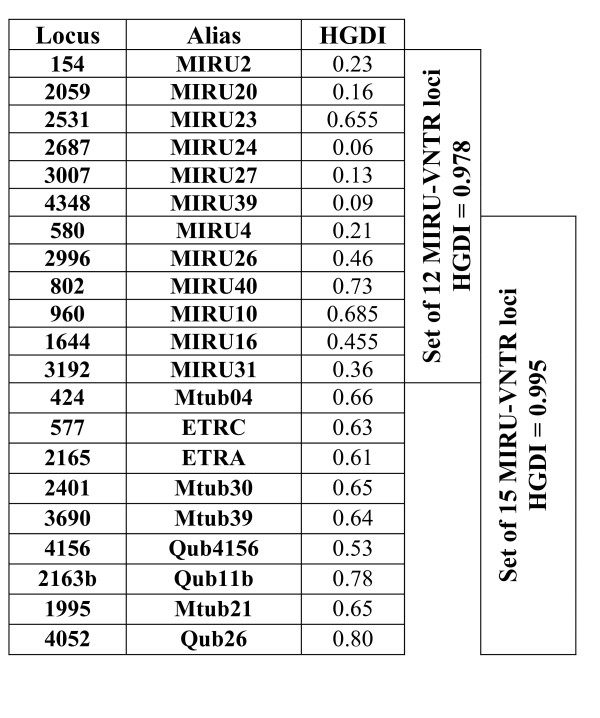
During the last few years, PCR-based methods have been developed to simplify and reduce the time required for genotyping Mycobacterium tuberculosis (MTB) by standard approaches based on IS6110-Restriction Fragment Length Polymorphism (RFLP). Of these, MIRU-12-VNTR (Mycobacterial interspersed repetitive units- variable number of tandem repeats) (MIRU-12) has been considered a good alternative. Nevertheless, some limitations and discrepancies with RFLP, which are minimized if the technique is complemented with spoligotyping, have been found. Recently, a new version of MIRU-VNTR targeting 15 loci (MIRU-15) has been proposed to improve the MIRU-12 format.
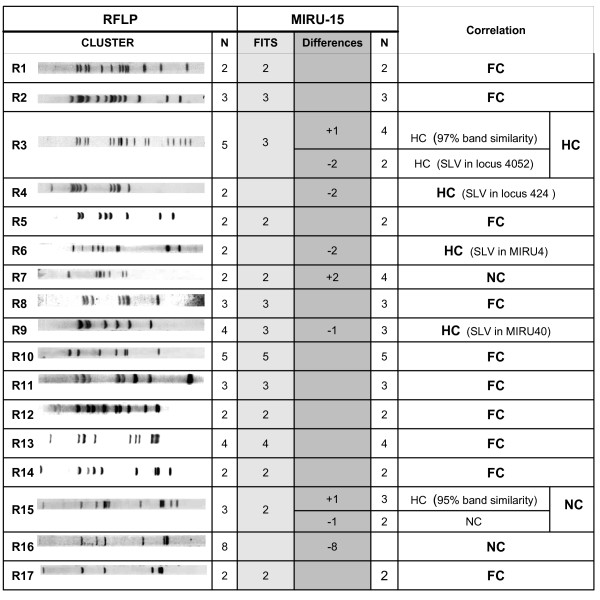
We evaluated the new MIRU-15 tool in two different samples. First, we analyzed the same convenience sample that had been used to evaluate MIRU-12 in a previous study, and the new 15-loci version offered higher discriminatory power (Hunter-Gaston discriminatory index [HGDI]: 0.995 vs 0.978; 34.4% of clustered cases vs 57.5%) and better correlation (full or high correlation with RFLP for 82% of the clusters vs 47%). Second, we evaluated MIRU-15 on a population-based sample and, once again, good correlation with the RFLP clustering data was observed (for 83% of the RFLP clusters). To understand the meaning of the discrepancies still found between MIRU-15 and RFLP, we analyzed the epidemiological data for the clustered patients. In most cases, splitting of RFLP-clustered patients by MIRU-15 occurred for those without epidemiological links, and RFLP-clustered patients with epidemiological links were also clustered by MIRU-15, suggesting a good epidemiological background for clustering defined by MIRU-15.
The data obtained by MIRU-15 suggest that the new design is very efficient at assigning clusters confirmed by epidemiological data. If we add this to the speed with which it provides results, MIRU-15 could be considered a suitable tool for real-time genotyping.
在过去几年中,已开发出基于聚合酶链反应(PCR)的方法,以简化基于IS6110 - 限制性片段长度多态性(RFLP)的标准方法对结核分枝杆菌(MTB)进行基因分型所需的时间并缩短时间。其中,间隔寡核苷酸重复序列 - 可变数目串联重复序列(MIRU)-12被认为是一个很好的替代方法。然而,已发现与RFLP存在一些局限性和差异,如果该技术与间隔寡核苷酸分型法互补,则这些局限性和差异会最小化。最近,有人提出了一种针对15个位点的新型MIRU - VNTR(MIRU - 15),以改进MIRU - 12格式。
我们在两个不同的样本中评估了新型MIRU - 15工具。首先,我们分析了先前研究中用于评估MIRU - 12的同一个便利样本,新的15位点版本具有更高的鉴别力(Hunter - Gaston鉴别指数[HGDI]:0.995对0.978;聚集病例的34.4%对57.5%)和更好的相关性(82%的聚类与RFLP完全或高度相关,而之前为47%)。其次,我们在一个基于人群的样本上评估了MIRU - 15,再次观察到与RFLP聚类数据有良好的相关性(83%的RFLP聚类)。为了理解MIRU - 15与RFLP之间仍然存在的差异的含义,我们分析了聚集患者的流行病学数据。在大多数情况下,MIRU - 15对RFLP聚类患者的划分发生在那些没有流行病学关联的患者中,而具有流行病学关联的RFLP聚类患者也被MIRU - 15聚类,这表明MIRU - 15定义的聚类具有良好的流行病学背景。
MIRU - 15获得的数据表明,新设计在分配经流行病学数据证实的聚类方面非常有效。如果再加上它提供结果的速度,MIRU - 15可被认为是实时基因分型的合适工具。