Ali Asho, Hasan Zahra, Tanveer Mahnaz, Siddiqui Amna R, Ghebremichael Solomon, Kallenius Gunilla, Hasan Rumina
Department of Pathology and Microbiology, The Aga Khan University, Stadium Road, PO Box 3500, Karachi, Pakistan.
BMC Microbiol. 2007 Aug 9;7:76. doi: 10.1186/1471-2180-7-76.
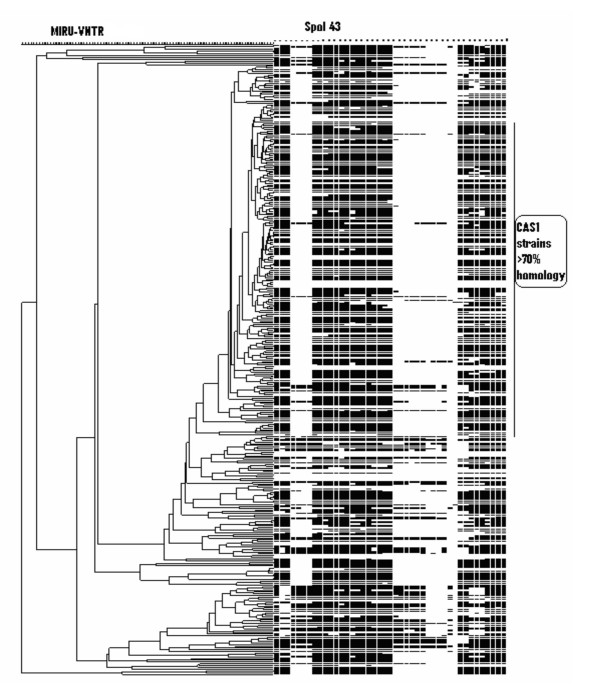
The Central Asian Strain 1 (CAS1) genogroup of Mycobacterium tuberculosis (MTB) is the most prevalent in Pakistan, India and Bangladesh. Mycobacterial interspersed repetitive units variable number tandem repeat (MIRU-VNTR) typing is a reliable and reproducible method for differentiation of MTB isolates. However, information of its utility in determining the diversity of CAS1 strain is limited. We performed standard 12 loci based MIRU-VNTR typing on previously spoligotyped CAS1 strains and 'unique' strains in order to evaluate its discriminatory power for these isolates.
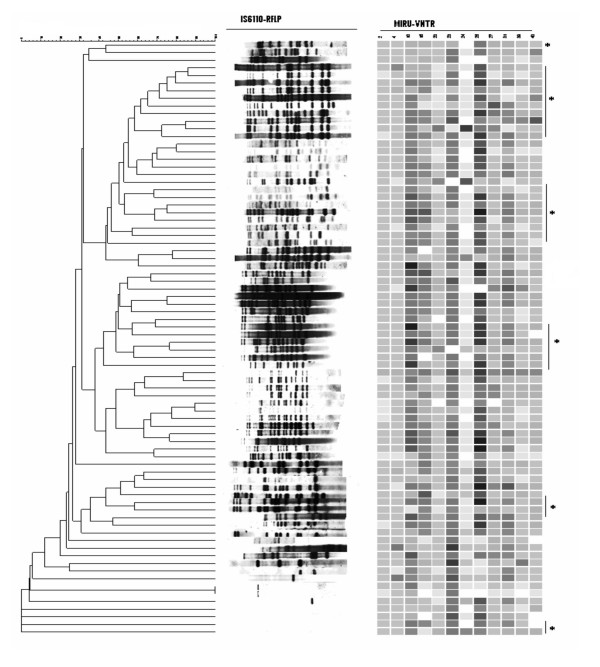
Twelve loci based MIRU- VNTR typing was used to type 178 CAS1 and 189 'unique' MTB strains. The discriminatory index for each of the loci was calculated using the Hunter Gaston Discriminatory Index (HGDI). A subset of these strains (n = 78) were typed using IS6110 restriction fragment length polymorphism (RFLP). MIRU-VNTR profiles were studied together with their drug susceptibility patterns.
A total of 349 MIRU patterns were obtained for the 367 strains tested. The CAS1 strains were subdivided into 160 distinct patterns; 15 clusters of 2 strains each, 1 cluster of four strains and 144 unique patterns. Using HGDI, seven MIRU loci, (numbers 26, 31, 27, 16, 10, 39, and 40) were found to be "highly discriminatory" (DI: >or=0.6), four MIRU loci (numbers 20, 24, 23, and 4) were "moderately discriminatory" (DI: 0.3-0.59), and one locus (number 2) was "poorly discriminatory" (DI< 0.3). Loci 26 and 31 were the most discriminatory for the CAS1 isolates. Amongst 'unique' strains in addition to loci 26, 31, 27, 16, 10, 39, and 40, locus 23 was highly discriminatory, while no locus was poorly discriminating. DI values for loci 4, 10 and 26 were significantly lower (P-value < .01) in CAS1 strains than in 'unique' strains. The association between CAS1 strains and MDR was not found to be significant (p value = 0.21).
We propose that MIRU typing could be used to estimate the phylogenetic relatedness amongst prevalent CAS1 strains, for which MIRU loci 26, 31, 16, 10, 27, 39 and 40 were found to be the most discriminatory.
结核分枝杆菌(MTB)的中亚1型菌株(CAS1)基因组群在巴基斯坦、印度和孟加拉国最为普遍。分枝杆菌散布重复单位可变数目串联重复序列(MIRU-VNTR)分型是区分MTB分离株的一种可靠且可重复的方法。然而,其在确定CAS1菌株多样性方面的效用信息有限。我们对先前进行过间隔寡核苷酸分型的CAS1菌株和“独特”菌株进行了基于12个位点的标准MIRU-VNTR分型,以评估其对这些分离株的鉴别能力。
使用基于12个位点的MIRU-VNTR分型对178株CAS1和189株“独特”的MTB菌株进行分型。使用Hunter Gaston鉴别指数(HGDI)计算每个位点的鉴别指数。其中一部分菌株(n = 78)使用IS6110限制性片段长度多态性(RFLP)进行分型。研究了MIRU-VNTR图谱及其药敏模式。
对367株测试菌株共获得349种MIRU模式。CAS1菌株被细分为160种不同模式;15个由2株组成的簇,1个由4株组成的簇和144种独特模式。使用HGDI,发现7个MIRU位点(编号26、31、27、16,、10、39和40)“鉴别力高”(DI:≥0.6),4个MIRU位点(编号20、24、23和4)“鉴别力中等”(DI:0.3 - 0.59),1个位点(编号2)“鉴别力差”(DI < 0.3)。位点26和31对CAS1分离株的鉴别力最强。在“独特”菌株中,除了位点26、31、27、16、10、39和40外,位点23鉴别力高,而没有鉴别力差的位点。CAS1菌株中位点4、10和26的DI值显著低于“独特”菌株(P值 < 0.01)。未发现CAS1菌株与耐多药之间存在显著关联(p值 = 0.21)。
我们建议MIRU分型可用于估计流行的CAS1菌株之间的系统发育相关性,其中发现MIRU位点26、31、16、10、27、39和40鉴别力最强。