Jiang Ying, Cheng Zhiliang, Mandon Elisabet C, Gilmore Reid
Department of Biochemistry and Molecular Pharmacology, University of Massachusetts Medical School, Worcester, MA 01605, USA.
J Cell Biol. 2008 Mar 24;180(6):1149-61. doi: 10.1083/jcb.200707196. Epub 2008 Mar 17.
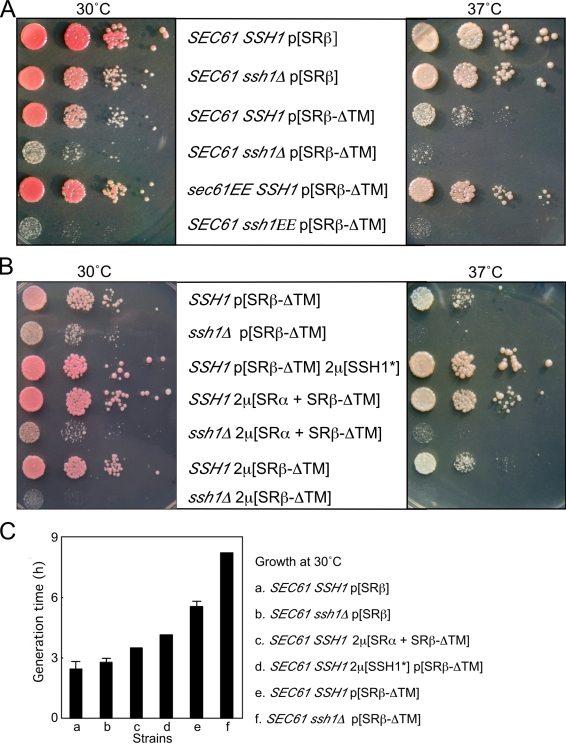
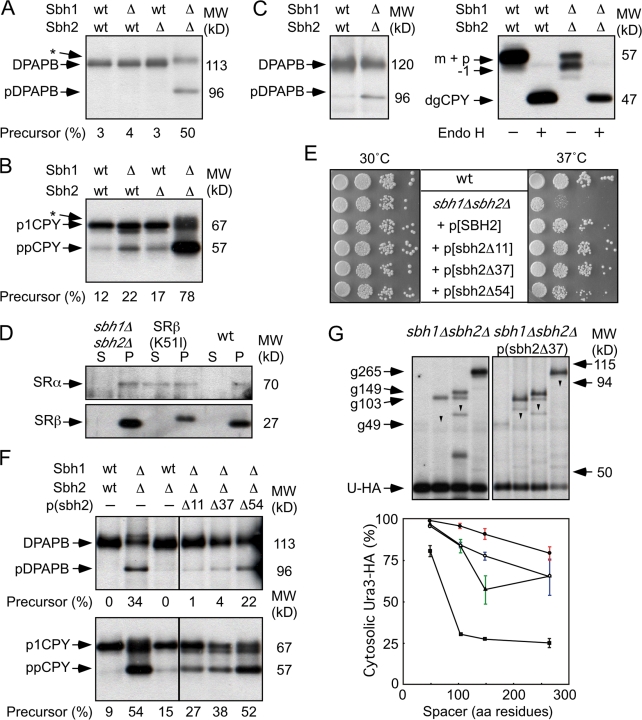
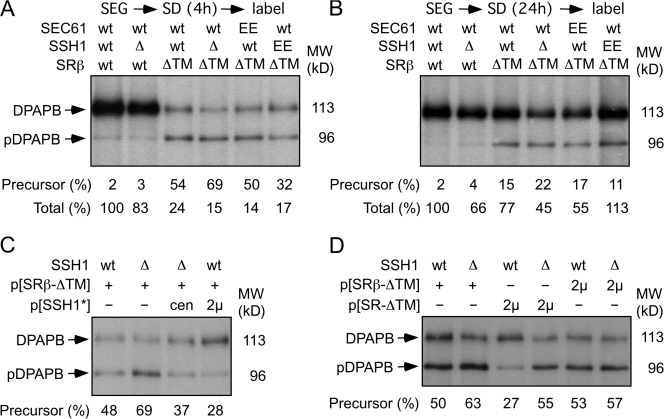
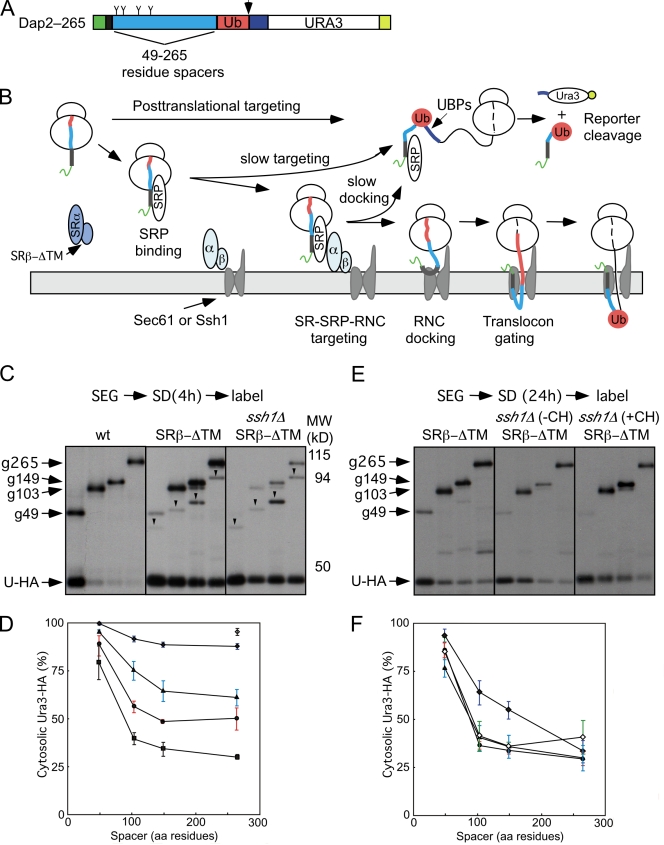
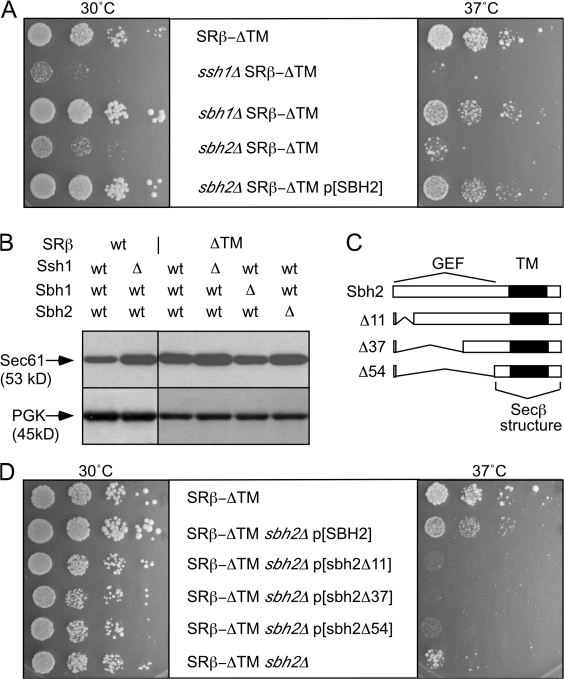
The signal recognition particle (SRP)-dependent targeting pathway facilitates rapid, efficient delivery of the ribosome-nascent chain complex (RNC) to the protein translocation channel. We test whether the SRP receptor (SR) locates a vacant protein translocation channel by interacting with the yeast Sec61 and Ssh1 translocons. Surprisingly, the slow growth and cotranslational translocation defects caused by deletion of the transmembrane (TM) span of yeast SRbeta (SRbeta-DeltaTM) are exaggerated when the SSH1 gene is disrupted. Disruption of the SBH2 gene, which encodes the beta subunit of the Ssh1p complex, likewise causes a growth defect when combined with SRbeta-DeltaTM. Cotranslational translocation defects in the ssh1DeltaSRbeta-DeltaTM mutant are explained by slow and inefficient in vivo gating of translocons by RNCs. A critical function for translocation channel beta subunits in the SR-channel interaction is supported by the observation that simultaneous deletion of Sbh1p and Sbh2p causes a defect in the cotranslational targeting pathway that is similar to the translocation defect caused by deletion of either subunit of the SR.
信号识别颗粒(SRP)依赖的靶向途径有助于将核糖体 - 新生链复合物(RNC)快速、高效地递送至蛋白质转运通道。我们测试了SRP受体(SR)是否通过与酵母Sec61和Ssh1转运体相互作用来定位空的蛋白质转运通道。令人惊讶的是,当SSH1基因被破坏时,酵母SRβ跨膜(TM)结构域缺失(SRβ - ΔTM)所导致的生长缓慢和共翻译转运缺陷会被放大。编码Ssh1p复合物β亚基的SBH2基因的破坏,与SRβ - ΔTM结合时同样会导致生长缺陷。ssh1ΔSRβ - ΔTM突变体中的共翻译转运缺陷可通过RNC在体内对转运体进行缓慢且低效的门控来解释。同时缺失Sbh1p和Sbh2p会导致共翻译靶向途径出现缺陷,这与缺失SR任一亚基所导致的转运缺陷相似,这一观察结果支持了转运通道β亚基在SR - 通道相互作用中的关键作用。