Torok M Estee, Chau Tran Thi Hong, Mai Pham Phuong, Phong Nguyen Duy, Dung Nguyen Thi, Chuong Ly Van, Lee Sue J, Caws M, de Jong Menno D, Hien Tran Tinh, Farrar Jeremy J
Oxford University Clinical Research Unit, Hospital for Tropical Diseases, Ho Chi Minh City, Vietnam.
PLoS One. 2008 Mar 19;3(3):e1772. doi: 10.1371/journal.pone.0001772.
The aim of this prospective, observational cohort study was to determine the clinical and microbiological features, outcome, and baseline variables predictive of death, in Vietnamese adults with HIV-associated tuberculous meningitis (TBM). 58 patients were admitted to the Hospital for Tropical Diseases in Ho Chi Minh City and underwent routine clinical and laboratory assessments. Treatment was with standard antituberculous therapy and adjunctive dexamethasone; antiretroviral therapy was not routinely available. Patients were followed up until the end of TB treatment or death.
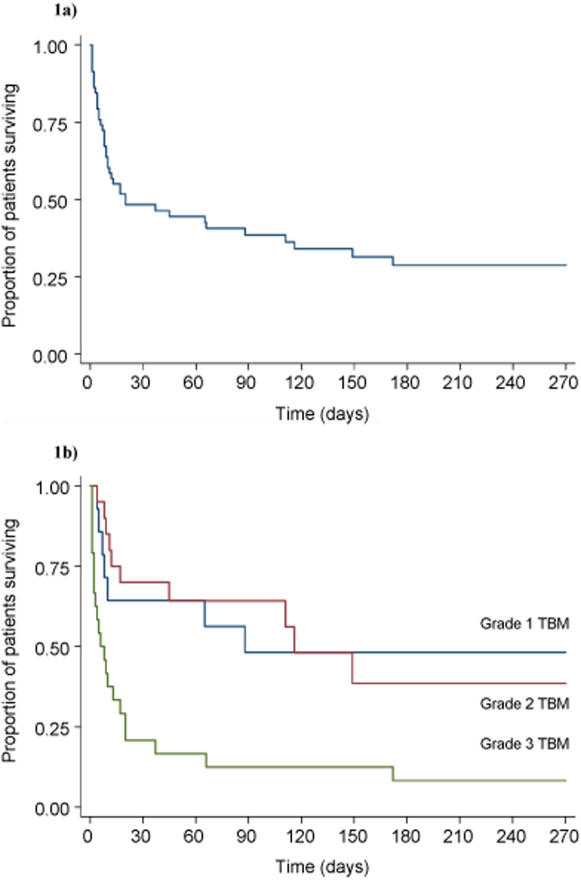
The median symptom duration was 11 days (range 2-90 days), 21.8% had a past history of TB, and 41.4% had severe (grade 3) TBM. The median CD4 count was 32 cells/mm(3). CSF findings were as follows: median leucocyte count 438 x 10(9)cells/l (63% neutrophils), 69% smear positive and 87.9% culture positive. TB drug resistance rates were high (13% mono-resistance 32.6% poly-resistance 8.7% multidrug resistance). 17% patients developed further AIDS-defining illnesses. 67.2% died (median time to death 20 days). Three baseline variables were predictive of death by multivariate analysis: increased TBM grade [adjusted hazard ratio (AHR) 1.73, 95% CI 1.08-2.76, p = 0.02], lower serum sodium (AHR 0.93, 95% CI 0.89 to 0.98, p = 0.002) and decreased CSF lymphocyte percentage (AHR 0.98, 95% CI 0.97 to 0.99, p = 0.003).
HIV-associated TBM is devastating disease with a dismal prognosis. CSF findings included CSF neutrophil predominance, high rates of smear and culture positivity, and high rates of antituberculous drug resistance. Three baseline variables were independently associated with death: increased TBM grade; low serum sodium and decreased CSF lymphocyte percentage.
这项前瞻性观察队列研究的目的是确定越南成人艾滋病相关结核性脑膜炎(TBM)的临床和微生物学特征、结局以及预测死亡的基线变量。58例患者入住胡志明市热带病医院,并接受了常规临床和实验室评估。治疗采用标准抗结核疗法及辅助地塞米松;抗逆转录病毒疗法并非常规可用。对患者进行随访直至结核病治疗结束或死亡。
症状持续时间中位数为11天(范围2 - 90天),21.8%有结核病既往史,41.4%患有重度(3级)TBM。CD4细胞计数中位数为32个/立方毫米。脑脊液检查结果如下:白细胞计数中位数为438×10⁹个/升(63%为中性粒细胞),涂片阳性率为69%,培养阳性率为87.9%。结核耐药率较高(单耐药13%,多耐药32.6%,耐多药8.7%)。17%的患者出现了进一步的艾滋病界定疾病。67.2%的患者死亡(死亡时间中位数为20天)。多因素分析显示,三个基线变量可预测死亡:TBM分级增加[校正风险比(AHR)1.73,95%置信区间1.08 - 2.76,p = 0.02]、血清钠降低(AHR 0.93,95%置信区间0.89至0.98,p = 0.002)以及脑脊液淋巴细胞百分比降低(AHR 0.98,95%置信区间0.97至0.99,p = 0.003)。
艾滋病相关TBM是一种预后极差的毁灭性疾病。脑脊液检查结果包括脑脊液以中性粒细胞为主、涂片和培养阳性率高以及抗结核药物耐药率高。三个基线变量与死亡独立相关:TBM分级增加;血清钠降低和脑脊液淋巴细胞百分比降低。