Deng Jian-Ming, Li Tao, Wang Gen-Xuan, Liu Jing, Yu Ze-Long, Zhao Chang-Ming, Ji Ming-Fei, Zhang Qiang, Liu Jian-Quan
MOE Key Laboratory of Arid and Grassland, School of Life Science, Lanzhou University, Lanzhou, China.
PLoS One. 2008 Mar 19;3(3):e1799. doi: 10.1371/journal.pone.0001799.
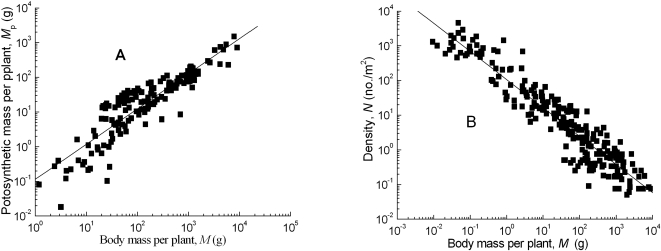
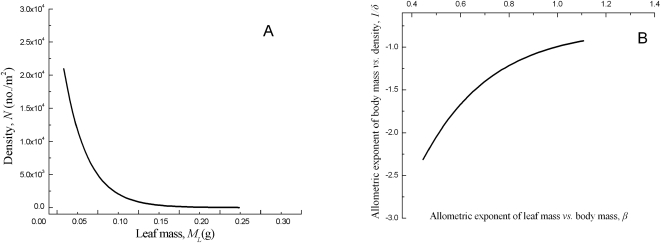
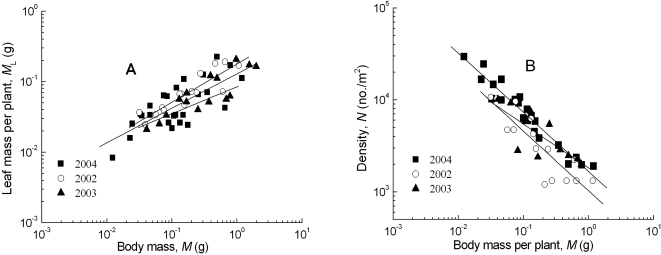
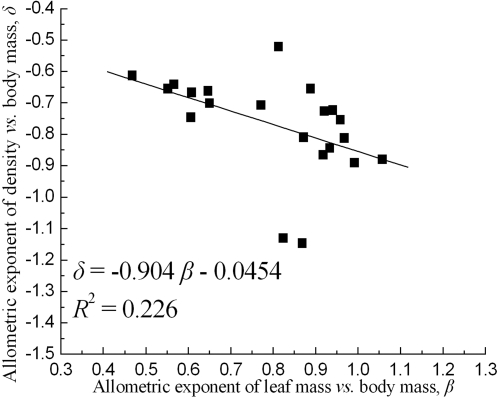
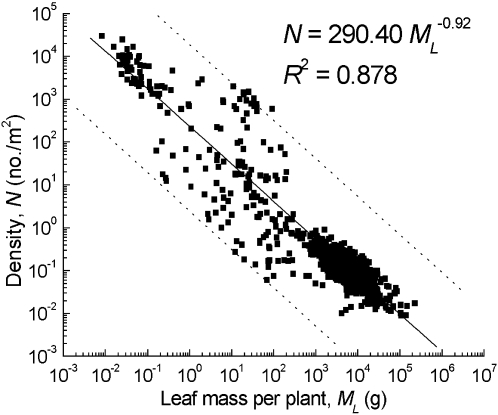
The energetic equivalence rule, which is based on a combination of metabolic theory and the self-thinning rule, is one of the fundamental laws of nature. However, there is a progressively increasing body of evidence that scaling relationships of metabolic rate vs. body mass and population density vs. body mass are variable and deviate from their respective theoretical values of 3/4 and -3/4 or -2/3. These findings questioned the previous hypotheses of energetic equivalence rule in plants. Here we examined the allometric relationships between photosynthetic mass (M(p)) or leaf mass (M(L)) vs. body mass (beta); population density vs. body mass (delta); and leaf mass vs. population density, for desert shrubs, trees, and herbaceous plants, respectively. As expected, the allometric relationships for both photosynthetic mass (i.e. metabolic rate) and population density varied with the environmental conditions. However, the ratio between the two exponents was -1 (i.e. beta/delta = -1) and followed the trade-off principle when local resources were limited. Our results demonstrate for the first time that the energetic equivalence rule of plants is based on trade-offs between the variable metabolic rate and population density rather than their constant allometric exponents.
基于代谢理论和自疏法则相结合的能量等价规则,是自然界的基本规律之一。然而,越来越多的证据表明,代谢率与体重以及种群密度与体重之间的标度关系是可变的,并且偏离了它们各自3/4和-3/4或-2/3的理论值。这些发现对先前关于植物能量等价规则的假设提出了质疑。在这里,我们分别研究了沙漠灌木、乔木和草本植物中光合质量(M(p))或叶质量(M(L))与体重(β)之间;种群密度与体重(δ)之间;以及叶质量与种群密度之间的异速生长关系。正如预期的那样,光合质量(即代谢率)和种群密度的异速生长关系随环境条件而变化。然而,当局部资源有限时,两个指数之间的比率为-1(即β/δ = -1),并遵循权衡原则。我们的结果首次证明,植物的能量等价规则是基于可变代谢率和种群密度之间的权衡,而不是它们恒定的异速生长指数。