Rothwangl Katharina B, Manicassamy Balaji, Uprichard Susan L, Rong Lijun
Department of Microbiology and Immunology, College of Medicine, University of Illinois at Chicago, Chicago, IL 60612, USA.
Virol J. 2008 Mar 20;5:46. doi: 10.1186/1743-422X-5-46.
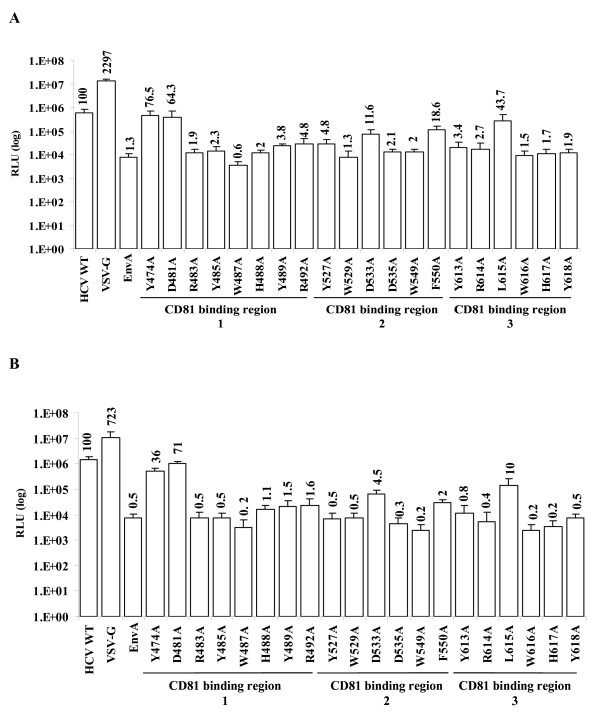
Hepatitis C virus (HCV) encodes two transmembrane glycoproteins E1 and E2 which form a heterodimer. E1 is believed to mediate fusion while E2 has been shown to bind cellular receptors including CD81. In this study, alanine substitutions in E2 were generated within putative CD81 binding regions to define residues critical for viral entry. The effect of each mutation was tested by challenging susceptible cell lines with mutant HCV E1E2 pseudotyped viruses generated using a lentiviral system (HCVpp). In addition to assaying infectivity, producer cell expression and HCVpp incorporation of HCV E1 and E2 proteins, CD81 binding profiles, and E1E2 association of mutants were examined.
Based on these characteristics, mutants either displayed wt characteristics (high infectivity [> or = 50% of wt HCVpp], CD81 binding, E1E2 expression, association, and incorporation into viral particles and proper conformation) or segregated into 4 distinct low infectivity (< or = 50% of wt HCVpp) mutant phenotypes: (I) CD81 binding deficient (despite wt E1E2 expression, incorporation and association and proper conformation); (II) CD81 binding competent, but lack of E1 detection on the viral particle, (despite adequate E1E2 expression in producer cell lysates and proper conformation); (III) CD81 binding competent, with adequate E1E2 expression, incorporation, association, and proper E2 conformation (i.e. no defect identified to explain the reduced infectivity observed); (IV) CD81 binding deficient due to disruption of E2 mutant protein conformation.
Although most alanine substitutions within the putative CD81 binding region 1 (amino acids 474-492) displayed greatly reduced HCVpp infectivity, they retained soluble CD81 binding, proper E2 conformation, E1E2 association and incorporation into HCVpp suggesting that region 1 of E2 does not mediate binding to CD81. In contrast, conformationally correct E2 mutants (Y527 and W529) within the second putative CD81 binding region (amino acids 522-551) disrupted binding of E2 to CD81-GST, suggesting that region 2 is critical to CD81 binding. Likewise, all conformationally intact mutants within the third putative CD81 binding region (amino acids 612-619), except L615A, were important for E2 binding to CD81-GST. This region is highly conserved across genotypes, underlining its importance in mediating viral entry.
丙型肝炎病毒(HCV)编码两种跨膜糖蛋白E1和E2,它们形成异二聚体。据信E1介导融合,而E2已被证明可结合包括CD81在内的细胞受体。在本研究中,在假定的CD81结合区域内对E2进行丙氨酸取代,以确定对病毒进入至关重要的残基。通过用使用慢病毒系统(HCVpp)产生的突变型HCV E1E2假型病毒挑战易感细胞系来测试每个突变的效果。除了测定感染性、生产细胞中HCV E1和E2蛋白的表达以及HCVpp掺入情况外,还检查了CD81结合谱以及突变体的E1E2缔合情况。
基于这些特征,突变体要么表现出野生型特征(高感染性[≥野生型HCVpp的50%]、CD81结合、E1E2表达、缔合以及掺入病毒颗粒和正确构象),要么分为4种不同的低感染性(≤野生型HCVpp的50%)突变表型:(I)CD81结合缺陷型(尽管有野生型E1E2表达、掺入和缔合以及正确构象);(II)CD81结合能力正常,但在病毒颗粒上未检测到E1(尽管生产细胞裂解物中有足够的E1E2表达和正确构象);(III)CD81结合能力正常,有足够的E1E2表达、掺入、缔合以及正确的E2构象(即未发现可解释观察到的感染性降低的缺陷);(IV)由于E2突变蛋白构象破坏导致CD81结合缺陷型。
尽管在假定的CD81结合区域1(氨基酸474 - 至492)内的大多数丙氨酸取代显示HCVpp感染性大幅降低,但它们保留了可溶性CD81结合、正确的E2构象、E1E2缔合以及掺入HCVpp,这表明E2的区域1不介导与CD81的结合。相比之下,第二个假定的CD81结合区域(氨基酸522 - 551)内构象正确的E2突变体(Y527和W529)破坏了E2与CD81 - GST的结合,表明区域2对CD81结合至关重要。同样,第三个假定的CD81结合区域(氨基酸612 - 619)内除L615A外的所有构象完整的突变体对E2与CD81 - GST的结合都很重要。该区域在各基因型中高度保守,突出了其在介导病毒进入中的重要性。