Freeman Roy, Durso-Decruz Edith, Emir Birol
Department of Neurology, Beth Israel Deaconess Medical Center, Harvard Medical School, Boston, Massachusetts, USA.
Diabetes Care. 2008 Jul;31(7):1448-54. doi: 10.2337/dc07-2105. Epub 2008 Mar 20.
To evaluate the efficacy, safety, and tolerability of pregabalin across the effective dosing range, to determine differences in the efficacy of three times daily (TID) versus twice daily (BID) dosage schedules, and to use time-to-event analysis to determine the time to onset of a sustained therapeutic effect using data from seven trials of pregabalin in painful diabetic peripheral neuropathy (DPN).
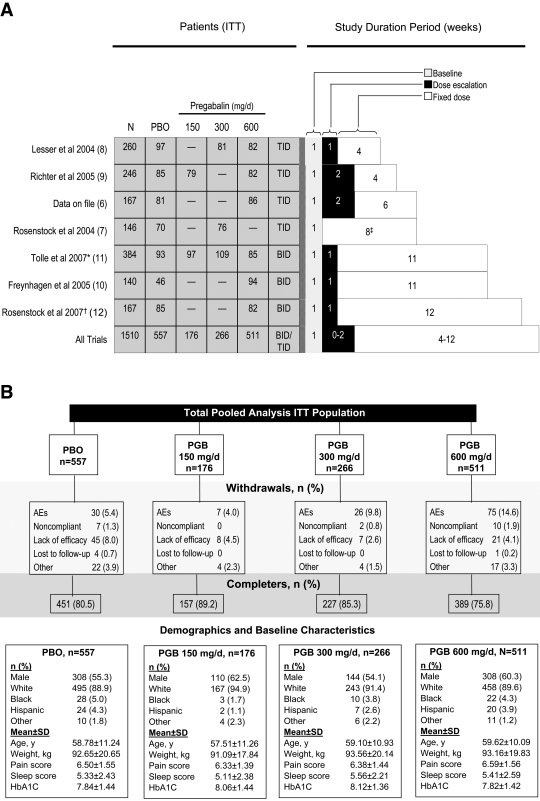
Data were pooled across seven double-blind, randomized, placebo-controlled trials using pregabalin to treat painful DPN with dosages of 150, 300, and 600 mg/day administered TID or BID. Only one trial included all three of these dosages, and TID dosing was used in four. All studies shared fundamental selection criteria, and treatment durations ranged from 5 to 13 weeks.
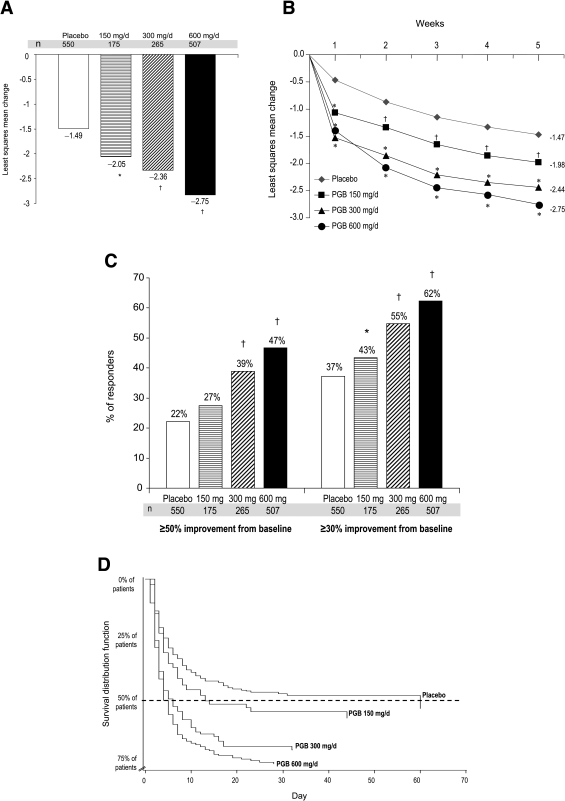
Pooled analysis showed that pregabalin significantly reduced pain and pain-related sleep interference associated with DPN (150, 300, and 600 mg/day administered TID vs. placebo, all P < or = 0.007). Only the 600 mg/day dosage showed efficacy when administered BID (P < or = 0.001). Pain and sleep interference reductions associated with pregabalin appear to be positively correlated with dosage; the greatest effect was observed in patients treated with 600 mg/day. Kaplan-Meier analysis revealed that the median time to onset of a sustained (> or =30% at end point) 1-point improvement was 4 days in patients treated with pregabalin at 600 mg/day, 5 days in patients treated with pregabalin at 300 mg/day, 13 days in patients treated with pregabalin at 150 mg/day, and 60 days in patients receiving placebo. The most common treatment-emergent adverse events were dizziness, somnolence, and peripheral edema.
Treatment with pregabalin across its effective dosing range is associated with significant, dose-related improvement in pain in patients with DPN.
评估普瑞巴林在有效剂量范围内的疗效、安全性和耐受性,确定每日三次(TID)与每日两次(BID)给药方案在疗效上的差异,并利用事件发生时间分析,根据普瑞巴林治疗疼痛性糖尿病周围神经病变(DPN)的7项试验数据,确定达到持续治疗效果的起效时间。
汇总了7项双盲、随机、安慰剂对照试验的数据,这些试验使用普瑞巴林治疗疼痛性DPN,剂量为150、300和600mg/天,采用TID或BID给药。只有一项试验包括所有这三种剂量,四项试验采用TID给药。所有研究都有基本的入选标准,治疗持续时间为5至13周。
汇总分析表明,普瑞巴林显著减轻了与DPN相关的疼痛和疼痛相关的睡眠干扰(TID给药的150、300和600mg/天与安慰剂相比,所有P≤0.007)。只有600mg/天的剂量在BID给药时显示出疗效(P≤0.001)。普瑞巴林相关的疼痛和睡眠干扰减轻似乎与剂量呈正相关;在接受600mg/天治疗的患者中观察到最大效果。Kaplan-Meier分析显示,在接受600mg/天普瑞巴林治疗的患者中,持续(终点时≥30%)改善1分的中位起效时间为4天,在接受300mg/天普瑞巴林治疗的患者中为5天,在接受150mg/天普瑞巴林治疗的患者中为13天,在接受安慰剂治疗的患者中为60天。最常见的治疗中出现的不良事件是头晕、嗜睡和外周水肿。
在有效剂量范围内使用普瑞巴林治疗与DPN患者疼痛的显著、剂量相关改善相关。