Neyman Sergey, Manahan-Vaughan Denise
Institute for Physiology of the Charité, Synaptic Plasticity Research Group, Humboldt University, Berlin, Germany.
Eur J Neurosci. 2008 Mar;27(6):1345-52. doi: 10.1111/j.1460-9568.2008.06109.x.
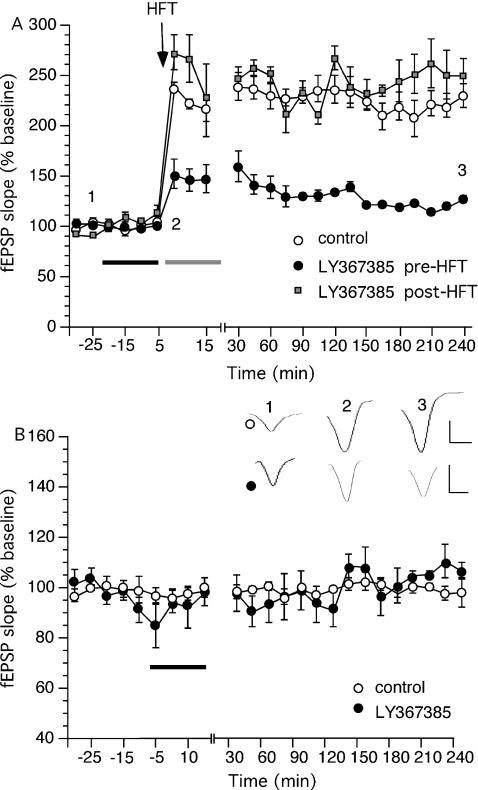
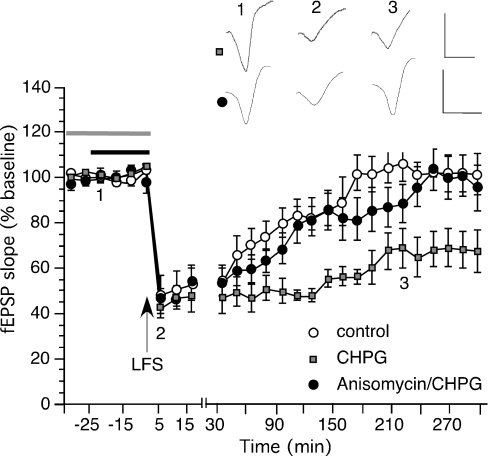
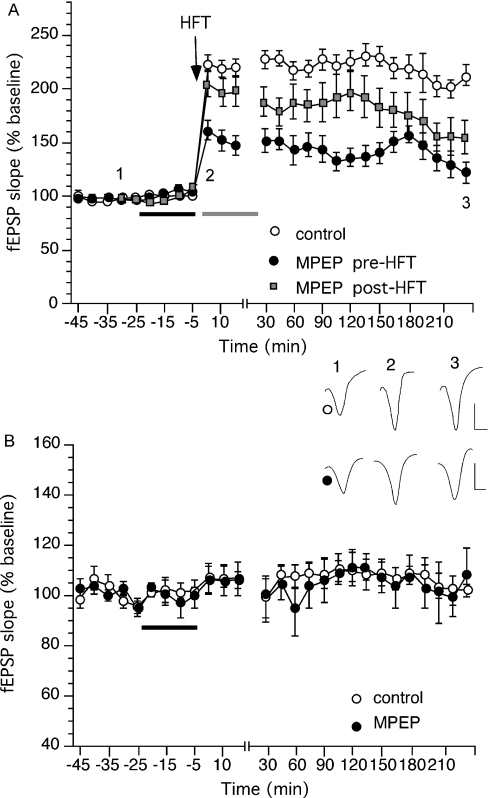
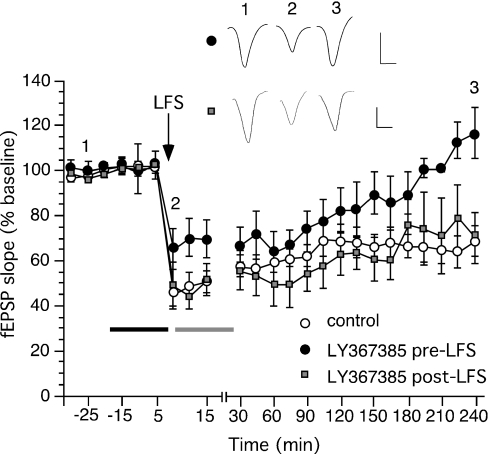
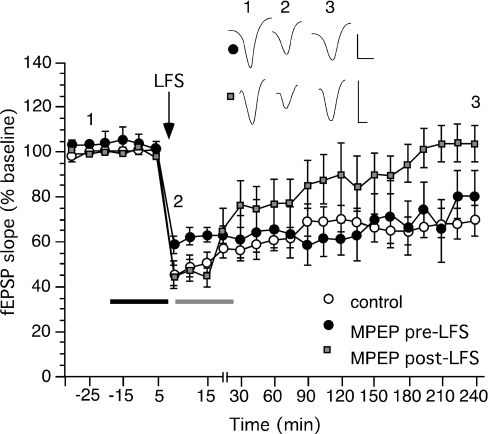
The group I metabotropic glutamate receptors, mGluR1 and mGluR5, exhibit differences in their regulation of synaptic plasticity, suggesting that these receptors may subserve separate functional roles in information storage. In addition, although effects in vivo are consistently described, conflicting reports of the involvement of mGluRs in hippocampal synaptic plasticity in vitro exist. We therefore addressed the involvement of mGluR1 and mGluR5 in long-term potentiation (LTP) and long-term depression (LTD) in the hippocampal CA1 region of adult male rats in vitro. The mGluR1 antagonist (S)-(+)-alpha-amino-4-carboxy-2-methylbenzene-acetic acid (LY367385) impaired both induction and late phases of both LTP and LTD, when applied before high-frequency tetanization (HFT; 100 Hz) or low-frequency stimulation (LFS; 1 Hz), respectively. Application after either HFT or LFS had no effect. The mGluR5 antagonist 2-methyl-6-(phenylethynyl)pyridine (MPEP), when given before HFT, inhibited both the induction and late phases of LTP. When given after HFT, late LTP was inhibited. MPEP, given prior to LFS, impaired LTD induction, although stable LTD was still expressed. Application after LFS significantly impaired late phases of LTD. Activation of protein synthesis may comprise a key mechanism underlying the group I mGluR contribution to synaptic plasticity. The mGluR5 agonist (R,S)-2-chloro-5-hydroxyphenylglycine (CHPG) converted short-term depression into LTD. Effects were prevented by application of the protein synthesis inhibitor anisomycin, suggesting that protein synthesis is triggered by group I mGluR activation to enable persistency of synaptic plasticity. Taken together, these data support the notion that both mGluR1 and mGluR5 are critically involved in bidirectional synaptic plasticity in the CA1 region and may enable functional differences in information encoding through LTP and LTD.
I 型代谢型谷氨酸受体 mGluR1 和 mGluR5 在调节突触可塑性方面存在差异,这表明这些受体可能在信息存储中发挥不同的功能作用。此外,尽管体内效应得到了一致描述,但关于 mGluRs 在体外海马突触可塑性中的作用存在相互矛盾的报道。因此,我们研究了 mGluR1 和 mGluR5 在成年雄性大鼠海马 CA1 区体外长时程增强 (LTP) 和长时程抑制 (LTD) 中的作用。mGluR1 拮抗剂 (S)-(+)-α-氨基-4-羧基-2-甲基苯乙酸 (LY367385) 在高频强直刺激 (HFT; 100 Hz) 或低频刺激 (LFS; 1 Hz) 之前应用时,会损害 LTP 和 LTD 的诱导期和后期。在 HFT 或 LFS 之后应用则没有效果。mGluR5 拮抗剂 2-甲基-6-(苯乙炔基)吡啶 (MPEP) 在 HFT 之前给予时,会抑制 LTP 的诱导期和后期。在 HFT 之后给予时,会抑制晚期 LTP。MPEP 在 LFS 之前给予时,会损害 LTD 的诱导,尽管仍能表达稳定的 LTD。在 LFS 之后应用会显著损害 LTD 的后期。蛋白质合成的激活可能是 I 型 mGluR 对突触可塑性贡献的关键机制。mGluR5 激动剂 (R,S)-2-氯-5-羟基苯甘氨酸 (CHPG) 将短期抑制转化为 LTD。蛋白质合成抑制剂茴香霉素的应用可阻止这种效应,这表明蛋白质合成是由 I 型 mGluR 激活触发的,以实现突触可塑性的持续性。综上所述,这些数据支持这样一种观点,即 mGluR1 和 mGluR5 在 CA1 区双向突触可塑性中都起着关键作用,并且可能通过 LTP 和 LTD 在信息编码中实现功能差异。