Lu Catherine P, Posey Jennifer E, Roth David B
Program in Molecular Pathogenesis, Department of Pathology, New York University School of Medicine, 540 First Avenue, New York, NY 10016, USA.
Nucleic Acids Res. 2008 May;36(9):2864-73. doi: 10.1093/nar/gkn128. Epub 2008 Mar 29.
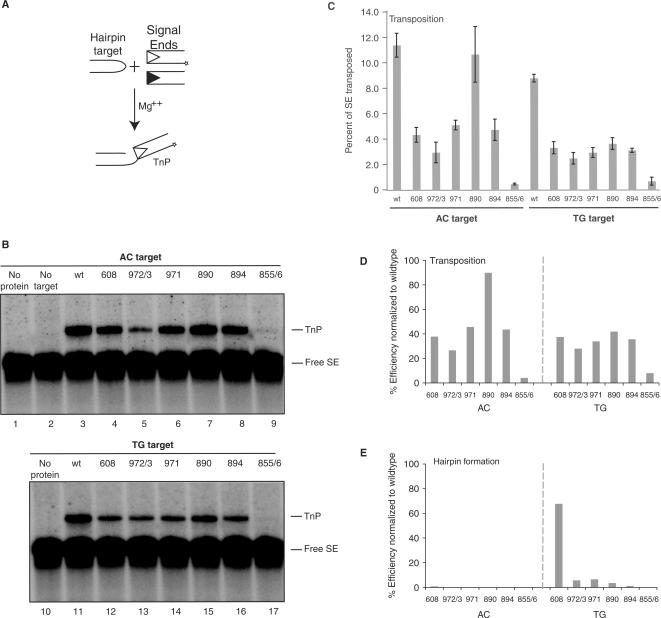
The Rag1 and Rag2 proteins initiate V(D)J recombination by introducing site-specific DNA double-strand breaks. Cleavage occurs by nicking one DNA strand, followed by a one-step transesterification reaction that forms a DNA hairpin structure. A similar reaction allows Rag transposition, in which the 3'-OH groups produced by Rag cleavage are joined to target DNA. The Rag1 active site DDE triad clearly plays a catalytic role in both cleavage and transposition, but no other residues in Rag1 responsible for transesterification have been identified. Furthermore, although Rag2 is essential for both cleavage and transposition, the nature of its involvement is unknown. Here, we identify basic amino acids in the catalytic core of Rag1 specifically important for transesterification. We also show that some Rag1 mutants with severe defects in hairpin formation nonetheless catalyze substantial levels of transposition. Lastly, we show that a catalytically defective Rag2 mutant is impaired in target capture and displays a novel form of coding flank sensitivity. These findings provide the first identification of components of Rag1 that are specifically required for transesterification and suggest an unexpected role for Rag2 in DNA cleavage and transposition.
Rag1和Rag2蛋白通过引入位点特异性DNA双链断裂来启动V(D)J重组。切割通过切割一条DNA链发生,随后是一步转酯反应,形成DNA发夹结构。类似的反应允许Rag转座,其中Rag切割产生的3'-OH基团与靶DNA连接。Rag1活性位点的DDE三联体显然在切割和转座中都起催化作用,但尚未确定Rag1中其他负责转酯的残基。此外,尽管Rag2对切割和转座都至关重要,但其参与的性质尚不清楚。在这里,我们确定了Rag1催化核心中对转酯特别重要的碱性氨基酸。我们还表明,一些在发夹形成方面有严重缺陷的Rag1突变体仍然能催化相当水平的转座。最后,我们表明,一个催化缺陷的Rag2突变体在靶捕获方面受损,并表现出一种新形式的编码侧翼敏感性。这些发现首次鉴定了转酯特异性所需的Rag1成分,并暗示了Rag2在DNA切割和转座中的意外作用。