Tan Cheong H, Vythilingam Indra, Matusop Asmad, Chan Seng T, Singh Balbir
Infectious Diseases Research Centre, Institute for Medical Research Jalan Pahang, 50588 Kuala Lumpur, Malaysia.
Malar J. 2008 Mar 31;7:52. doi: 10.1186/1475-2875-7-52.
A large focus of human infections with Plasmodium knowlesi, a simian parasite naturally found in long-tailed and pig-tailed macaques was discovered in the Kapit Division of Sarawak, Malaysian Borneo. A study was initiated to identify the vectors of malaria, to elucidate where transmission is taking place and to understand the bionomics of the vectors in Kapit.
Three different ecological sites in the forest, farm and longhouse in the Kapit district were selected for the study. Mosquitoes were collected by human landing collection at all sites and at the forest also by monkey-baited-traps situated on three different levels. All mosquitoes were identified and salivary glands and midguts of anopheline mosquitoes were dissected to determine the presence of malaria parasites.
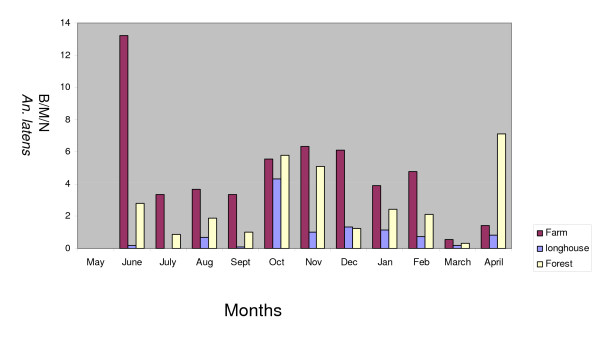
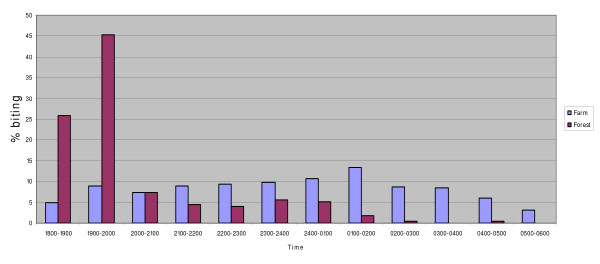
Over an 11-month period, a total of 2,504 Anopheles mosquitoes comprising 12 species were caught; 1,035 at the farm, 774 at the forest and 425 at the longhouse. Anopheles latens (62.3%) and Anopheles watsonii (30.6%) were the predominant species caught in the forested ecotypes, while in the farm Anopheles donaldi (49.9%) and An. latens (35.6%) predominated. In the long house, An. latens (29.6%) and An. donaldi (22.8%) were the major Anopheline species. However, An. latens was the only mosquito positive for sporozoites and it was found to be attracted to both human and monkey hosts. In monkey-baited net traps, it preferred to bite monkeys at the canopy level than at ground level. An. latens was found biting early as 18.00 hours.
Anopheles latens is the main vector for P. knowlesi malaria parasites in the Kapit District of Sarawak, Malaysian Borneo. The study underscores the relationship between ecology, abundance and bionomics of anopheline fauna. The simio-anthropophagic and acrodendrophilic behaviour of An. latens makes it an efficient vector for the transmission of P. knowlesi parasites to both human and monkey hosts.
在马来西亚婆罗洲沙捞越州的加帛地区发现,诺氏疟原虫这种自然存在于长尾猕猴和猪尾猕猴体内的猿类寄生虫引发的人类感染情况很严重。于是开展了一项研究,以确定疟疾的传播媒介,阐明传播发生的地点,并了解加帛地区传播媒介的生物学特性。
在加帛地区的森林、农场和长屋这三个不同的生态地点选取进行研究。在所有地点通过人诱捕法收集蚊子,在森林中还通过设置在三个不同高度的猴饵诱捕器收集蚊子。对所有蚊子进行鉴定,并解剖按蚊的唾液腺和中肠以确定疟原虫的存在情况。
在11个月的时间里,共捕获2504只按蚊,分属12个种类;在农场捕获1035只,在森林捕获774只,在长屋捕获425只。在森林生态类型中捕获的主要种类是迟缓按蚊(62.3%)和华氏按蚊(30.6%),而在农场中,多氏按蚊(49.9%)和迟缓按蚊(35.6%)占主导。在长屋中,迟缓按蚊(29.6%)和多氏按蚊(22.8%)是主要的按蚊种类。然而,迟缓按蚊是唯一检测到子孢子呈阳性的蚊子,并且发现它会被人类和猴子宿主吸引。在猴饵诱捕网中,它更喜欢在树冠层叮咬猴子而非地面层的猴子。发现迟缓按蚊早在18:00就开始叮咬。
迟缓按蚊是马来西亚婆罗洲沙捞越州加帛地区诺氏疟原虫疟疾寄生虫的主要传播媒介。该研究强调了按蚊动物群落的生态、数量和生物学特性之间的关系。迟缓按蚊的嗜猴嗜人以及栖于高处树木的行为使其成为将诺氏疟原虫寄生虫传播给人类和猴子宿主的有效媒介。