Hockings Jennifer K, Degner Stephanie C, Morgan Sherif S, Kemp Michael Q, Romagnolo Donato F
Cancer Biology Interdisciplinary Graduate Program, Department of Nutritional Sciences, The University of Arizona, E 4th Street, Tucson, Arizona 85721-0038, USA.
Breast Cancer Res. 2008;10(2):R29. doi: 10.1186/bcr1987. Epub 2008 Mar 31.
Increased estrogen level has been regarded to be a risk factor for breast cancer. However, estrogen has also been shown to induce the expression of the tumor suppressor gene, BRCA1. Upregulation of BRCA1 is thought to be a feedback mechanism for controlling DNA repair in proliferating cells. Estrogens enhance transcription of target genes by stimulating the association of the estrogen receptor (ER) and related coactivators to estrogen response elements or to transcription complexes formed at activator protein (AP)-1 or specificity protein (Sp)-binding sites. Interestingly, the BRCA1 gene lacks a consensus estrogen response element. We previously reported that estrogen stimulated BRCA1 transcription through the recruitment of a p300/ER-alpha complex to an AP-1 site harbored in the proximal BRCA1 promoter. The purpose of the study was to analyze the contribution of cis-acting sites flanking the AP-1 element to basal and estrogen-dependent regulation of BRCA1 transcription.
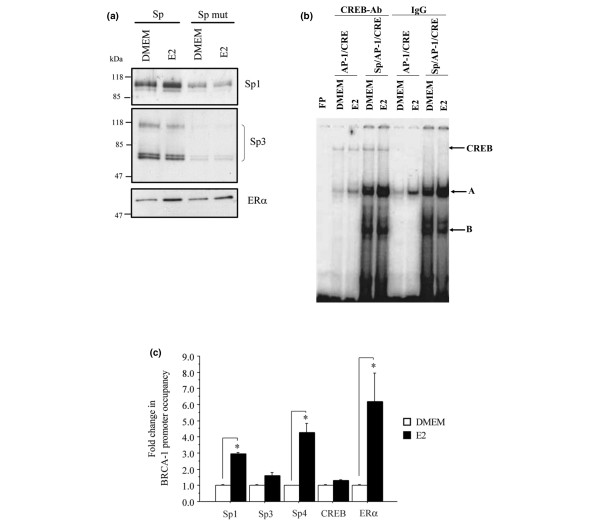
Using transfection studies with wild-type and mutated BRCA1 promoter constructs, electromobility binding and shift assays, and DNA-protein interaction and chromatin immunoprecipitation assays, we investigated the role of Sp-binding sites and cAMP response element (CRE)-binding sites harbored in the proximal BRCA1 promoter.
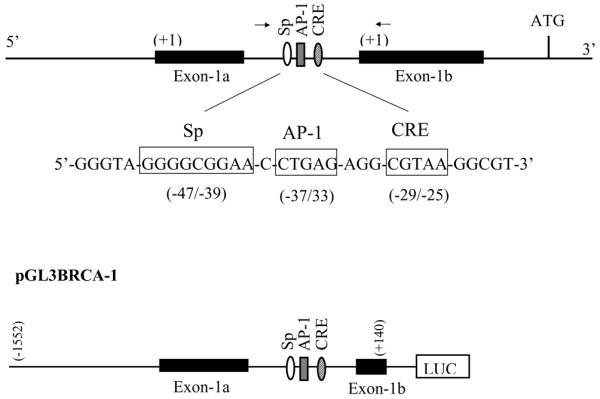
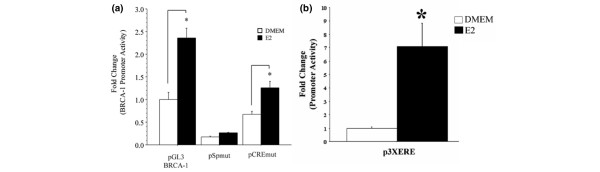
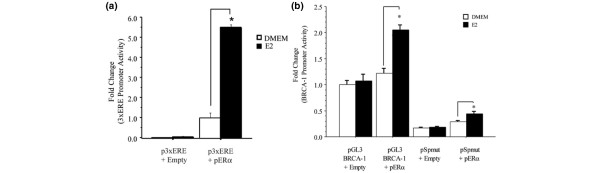
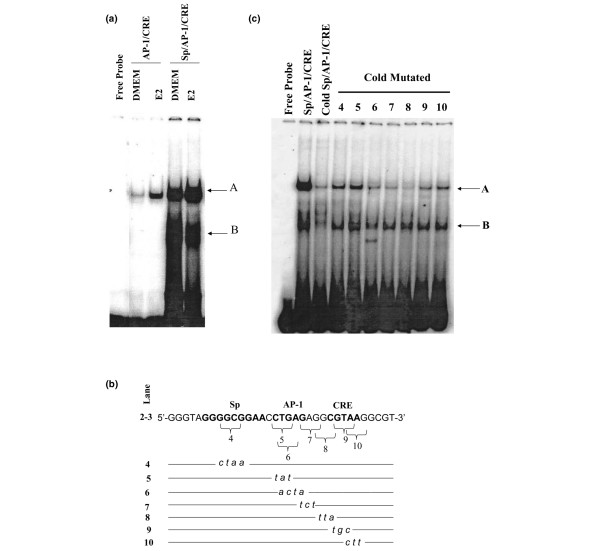
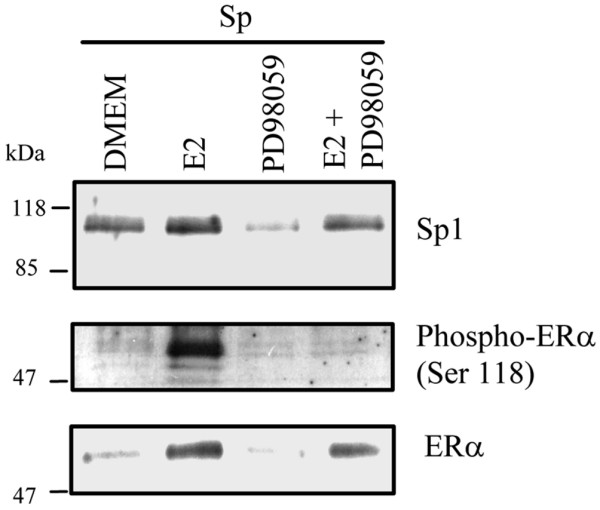
We report that in the BRCA1 promoter the AP-1 site is flanked upstream by an element (5'-GGGGCGGAA-3') that recruits Sp1, Sp3, and Sp4 factors, and downstream by a half CRE-binding motif (5'-CGTAA-3') that binds CRE-binding protein. In ER-alpha-positive MCF-7 cells and ER-alpha-negative Hela cells expressing exogenous ER-alpha, mutation of the Sp-binding site interfered with basal and estrogen-induced BRCA1 transcription. Conversely, mutation of the CRE-binding element reduced basal BRCA1 promoter activity but did not prevent estrogen activation. In combination with the AP-1/CRE sites, the Sp-binding domain enhanced the recruitment of nuclear proteins to the BRCA1 promoter. Finally, we report that the MEK1 (mitogen-activated protein kinase kinase-1) inhibitor PD98059 attenuated the recruitment of Sp1 and phosphorylated ER-alpha, respectively, to the Sp and AP-1 binding element.
These cumulative findings suggest that the proximal BRCA1 promoter segment comprises cis-acting elements that are targeted by Sp-binding and CRE-binding proteins that contribute to regulation of BRCA1 transcription.
雌激素水平升高被认为是乳腺癌的一个风险因素。然而,雌激素也已被证明可诱导肿瘤抑制基因BRCA1的表达。BRCA1的上调被认为是一种在增殖细胞中控制DNA修复的反馈机制。雌激素通过刺激雌激素受体(ER)和相关共激活因子与雌激素反应元件或在激活蛋白(AP)-1或特异性蛋白(Sp)结合位点形成的转录复合物的结合来增强靶基因的转录。有趣的是,BRCA1基因缺乏一致的雌激素反应元件。我们之前报道,雌激素通过将p300/ER-α复合物募集到BRCA1近端启动子中含有的AP-1位点来刺激BRCA1转录。本研究的目的是分析AP-1元件侧翼的顺式作用位点对BRCA1转录的基础调控和雌激素依赖性调控的作用。
通过使用野生型和突变型BRCA1启动子构建体的转染研究、电泳迁移率结合和迁移分析以及DNA-蛋白质相互作用和染色质免疫沉淀分析,我们研究了BRCA1近端启动子中含有的Sp结合位点和cAMP反应元件(CRE)结合位点的作用。
我们报道,在BRCA1启动子中,AP-1位点上游侧翼有一个元件(5'-GGGGCGGAA-3'),可募集Sp1、Sp3和Sp4因子,下游侧翼有一个半CRE结合基序(5'-CGTAA-3'),可结合CRE结合蛋白。在表达外源性ER-α的ER-α阳性MCF-7细胞和ER-α阴性Hela细胞中,Sp结合位点的突变干扰了基础和雌激素诱导的BRCA1转录。相反,CRE结合元件的突变降低了基础BRCA1启动子活性,但并未阻止雌激素激活。与AP-1/CRE位点结合,Sp结合结构域增强了核蛋白向BRCA1启动子的募集。最后,我们报道丝裂原活化蛋白激酶激酶-1(MEK1)抑制剂PD98059分别减弱了Sp1和磷酸化ER-α向Sp和AP-1结合元件的募集。
这些累积的发现表明,BRCA1近端启动子区段包含顺式作用元件,这些元件是Sp结合蛋白和CRE结合蛋白的作用靶点,有助于BRCA1转录的调控。