Fernandes Jacqueline, Lorenzo Ivan M, Andrade Yaniré N, Garcia-Elias Anna, Serra Selma A, Fernández-Fernández José M, Valverde Miguel A
Laboratory of Molecular Physiology and Channelopathies, Department of Experimental and Health Sciences, Universitat Pompeu Fabra, Barcelona 08003, Spain.
J Cell Biol. 2008 Apr 7;181(1):143-55. doi: 10.1083/jcb.200712058. Epub 2008 Mar 31.
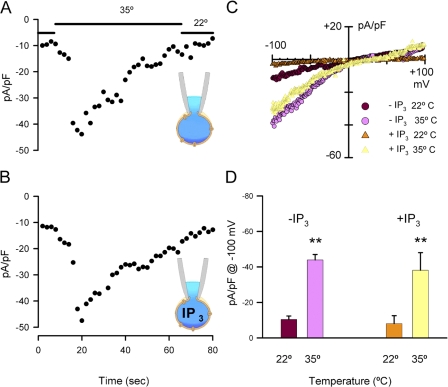
Mechanical and osmotic sensitivity of the transient receptor potential vanilloid 4 (TRPV4) channel depends on phospholipase A(2) (PLA(2)) activation and the subsequent production of the arachidonic acid metabolites, epoxyeicosatrienoic acid (EET). We show that both high viscous loading and hypotonicity stimuli in native ciliated epithelial cells use PLA(2)-EET as the primary pathway to activate TRPV4. Under conditions of low PLA(2) activation, both also use extracellular ATP-mediated activation of phospholipase C (PLC)-inositol trisphosphate (IP(3)) signaling to support TRPV4 gating. IP(3), without being an agonist itself, sensitizes TRPV4 to EET in epithelial ciliated cells and cells heterologously expressing TRPV4, an effect inhibited by the IP(3) receptor antagonist xestospongin C. Coimmunoprecipitation assays indicated a physical interaction between TRPV4 and IP(3) receptor 3. Collectively, our study suggests a functional coupling between plasma membrane TRPV4 channels and intracellular store Ca(2+) channels required to initiate and maintain the oscillatory Ca(2+) signal triggered by high viscosity and hypotonic stimuli that do not reach a threshold level of PLA(2) activation.
瞬时受体电位香草酸亚型4(TRPV4)通道的机械敏感性和渗透敏感性取决于磷脂酶A2(PLA2)的激活以及随后花生四烯酸代谢产物环氧二十碳三烯酸(EET)的产生。我们发现,在天然纤毛上皮细胞中,高粘性负荷和低渗刺激均以PLA2-EET作为激活TRPV4的主要途径。在PLA2激活水平较低的情况下,二者还利用细胞外ATP介导的磷脂酶C(PLC)-肌醇三磷酸(IP3)信号传导激活来支持TRPV4门控。IP3本身并非激动剂,但可使上皮纤毛细胞和异源表达TRPV4的细胞中的TRPV4对EET敏感,IP3受体拮抗剂西司他汀C可抑制该效应。免疫共沉淀试验表明TRPV4与IP3受体3之间存在物理相互作用。总的来说,我们的研究表明,质膜TRPV4通道与细胞内储存Ca2+通道之间存在功能偶联,这对于启动和维持由高粘度和低渗刺激触发的振荡性Ca2+信号是必需的,而这些刺激未达到PLA2激活的阈值水平。