Department of Microbiology and Immunology, University of Rochester Medical Center, Rochester, NY 14642, USA.
Biol Proced Online. 2008 Jan 17;10:1-8. doi: 10.1251/bpo137.
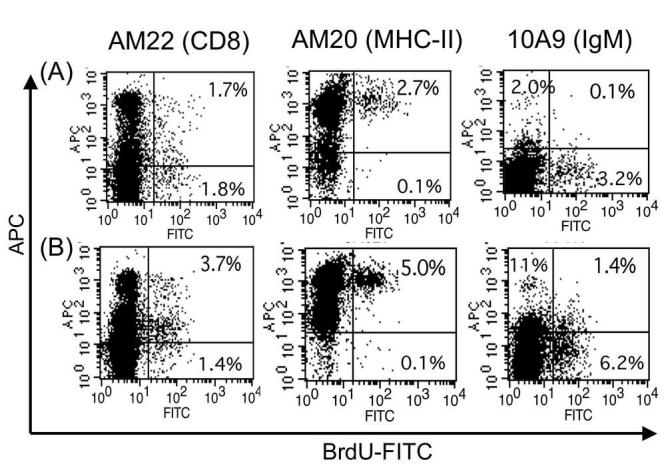
Activation of lymphocytes in mammals is often quantified by measuring the amount of proliferation during the expansion phase of an immune response. Bromodeoxyuridine (BrdU) incorporation and carboxyfluorescein diacetate succinimidyl ester (CFSE) dilution assays are some of the techniques widely used in mammalian studies of pathogen-induced proliferation and provide a convenient way of quantifying the cellular response. We have extended the use of these proliferation assays to the amphibian Xenopus laevis. We have developed this species as a valuable comparative model to study immunity against a well-known amphibian pathogen, Frog Virus 3 (FV3). Fluorescence activated cell sorting was used to assess the level of BrdU incorporation of lymphocytes in vivo and CFSE dilution in an in vitro activation assay. Both techniques have shown that splenic lymphocytes proliferate specifically upon FV3 challenge. This indicates that common methods for detection of proliferation upon immunologic challenge are easily applied to other vertebrate species, as it highlights the evolutionary conservation of the proliferative nature of immune responses throughout vertebrate phyla.
在哺乳动物中,淋巴细胞的激活通常通过测量免疫反应扩增阶段的增殖量来定量。溴脱氧尿苷(BrdU)掺入和羧基荧光素二乙酸琥珀酰亚胺酯(CFSE)稀释测定是在哺乳动物中研究病原体诱导的增殖中广泛使用的技术之一,为定量细胞反应提供了一种便利的方法。我们已经将这些增殖测定方法扩展到了两栖动物非洲爪蟾(Xenopus laevis)中。我们将该物种作为一种有价值的比较模型来研究针对一种众所周知的两栖动物病原体蛙病毒 3(FV3)的免疫。使用荧光激活细胞分选(FACS)来评估体内 BrdU 掺入和体外激活测定中 CFSE 稀释的淋巴细胞水平。这两种技术都表明,脾脏淋巴细胞在 FV3 挑战下特异性增殖。这表明,在免疫挑战时检测增殖的常见方法可以很容易地应用于其他脊椎动物物种,因为它突出了免疫反应的增殖性质在整个脊椎动物门中的进化保守性。