Jiménez-Díaz Lydia, Géranton Sandrine M, Passmore Gayle M, Leith J Lianne, Fisher Amy S, Berliocchi Laura, Sivasubramaniam Anantha K, Sheasby Anne, Lumb Bridget M, Hunt Stephen P
Department of Anatomy and Developmental Biology, University College London, London, United Kingdom.
PLoS One. 2008 Apr 9;3(4):e1961. doi: 10.1371/journal.pone.0001961.
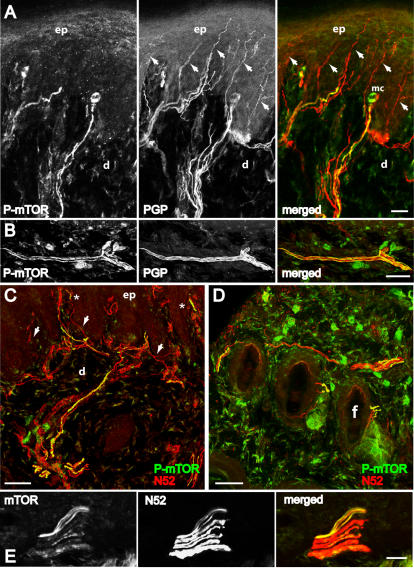
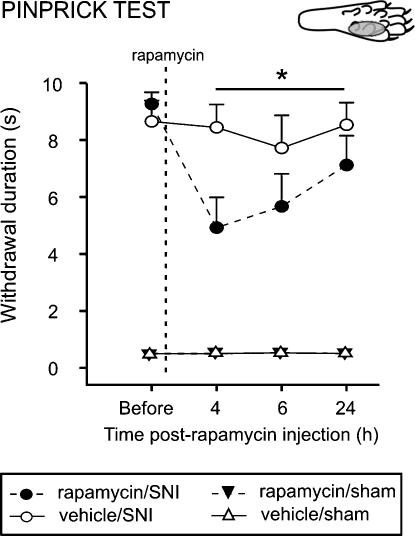
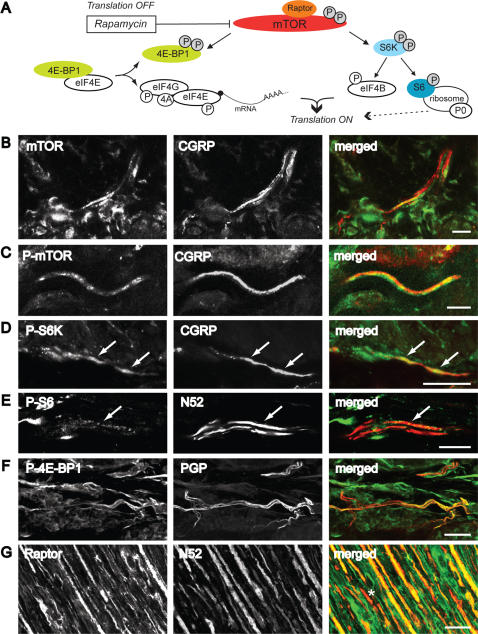
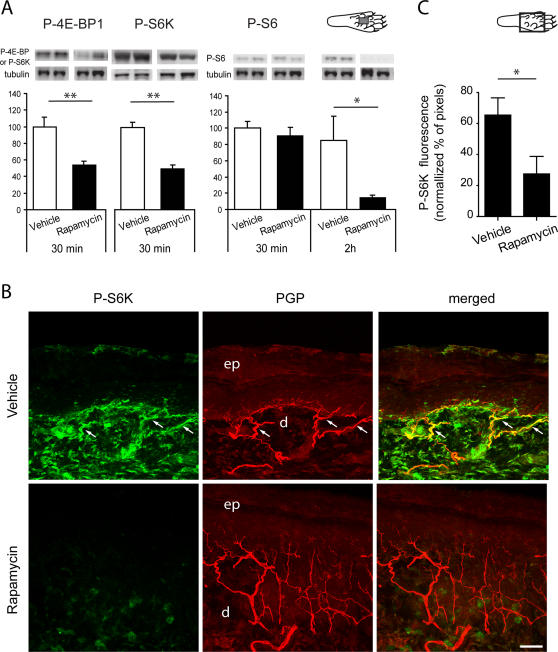
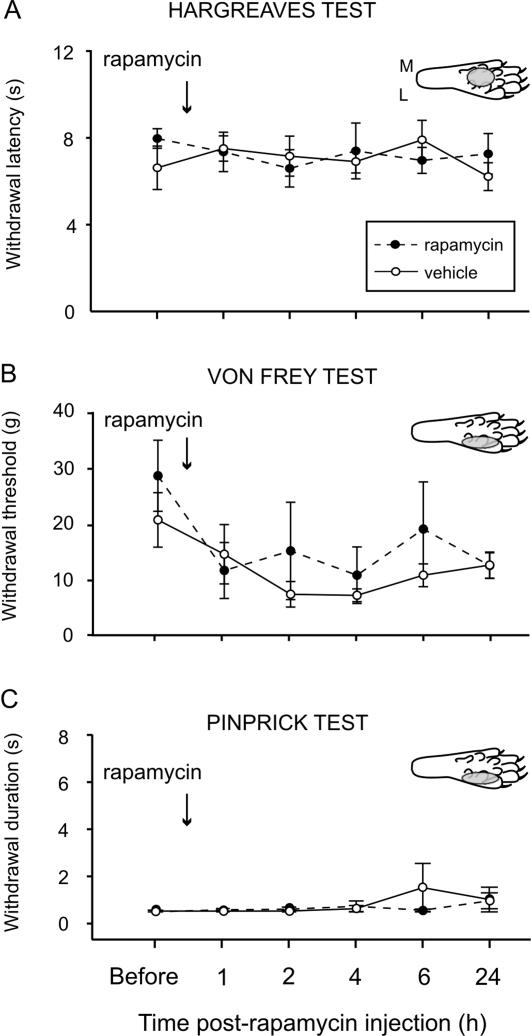
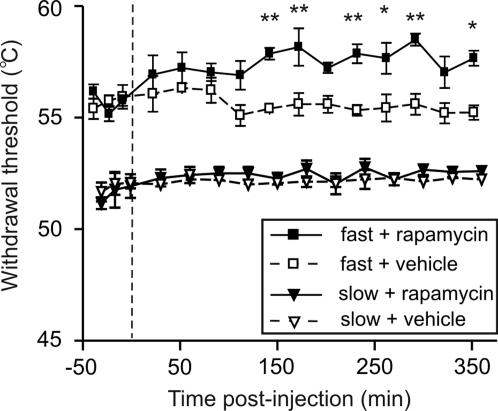
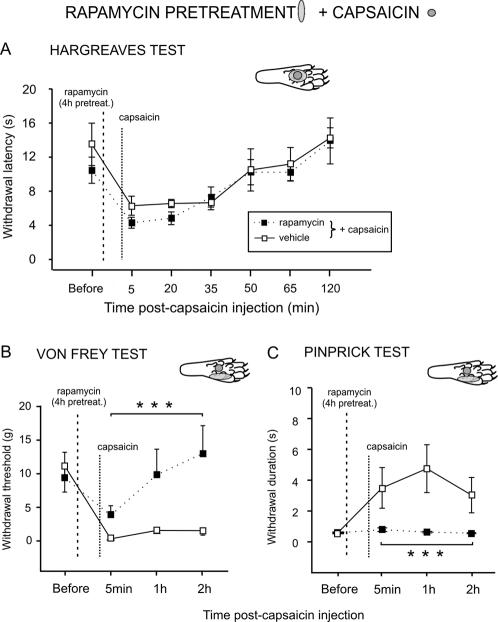
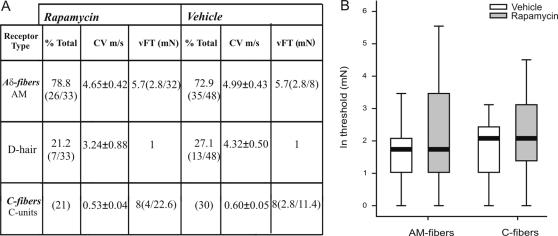
Recent studies have demonstrated the importance of local protein synthesis for neuronal plasticity. In particular, local mRNA translation through the mammalian target of rapamycin (mTOR) has been shown to play a key role in regulating dendrite excitability and modulating long-term synaptic plasticity associated with learning and memory. There is also increased evidence to suggest that intact adult mammalian axons have a functional requirement for local protein synthesis in vivo. Here we show that the translational machinery is present in some myelinated sensory fibers and that active mTOR-dependent pathways participate in maintaining the sensitivity of a subpopulation of fast-conducting nociceptors in vivo. Phosphorylated mTOR together with other downstream components of the translational machinery were localized to a subset of myelinated sensory fibers in rat cutaneous tissue. We then showed with electromyographic studies that the mTOR inhibitor rapamycin reduced the sensitivity of a population of myelinated nociceptors known to be important for the increased mechanical sensitivity that follows injury. Behavioural studies confirmed that local treatment with rapamycin significantly attenuated persistent pain that follows tissue injury, but not acute pain. Specifically, we found that rapamycin blunted the heightened response to mechanical stimulation that develops around a site of injury and reduced the long-term mechanical hypersensitivity that follows partial peripheral nerve damage--a widely used model of chronic pain. Our results show that the sensitivity of a subset of sensory fibers is maintained by ongoing mTOR-mediated local protein synthesis and uncover a novel target for the control of long-term pain states.
最近的研究已经证明了局部蛋白质合成对神经元可塑性的重要性。特别是,通过哺乳动物雷帕霉素靶蛋白(mTOR)进行的局部mRNA翻译已被证明在调节树突兴奋性和调节与学习和记忆相关的长期突触可塑性中起关键作用。也有越来越多的证据表明,完整的成年哺乳动物轴突在体内对局部蛋白质合成有功能需求。在这里,我们表明翻译机制存在于一些有髓感觉纤维中,并且活跃的mTOR依赖性途径参与维持体内快速传导伤害感受器亚群的敏感性。磷酸化的mTOR与翻译机制的其他下游成分定位于大鼠皮肤组织中有髓感觉纤维的一个子集。然后,我们通过肌电图研究表明,mTOR抑制剂雷帕霉素降低了一群已知对损伤后机械敏感性增加很重要的有髓伤害感受器的敏感性。行为学研究证实,雷帕霉素局部治疗可显著减轻组织损伤后的持续性疼痛,但对急性疼痛无效。具体而言,我们发现雷帕霉素减弱了损伤部位周围对机械刺激的增强反应,并降低了部分周围神经损伤后出现的长期机械性超敏反应——这是一种广泛使用的慢性疼痛模型。我们的结果表明,感觉纤维亚群的敏感性由持续的mTOR介导的局部蛋白质合成维持,并揭示了控制长期疼痛状态的新靶点。