Gloza-Rausch Florian, Ipsen Anne, Seebens Antje, Göttsche Matthias, Panning Marcus, Drexler Jan Felix, Petersen Nadine, Annan Augustina, Grywna Klaus, Müller Marcel, Pfefferle Susanne, Drosten Christian
Centre for Bat Protection and Information, Bad Segeberg, Germany.
Emerg Infect Dis. 2008 Apr;14(4):626-31. doi: 10.3201/eid1404.071439.
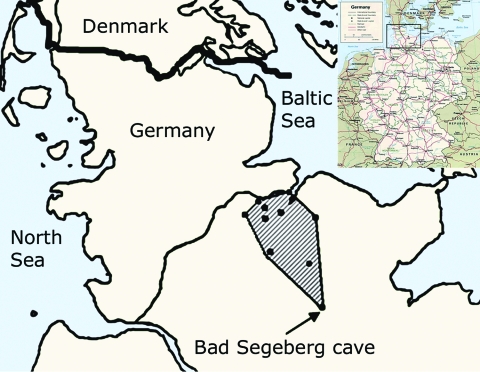
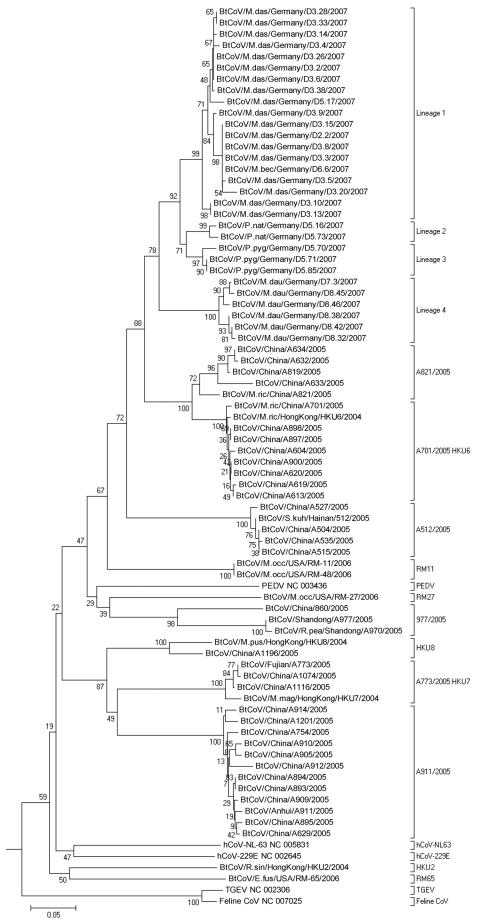
We tested 315 bats from 7 different bat species in northern Germany for coronaviruses by reverse transcription-PCR. The overall prevalence was 9.8%. There were 4 lineages of group I coronaviruses in association with 4 different species of verspertilionid bats (Myotis dasycneme, M. daubentonii, Pipistrellus nathusii, P. pygmaeus). The lineages formed a monophyletic clade of bat coronaviruses found in northern Germany. The clade of bat coronaviruses have a sister relationship with a clade of Chinese type I coronaviruses that were also associated with the Myotis genus (M. ricketti). Young age and ongoing lactation, but not sex or existing gravidity, correlated significantly with coronavirus detection. The virus is probably maintained on the population level by amplification and transmission in maternity colonies, rather than being maintained in individual bats.
我们通过逆转录聚合酶链反应对德国北部7种不同蝙蝠物种的315只蝙蝠进行了冠状病毒检测。总体患病率为9.8%。有4个I群冠状病毒谱系与4种不同的伏翼蝠科蝙蝠(大足鼠耳蝠、道氏鼠耳蝠、纳氏伏翼、库氏伏翼)相关。这些谱系在德国北部形成了一个蝙蝠冠状病毒的单系分支。蝙蝠冠状病毒分支与同样与鼠耳蝠属(中菊头蝠)相关的中国I型冠状病毒分支具有姐妹关系。年龄小和正在哺乳与冠状病毒检测显著相关,而性别或是否怀孕则不然。该病毒可能通过在繁殖群体中的扩增和传播在种群水平上得以维持,而非在个体蝙蝠中维持。