Ennett Susan T, Faris Robert, Hipp John, Foshee Vangie A, Bauman Karl E, Hussong Andrea, Cai Li
Department of Health Behavior and Health Education, The University of North Carolina at Chapel Hill, Chapel Hill, NC 27599, USA.
Prev Sci. 2008 Jun;9(2):88-98. doi: 10.1007/s11121-008-0087-8. Epub 2008 Apr 11.
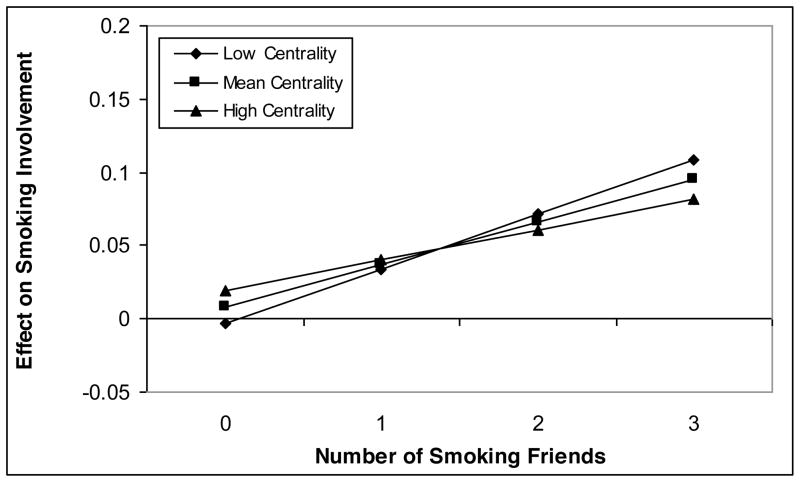
Peer attributes other than smoking have received little attention in the research on adolescent smoking, even though the developmental literature suggests the importance of multiple dimensions of adolescent friendships and peer relations. Social network analysis was used to measure the structure of peer relations (i.e., indicators of having friends, friendship quality, and status among peers) and peer smoking (i.e., friend and school smoking). We used three-level hierarchical growth models to examine the contribution of each time-varying peer variable to individual trajectories of smoking from age 11 to 17 while controlling for the other variables, and we tested interactions between the peer structure and peer smoking variables. Data were collected over five waves of assessment from a longitudinal sample of 6,579 students in three school districts. Findings suggest a greater complexity in the peer context of smoking than previously recognized.
除吸烟外的同伴属性在青少年吸烟研究中很少受到关注,尽管发展心理学文献表明青少年友谊和同伴关系的多个维度很重要。社会网络分析被用于衡量同伴关系的结构(即有朋友的指标、友谊质量和同伴中的地位)以及同伴吸烟情况(即朋友吸烟和学校吸烟情况)。我们使用三级分层增长模型来检验每个随时间变化的同伴变量对11至17岁个体吸烟轨迹的贡献,同时控制其他变量,并测试同伴结构和同伴吸烟变量之间的相互作用。数据来自对三个学区6579名学生的纵向样本进行的五轮评估。研究结果表明,吸烟的同伴环境比之前认为的更为复杂。