Bruins Slot Madeleine H E, van der Heijden Geert J M G, Rutten Frans H, van der Spoel Onno P, Mast E Gijs, Bredero Ad C, Doevendans Pieter A, Glatz Jan F C, Hoes Arno W
Julius Center for Health Sciences and Primary Care, University Medical Center Utrecht, PO Box 85500, 3508 GA Utrecht, The Netherlands.
BMC Cardiovasc Disord. 2008 Apr 15;8:8. doi: 10.1186/1471-2261-8-8.
Currently used biomarkers for cardiac ischemia are elevated in blood plasma after a delay of several hours and therefore unable to detect acute coronary syndrome (ACS) in a very early stage. General practitioners (GPs), however, are often confronted with patients suspected of ACS within hours after onset of complaints. This ongoing study aims to evaluate the added diagnostic value beyond clinical assessment for a rapid bedside test for heart-type fatty-acid binding protein (H-FABP), a biomarker that is detectable as soon as one hour after onset of ischemia.
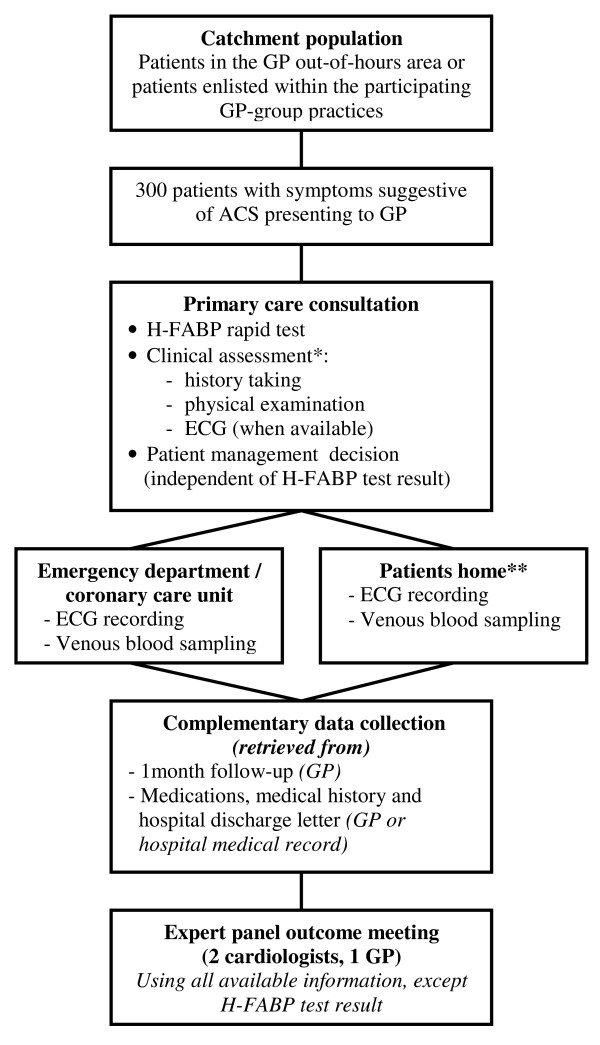
Participating GPs perform a blinded H-FABP rapid bedside test (Cardiodetect) in patients with symptoms suggestive of ACS such as chest pain or discomfort at rest. All patients, whether referred to hospital or not, undergo electrocardiography (ECG) and venapunction for a plasma troponin test within 12-36 hours after onset of complaints. A final diagnosis will be established by an expert panel consisting of two cardiologists and one general practitioner (blinded to the H-FABP test result), using all available patient information, also including signs and symptoms. The added diagnostic value of the H-FABP test beyond history taking and physical examination will be determined with receiver operating characteristic curves derived from multivariate regression analysis.
Reasons for presenting the design of our study include the prevention of publication bias and unacknowledged alterations in the study aim, design or data-analysis. To our knowledge this study is the first to assess the diagnostic value of H-FABP outside a hospital-setting. Several previous hospital-based studies showed the potential value of H-FABP in diagnosing ACS. Up to now however it is unclear whether these results are equally promising when the test is used in primary care. The first results are expected in the end of 2008.
目前用于诊断心脏缺血的生物标志物在血浆中升高存在数小时的延迟,因此无法在极早期检测出急性冠状动脉综合征(ACS)。然而,全科医生(GPs)经常会在患者出现症状后的数小时内就遇到疑似ACS的患者。这项正在进行的研究旨在评估一种用于心脏型脂肪酸结合蛋白(H-FABP)的快速床边检测在临床评估之外的附加诊断价值,H-FABP是一种在缺血发生后一小时即可检测到的生物标志物。
参与研究的全科医生对有胸痛或静息时不适等提示ACS症状的患者进行盲法H-FABP快速床边检测(Cardiodetect)。所有患者,无论是否转诊至医院,均在出现症状后的12 - 36小时内接受心电图(ECG)检查和静脉穿刺以进行血浆肌钙蛋白检测。最终诊断将由由两名心脏病专家和一名全科医生组成的专家小组(对H-FABP检测结果不知情)根据所有可用的患者信息(包括体征和症状)来确定。H-FABP检测超出病史采集和体格检查的附加诊断价值将通过多变量回归分析得出的受试者工作特征曲线来确定。
展示我们研究设计的原因包括防止发表偏倚以及研究目的、设计或数据分析中未被认可的改变。据我们所知,本研究是首次在医院环境之外评估H-FABP的诊断价值。此前的几项基于医院的研究显示了H-FABP在诊断ACS方面的潜在价值。然而,到目前为止尚不清楚当该检测用于初级保健时这些结果是否同样有前景。预计在2008年底得出首批结果。