Levasseur Mélanie, Desrosiers Johanne, St-Cyr Tribble Denise
Research Centre on Aging, Health and Social Services Centre - University Institute of Geriatrics of Sherbrooke (CSSS-IUGS), Sherbrooke, Québec, Canada.
Health Qual Life Outcomes. 2008 Apr 29;6:30. doi: 10.1186/1477-7525-6-30.
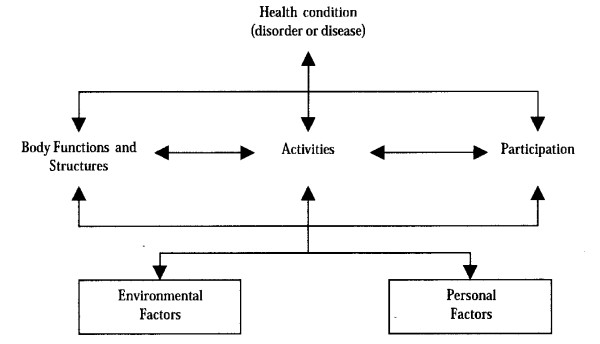
Activity limitation is one of the most frequent geriatric clinical syndromes that have significant individual and societal impacts. People living with activity limitations might have fewer opportunities to be satisfied with life or experience happiness, which can have a negative effect on their quality of life. Participation and environment are also important modifiable variables that influence community living and are targeted by health interventions. However, little is known about how quality of life, participation and environment differ according to activity level. This study examines if quality of life, participation (level and satisfaction) and perceived quality of the environment (facilitators or obstacles in the physical or social environment) of community-dwelling older adults differ according to level of activity.
A cross-sectional design was used with a convenience sample of 156 older adults (mean age = 73.7; 76.9% women), living at home and having good cognitive functions, recruited according to three levels of activity limitations (none, slight to moderate and moderate to severe). Quality of life was estimated with the Quality of Life Index, participation with the Assessment of Life Habits and environment with the Measure of the Quality of the Environment. Analysis of variance (ANOVA) or Welch F-ratio indicated if the main variables differed according to activity level.
Quality of life and satisfaction with participation were greater with a higher activity level (p < 0.001). However, these differences were clinically significant only between participants without activity limitations and those with moderate to severe activity limitations. When activity level was more limited, participation level was further restricted (p < 0.001) and the physical environment was perceived as having more obstacles (p < 0.001). No differences were observed for facilitators in the physical and social environment or for obstacles in the social environment.
This study suggests that older adults' participation level and obstacles in the physical environment differ according to level of activity. Quality of life and satisfaction with participation also differ but only when activity level is sufficiently disrupted. The study suggests the importance of looking beyond activity when helping older adults live in the community.
活动受限是最常见的老年临床综合征之一,对个人和社会都有重大影响。活动受限的人可能较少有机会对生活感到满意或体验幸福,这会对他们的生活质量产生负面影响。参与和环境也是影响社区生活的重要可变因素,并且是健康干预的目标。然而,对于生活质量、参与和环境如何根据活动水平而有所不同,我们知之甚少。本研究探讨社区居住的老年人的生活质量、参与(水平和满意度)以及对环境的感知质量(物理或社会环境中的促进因素或障碍)是否因活动水平而异。
采用横断面设计,对156名居家且认知功能良好的老年人(平均年龄 = 73.7岁;76.9%为女性)进行便利抽样,根据活动受限的三个水平(无、轻度至中度、中度至重度)进行招募。生活质量采用生活质量指数进行评估,参与采用生活习惯评估进行评估,环境采用环境质量测量进行评估。方差分析(ANOVA)或韦尔奇F比率表明主要变量是否因活动水平而异。
活动水平越高,生活质量和参与满意度越高(p < 0.001)。然而,这些差异仅在无活动受限的参与者与中度至重度活动受限的参与者之间具有临床意义。当活动水平受到更多限制时,参与水平进一步受限(p < 0.001),并且物理环境被认为有更多障碍(p < 0.001)。在物理和社会环境中的促进因素或社会环境中的障碍方面未观察到差异。
本研究表明,老年人的参与水平和物理环境中的障碍因活动水平而异。生活质量和参与满意度也有所不同,但仅在活动水平受到足够干扰时才会出现这种情况。该研究表明,在帮助老年人在社区生活时,超越活动本身去考虑问题具有重要意义。